
| ✨Hey there! This post may contain affiliate links, meaning we earn a commission if you make a purchase through our links, at no cost to you. Please read our disclosures for more info. |
Quick answer: fractionated coconut oil is the easiest all-round carrier for rollerballs and sprays because it stays liquid, has almost no scent and keeps well. Jojoba is the best pick for face blends and anything you want to last, since it is a stable liquid wax rather than a true oil. Sweet almond oil is a classic, affordable massage oil but should be skipped by anyone with a tree nut allergy. Virgin coconut oil turns solid at cool room temperature, which makes it better for balms and whipped body butters than for roller bottles.
Essential oils almost always need something to dilute them before they touch skin, and that something is usually a carrier oil. The carrier is more than filler. It decides how a blend feels, how fast it absorbs, how long it keeps and whether it suits sensitive or allergy-prone skin.
Four carriers dominate most home blending shelves: jojoba, sweet almond, coconut and fractionated coconut. They behave very differently. This comparison explains what each one is, where it shines and where it falls short, so you can match the carrier to the job. For the safety basics that apply to every blend, see our complete guide to using essential oils safely. Nothing here is medical advice; ask a dermatologist if you have a skin condition or a history of allergies.

Contents
hide
What a Carrier Oil Does
A carrier oil has three jobs. It dilutes essential oils to a safe concentration, it spreads them evenly over a larger area of skin, and it slows evaporation so the aroma lingers. Essential oils are made of small, volatile molecules that evaporate quickly; carrier oils are mostly heavier fats or waxes that do not.
Why the carrier matters for safety
The National Association for Holistic Aromatherapy (NAHA) lists irritation, sensitization and phototoxicity as the main skin reactions to essential oils, and dilution in a vegetable oil is its first line of defense. The Tisserand Institute’s guideline ranges, roughly 0.5 to 1.2 percent for the face and 1 to 3 percent for body oils, all assume a suitable carrier is doing the diluting.
Other bases that work like carriers
Unscented lotions, creams and balms can do the same job as a liquid carrier. Stirring 3 to 6 drops of essential oil into 10 mL of a fragrance-free lotion gives roughly a 1 to 2 percent blend, which is often easier than making a body oil from scratch. Water-based bases such as aloe gel or hydrosols are different: essential oils do not dissolve in water, so NAHA recommends a dispersant or solubilizer to keep the oil from separating and reaching the skin in concentrated droplets.
Why the carrier matters for feel
Some carriers sink in fast and leave little residue. Others stay on the surface and give a cushioned, slippery glide that suits massage. Fatty acid makeup, wax content and whether the oil is solid or liquid at room temperature all change the result.

Jojoba Oil
Jojoba (pronounced ho-HO-ba) comes from the seeds of Simmondsia chinensis, a shrub native to the Sonoran Desert of the southwestern United States and northwestern Mexico. What is sold as jojoba oil is chemically a liquid wax. Analyses summarized by the Cosmetic Ingredient Review panel describe it as about 97 to 98 percent wax esters, mostly long-chain monounsaturated esters, rather than the triglycerides that make up most plant oils.
Strengths
- Very resistant to oxidation. Published studies of jojoba’s oxidative stability report that crude jojoba resists rancidity far longer than refined versions, partly because it keeps natural tocopherols.
- Light, non-greasy feel that suits facial blends, cuticle oils and beard oils.
- Stays liquid at normal room temperature, though it may cloud or partly solidify in a cold room and clear again when warmed.
Drawbacks
- Usually the most expensive of the four.
- Golden, unrefined jojoba has a faint nutty smell; clear refined jojoba is almost odorless but loses some natural antioxidants.
Best uses
Face serums at 0.5 to 1 percent essential oil, small perfume-style rollerballs, and any blend you plan to keep for months.

Sweet Almond Oil
Sweet almond oil is pressed from the kernels of the sweet almond tree, Prunus dulcis. This is one of the oldest massage oils in use. A 2022 review in the International Journal of Cosmetic Science describes it as rich in oleic acid, a monounsaturated fat, with a smaller share of linoleic acid.
Strengths
- Smooth glide with enough “slip” for full-body massage.
- Mild scent that does not compete with essential oils.
- Usually affordable and easy to find.
Drawbacks
- Made from a tree nut. Anyone with a tree nut allergy should avoid it, and it is a poor choice for blends shared with people whose allergies you do not know.
- Shorter shelf life than jojoba or fractionated coconut, because unsaturated fats oxidize more readily.
- A 2018 review of topical plant oils in the International Journal of Molecular Sciences notes that oils high in oleic acid, such as olive oil, may disrupt the skin barrier in some cases, so very sensitive or eczema-prone skin may do better with another option.
Best uses
Massage and body oils at 1 to 3 percent essential oil, and short-term blends you will use within a few months.

Virgin and Refined Coconut
This familiar kitchen staple is pressed from coconut meat and is mostly saturated fat. Fatty acid profiles published in cosmetic science literature put lauric acid at roughly 46 to 50 percent, with myristic, palmitic, caprylic and capric acids making up much of the rest. The virgin type keeps a coconut aroma, while the refined type is deodorized.
The melting point issue
Virgin coconut melts at roughly 24 to 25 degrees Celsius, which is about 76 degrees Fahrenheit. In a cool house it is solid; on a warm summer day it turns liquid. That makes it awkward for rollerballs and dropper bottles but convenient for balms, whipped body butters and lotion bars, especially when combined with a richer butter like shea butter.
Strengths
- Inexpensive and widely available.
- Rich, protective feel on dry hands, elbows and feet.
- The 2018 plant-oil review notes that the virgin type showed benefits for skin barrier function in small studies of children with mild to moderate atopic dermatitis.
Drawbacks
- Its own scent (virgin type) changes the aroma of a blend.
- Heavy for the face. People prone to clogged pores often prefer lighter carriers on facial skin.
- Not suitable for anyone allergic to coconut.
Best uses
Body balms and whipped butters at 1 to 2 percent essential oil, and hand or foot salves.

Fractionated Coconut Oil
Fractionated coconut, often abbreviated FCO, is regular coconut that has been processed to remove most of the long-chain fatty acids, leaving medium-chain triglycerides that stay liquid. On cosmetic labels it frequently appears as caprylic/capric triglyceride, named after the two fatty acids (C8 and C10) that dominate it.
Strengths
- Stays liquid in any normal room temperature.
- Nearly odorless and colorless, so the essential oils are what you smell.
- Very stable, with a long shelf life.
- Light, non-greasy feel and easy to wash out of fabric.
Drawbacks
- Highly processed, which matters to some people who prefer cold-pressed oils.
- Offers none of the natural vitamins or antioxidants present in unrefined oils.
- Still derived from coconut, so check with an allergist if you react to coconut.
Best uses
Rollerballs, travel blends, perfume oils and sprays that use a solubilizer. Many commercial roller blends use it as the default carrier for these reasons.
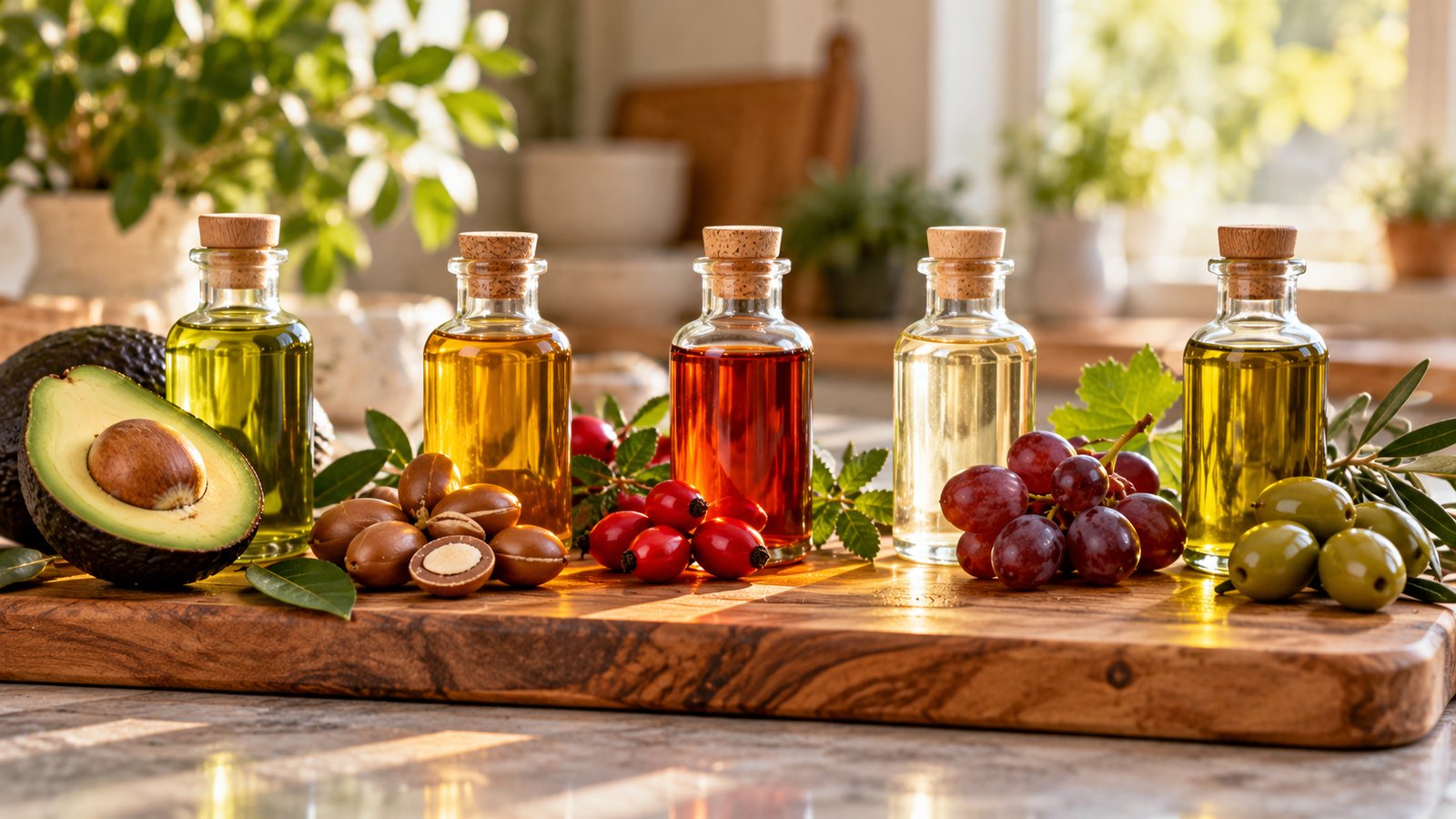
Five More Carrier Oils: Avocado, Argan, Rosehip, Grapeseed and Olive
The four carrier oils above cover most essential oil blends made at home, but these five are worth knowing, especially for skin care. The label names in parentheses are the INCI names (International Nomenclature of Cosmetic Ingredients) you will see on ingredient lists.
Avocado oil (Persea Gratissima Oil)
Avocado oil is pressed from the fruit flesh of the avocado tree, botanically Persea americana, rather than from a seed. The oil is thick, green when unrefined and rich in oleic acid, which gives it a cushioning feel on very dry hands, heels and elbows. Many people blend a little avocado oil into a lighter carrier oil instead of using it on its own, since it can feel heavy on the face.
Argan oil (Argania Spinosa Kernel Oil)
Argan oil comes from the kernels of the argan tree, which grows mainly in southwestern Morocco. Its fatty acids are roughly balanced between oleic and linoleic acid, and it absorbs faster than avocado or olive. A 2015 study of 60 postmenopausal women in Clinical Interventions in Aging found improved skin elasticity after 60 days of applying argan oil, with a larger gain in women who also ate it; because every participant applied argan oil, the study could not compare it with applying nothing. Treat argan oil as a pleasant, fairly light face and hair oil rather than an anti-aging treatment.
Rosehip oil (Rosa Canina Fruit Oil)
Rosehip oil, also sold as rosehip seed oil, is pressed from the seeds of wild roses such as Rosa canina and Rosa rubiginosa. It is rich in two essential fatty acids, linoleic acid (omega-6) and alpha-linolenic acid (omega-3), which the body cannot make on its own. That high polyunsaturated content also makes rosehip seed oil one of the quickest carriers to go rancid, so buy small bottles and keep them in the refrigerator. You will often see it marketed for collagen production; the better-known research on rosehip and skin aging comes from a small 2015 trial of an oral rosehip powder, not from applying the oil to skin.
Grapeseed oil (Vitis Vinifera Seed Oil)
Grapeseed oil is a by-product of winemaking, extracted from the seeds of Vitis vinifera grapes. As a carrier oil it is light, thin and inexpensive, with most of its fat coming from linoleic acid. Much commercial grapeseed oil is solvent-extracted and refined, so look for “cold pressed” on the label if you prefer a less processed oil. Its high linoleic content means it oxidizes more readily than jojoba, so it suits essential oil blends you will use within a few months.
Olive oil (Olea Europaea Fruit Oil)
Olive oil is the carrier most people already own. Heavy and distinctly scented, it is high in oleic acid. A 2013 study in Pediatric Dermatology found that applying olive oil to the forearms for four weeks weakened the skin barrier in adults, while sunflower seed oil preserved it, which is why Danby and colleagues advised against olive oil for infant skin care. It is fine in a pinch for a foot rub, but lighter carriers are kinder to sensitive skin.
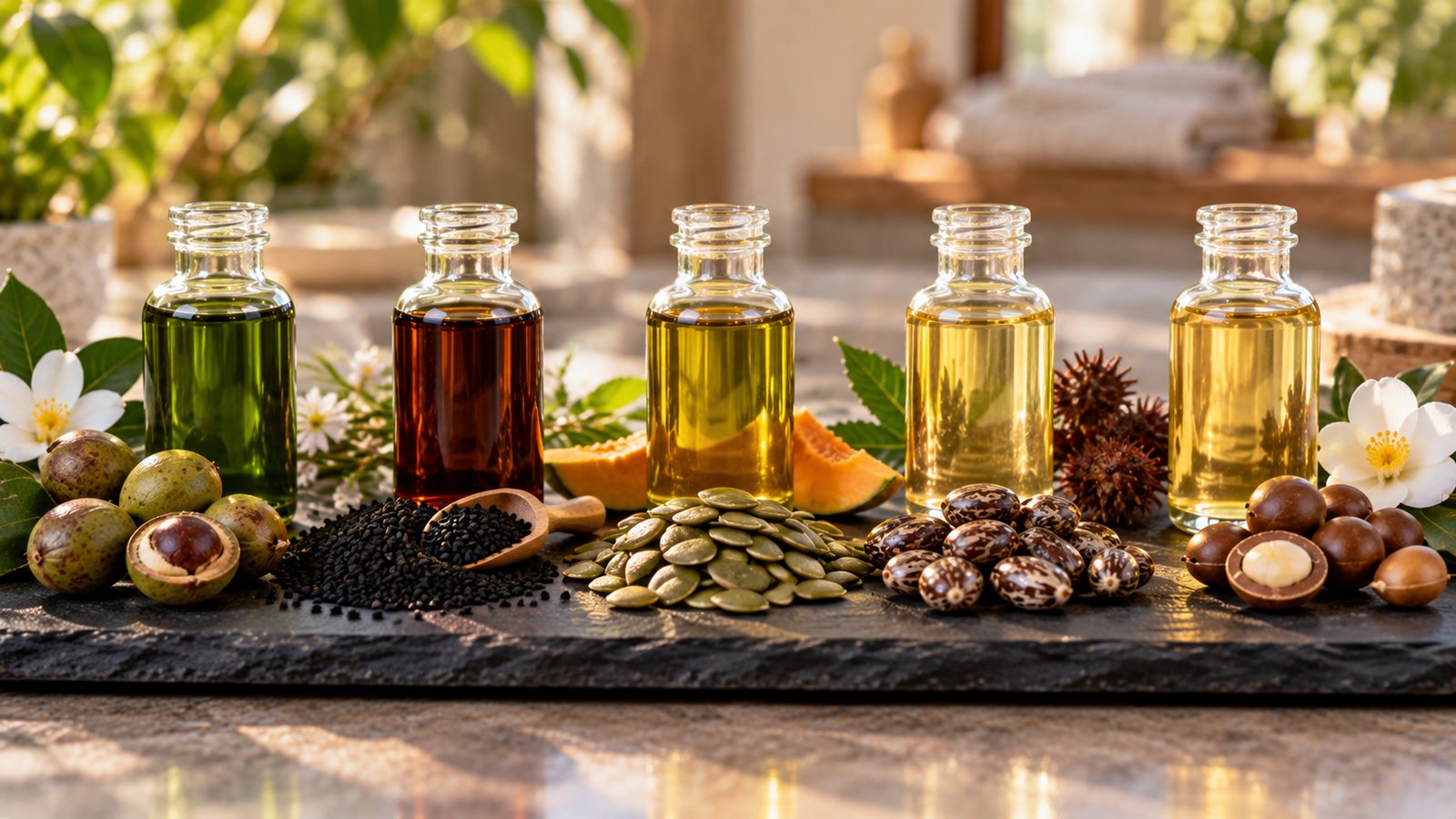
Specialty Carriers: Tamanu, Black Seed, Pumpkin Seed, Castor and Camellia
These carriers are usually used in small amounts, blended into a lighter base, for their texture, color or traditional reputation.
Tamanu oil (Calophyllum Inophyllum Seed Oil)
Tamanu oil is pressed from the nuts of the tamanu tree, which grows across tropical Asia and the Pacific islands, and it has a long history of traditional skin use in Polynesia. It is thick, dark green and strongly scented, so most people blend a small share of tamanu into a lighter carrier rather than using it alone. Because it comes from a nut, anyone with a tree nut allergy should check with an allergist first.
Black seed oil (Nigella Sativa Seed Oil)
Black seed oil comes from the seeds of Nigella sativa, a flowering plant used in traditional practices across the Middle East and South Asia. It has a peppery, pungent smell. Cases of allergic contact dermatitis from black seed oil applied to skin have been published in the medical literature, so patch test it on its own before adding it to a blend.
Pumpkin seed oil (Cucurbita Pepo Seed Oil)
Pumpkin seed oil is dark green and rich in linoleic and oleic acids. It is better known in the kitchen, especially the toasted Styrian oil from Austria, than on the skin. Cold-pressed, untoasted versions smell milder, and the deep color can tint a pale lotion.
Castor oil (Ricinus Communis Seed Oil)
Castor oil is very thick and sticky because ricinoleic acid typically makes up 87 to 90 percent of its fatty acids, according to the Cosmetic Ingredient Review, an unusual fatty acid with an extra hydroxyl group. It is a common ingredient in lip balms, lipsticks and hair products, and a small amount adds cushion to a blend, but it is too heavy for most massage on its own.
Camellia oil (Camellia Japonica Seed Oil)
Camellia oil, called tsubaki oil in Japan, is pressed from camellia seeds and is high in oleic acid. It is a traditional hair and skin oil in Japan and feels light and silky. A related species, Camellia oleifera, is pressed for cooking oil in China.
Infused oils: calendula and “aloe vera oil”
Some products sold as carrier oils are really infused oils. Calendula oil is made by steeping dried Calendula officinalis flowers in a base such as sunflower or olive oil, so it takes on the shelf life and allergy profile of that base. “Aloe vera oil” works the same way: aloe gel contains almost no oil, so the product is aloe extract infused into another carrier. Read the full ingredient list to see which oil is underneath. Calendula belongs to the daisy family (Asteraceae), so people with allergies to that plant family should patch test carefully.

Side-by-Side Comparison
Here is how the four carriers stack up on the questions people ask most often.
- Texture: jojoba is light and silky; sweet almond is smooth with good glide; virgin coconut is rich and solid when cool; fractionated coconut is light and thin.
- Scent: jojoba (golden) is faintly nutty; sweet almond is mild; virgin coconut smells of coconut; fractionated coconut is nearly odorless.
- State at room temperature: jojoba, sweet almond and fractionated coconut are liquid; virgin and refined coconut are solid below about 76 degrees Fahrenheit.
- Shelf stability: jojoba and fractionated coconut are the most stable; regular coconut is fairly stable; sweet almond is the most prone to going rancid.
- Allergy watch-outs: sweet almond (tree nuts); coconut and fractionated coconut (coconut allergy).
- Best for the face: jojoba.
- Best for massage: sweet almond.
- Best for balms: coconut.
- Best for rollerballs: fractionated coconut, with jojoba a close second.
What about the others?
Sunflower seed oil (Helianthus Annuus Seed Oil) is inexpensive and light, and the 2018 review highlights it, since it is high in linoleic acid, for preserving skin barrier integrity. Apricot kernel oil (Prunus Armeniaca Kernel Oil) feels similar to sweet almond and is another stone-fruit kernel option. Vitamin E oil is often added in small amounts to slow rancidity in blends; our article on vitamin E oil explains how it is used on skin.
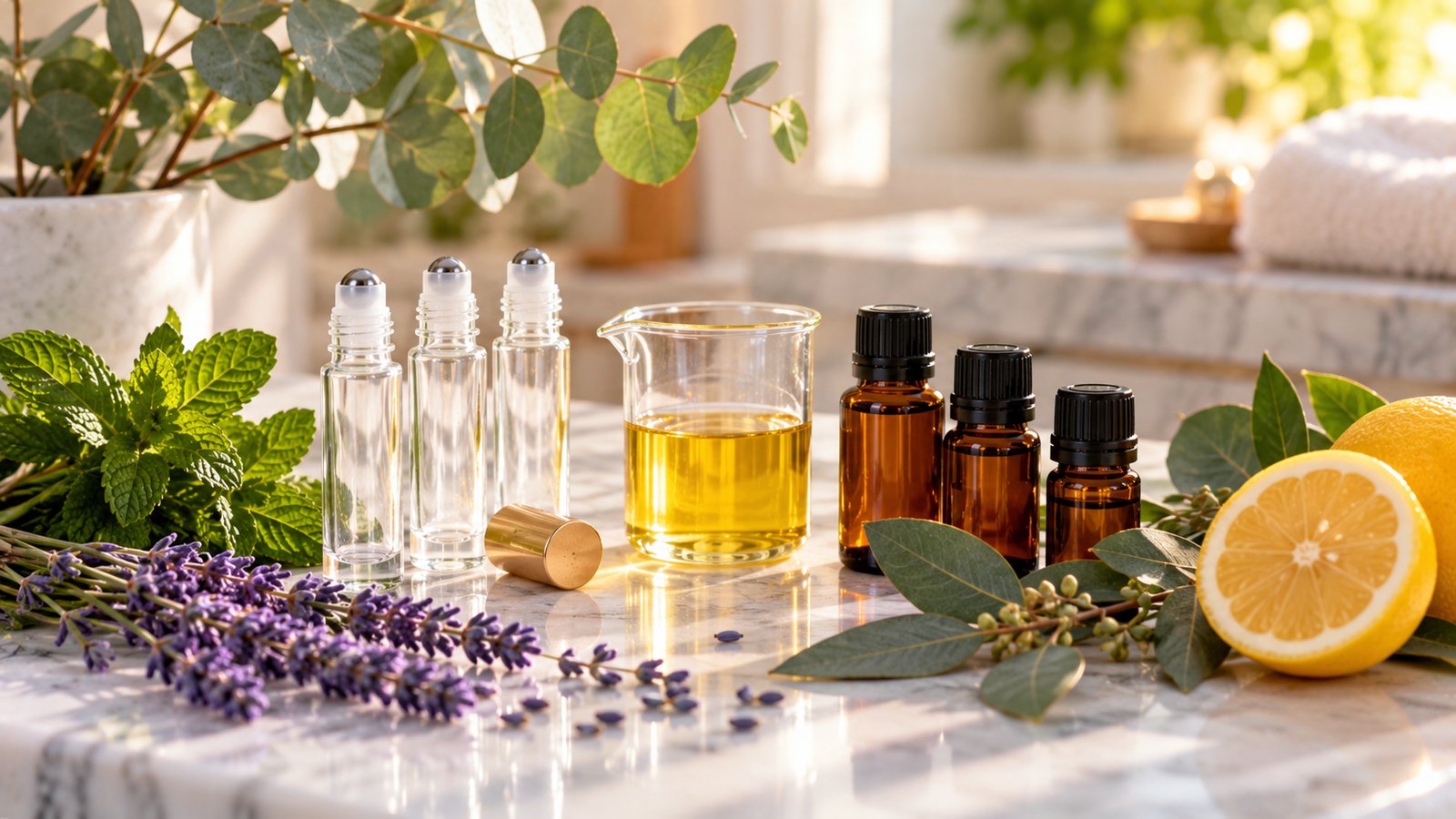
Pairing Carriers With Popular Essential Oils
How an essential oil is made and how it behaves both affect which carrier suits it.
How essential oils differ from carrier oils
Most essential oils are made by steam distillation, in which steam carries volatile aromatic compounds out of plant material and the oil separates as the steam condenses. Citrus oils are usually cold pressed from the peel, and some delicate flowers such as jasmine are processed by solvent extraction, producing concentrated absolutes. Carrier oils are made differently: they are pressed from seeds, nuts or fruit, or extracted with solvents and then refined, and their heavier fats do not evaporate. That is why a carrier can dilute essential oils without changing them.
Lavender essential oil
Lavender is the easiest pairing and works with any of the four main carriers. Jojoba makes a stable face oil, sweet almond a classic massage oil and fractionated coconut a simple rollerball.
Tea tree essential oil
Tea tree oil oxidizes as it ages, and the Tisserand Institute notes that oxidized tea tree oil is more likely to cause skin sensitization. Pair it with a stable carrier such as jojoba or fractionated coconut, make small batches and store them cool and dark.
Peppermint essential oil
Peppermint is strong and cooling, so it calls for conservative dilution guidelines; around 1 percent or less in a body blend suits most adults. The Tisserand Institute advises against applying peppermint oil on or near the face of infants and young children. Fractionated coconut oil is a common carrier for peppermint rollerballs.
Helichrysum essential oil
Helichrysum italicum oil is one of the pricier essential oils, so people often pair it with jojoba, whose long shelf life keeps a costly blend from going rancid before it is used up.
Omega fatty acids and skin absorption
Carrier labels often mention omega fatty acids. Linoleic acid is an omega-6, alpha-linolenic acid is an omega-3 and oleic acid is an omega-9; the first two are essential fatty acids the body cannot make. Oils rich in linoleic acid, such as grapeseed and rosehip, tend to feel lighter and less greasy, which is usually what “fast skin absorption” means on a label, while oleic-rich oils such as avocado and olive feel heavier. Fast-absorbing describes feel, not a deeper delivery of essential oils, and claims that a carrier boosts collagen production are marketing rather than established fact.

How to Choose for Your Blend
Start with how and where the blend will be used, then narrow by skin type and storage.
- Decide on the format. Rollerball or spray: fractionated coconut or jojoba. Massage: sweet almond, or jojoba for nut-free blends. Balm or butter: coconut, often with shea.
- Consider the skin. For the face or sensitive skin, jojoba is the gentlest default. For very dry skin on the body, a richer coconut or shea base can help.
- Check allergies. Rule out sweet almond for anyone with a tree nut allergy and coconut-based carriers for anyone allergic to coconut.
- Think about shelf life. If you make a blend in bulk or use it slowly, choose jojoba or FCO.
- Work out the dilution. Use the Tisserand Institute’s ranges, about 3 drops of essential oil per 10 mL of carrier for each 1 percent, and remember the total covers all essential oils combined.
Reading labels: INCI names, cold pressed and marketing terms
INCI names make it easy to check what you are buying. Jojoba appears as Simmondsia Chinensis (Jojoba) Seed Oil, sweet almond as Prunus Amygdalus Dulcis (Sweet Almond) Oil, coconut as Cocos Nucifera (Coconut) Oil and FCO as Caprylic/Capric Triglyceride. A single-ingredient carrier should list just one name.
“Cold pressed” means the oil was pressed mechanically without added heat or solvents, which keeps more of its natural vitamins and scent; refined oils are filtered and deodorized for a longer shelf life and a neutral smell. Pure carrier oils contain no water, so they do not need preservatives, and an additive-free or preservative-free label is normal rather than special. A small amount of vitamin E (listed as tocopherol) is sometimes added as an antioxidant to slow rancidity. Be skeptical of “therapeutic-grade carrier oils,” a marketing phrase that, like “therapeutic grade” on essential oils, is not certified by any official body.
Carriers and skin health
Carrier oils do more than dilute essential oils. Linoleic acid is a building block of the skin’s own barrier lipids, and the 2018 plant-oil review in the International Journal of Molecular Sciences links linoleic-rich oils such as sunflower with better barrier repair than oleic-rich oils such as olive. That makes the fatty acid profile a useful guide: lighter, linoleic-rich carriers for oily or reactive skin, richer oleic carriers for very dry skin. None of these oils treats a skin condition, so see a dermatologist for eczema, acne or persistent irritation.
Mixing carriers
Carriers can be combined. A body oil made of half sweet almond and half jojoba balances glide with stability. A balm of virgin coconut and shea butter is firmer and richer than either alone. Keep the essential oil percentage based on the total volume of the mixed carriers.

Storage, Rancidity and Patch Testing
Carrier oils can spoil, and a rancid oil can irritate skin even before any essential oil is added.
Spotting rancidity
Fresh carrier oils smell faint and pleasant. A rancid oil smells sharp, sour, crayon-like or paint-like. If you notice that, throw it out rather than masking it with essential oils.
Storing carriers well
- Keep bottles tightly capped and away from heat and light.
- Buy small bottles of oils you use slowly, especially sweet almond.
- Write the opening date on each bottle, and consider adding a few drops of vitamin E oil to slow rancidity in oils you use slowly.
- Store finished blends in dark glass, which also protects the essential oils.
Patch testing a new blend
A patch test takes one day and can save weeks of irritation. Apply a little of the finished, diluted blend to the inner forearm and wait 24 hours. Redness, itching or bumps mean that combination is not for you. Because a reaction could come from the essential oil or the carrier, testing the carrier on its own first makes it easier to identify the cause.

Frequently Asked Questions
Which carrier oil is best for essential oils on the face?
Jojoba is the most common choice because it is light, stable and liquid at room temperature. Keep essential oils at 0.5 to 1.2 percent for face blends, as the Tisserand Institute suggests.
Is fractionated coconut oil better than regular coconut oil?
Neither is better overall. FCO stays liquid and odorless, which suits rollerballs and sprays, while the regular kind is solid when cool and better for balms and body butters.
Can I use olive oil as a carrier oil?
Yes, olive oil can dilute essential oils, but it is heavy, has a strong scent and, according to the 2018 plant-oil review, may disrupt the skin barrier in some people. Lighter carriers are usually more pleasant.
Does sweet almond oil cause nut allergies?
Because it is pressed from almonds, people with a tree nut allergy should avoid it. Ask an allergist if you are unsure.
How long do carrier oils last?
That varies. Jojoba and FCO are very stable, while oils rich in unsaturated fats, such as sweet almond, go rancid sooner. Smell the oil before each use and discard it if it smells sharp or stale.
What is the best carrier oil for tea tree oil?
A stable carrier such as jojoba or fractionated coconut oil is a good match, because tea tree oil becomes more irritating as it oxidizes. Make small batches and patch test first.
Is aloe vera oil a real carrier oil?
Not on its own. Aloe gel contains almost no oil, so “aloe vera oil” is aloe extract infused into another carrier oil. Check the ingredient list to see which oil it is based on.
Do I need to patch test a carrier oil?
It is a good habit, especially with nut oils, black seed oil and infused oils such as calendula. Apply a little to the inner forearm and wait 24 hours before using it in a blend.
Sources: Cosmetic Ingredient Review safety assessment of jojoba (composition and stability); Boucetta and colleagues, Clinical Interventions in Aging 2015 (argan oil and skin elasticity); Phetcharat and colleagues, Clinical Interventions in Aging 2015 (oral rosehip powder); Danby and colleagues, Pediatric Dermatology 2013 (olive and sunflower oil on the skin barrier); published studies on jojoba oxidative stability; Blaak and Staib, International Journal of Cosmetic Science 2022 (sweet almond, evening primrose and jojoba review); Lin, Zhong and Santiago, International Journal of Molecular Sciences 2018 (topical plant oils and skin barrier); Tisserand Institute (dilution ranges); National Association for Holistic Aromatherapy (skin reactions); Tisserand Institute (tea tree oil oxidation and sensitization; peppermint oil and young children); Cosmetic Ingredient Review safety assessments of plant-derived oils, including castor oil and ricinoleic acid; published case reports of allergic contact dermatitis to Nigella sativa oil in Contact Dermatitis. This article is for general education and is not medical advice.


