
| ✨Hey there! This post may contain affiliate links, meaning we earn a commission if you make a purchase through our links, at no cost to you. Please read our disclosures for more info. |
Quick answer: lavender essential oil is steam-distilled from the flowering tops of true lavender, Lavandula angustifolia. People mostly use it for its calming scent in a diffuser, in diluted body and massage oils, and in baths. The National Center for Complementary and Integrative Health (NCCIH) says lavender aromatherapy is considered possibly safe but may cause headache or coughing, topical lavender can cause allergic skin reactions in some people, and it is still unclear whether lavender aromatherapy helps anxiety, stress or sleep. Dilute it to about 1 percent for the face and 1 to 3 percent for the body.
Lavender is the essential oil most people buy first, and for good reason. Its scent is soft and familiar, it blends with almost everything, and it is easy to find at a reasonable price. Its gentle reputation can also make people careless with it, which is how reactions happen.
This guide covers what lavender oil is, how true lavender differs from its look-alikes, the most common ways to use it, how much to use, what the research actually shows and who should take extra care. It is part of our essential oils guide, which explains the safety rules that apply to every oil. This article is general education, not medical advice; talk with a health care provider before using lavender if you are pregnant, breastfeeding or taking medication.

Contents
hide
What Lavender Essential Oil Is
Lavender is an evergreen, aromatic shrub native to the Mediterranean region, including France, Spain, Andorra and Italy, according to NCCIH. The name comes from the Latin verb lavare, “to wash,” a reminder of how long the plant has scented baths and laundry.
The essential oil comes from the flowering tops of the lavender plant, harvested in summer when the flowers are fully open. Producers use steam distillation: steam passes through the lavender flowers, carries the aromatic compounds away and condenses, and the oil separates from the water. The water left behind is sold as lavender hydrosol or floral water, a much milder product with a faint scent. Natural lavender oil is different again from the synthetic “lavender scent” in many detergents and air fresheners, which is usually built from fragrance chemicals rather than distilled from the plant.
What gives lavender its scent
True lavender oil is dominated by two compounds, linalool and linalyl acetate. Together they give the soft, floral, slightly sweet smell most people associate with lavender. The International Organization for Standardization (ISO) publishes a standard for Lavandula angustifolia oil that sets expected ranges for these and other constituents, and good suppliers test batches against it.
Lavender in history and home use
Lavender has scented soaps, linens and perfumes for centuries, and NCCIH notes it is a common ingredient in bath products, perfumes and aromatherapy. Herbal traditions describe it as a nervous calming herb, the kind of plant once tucked into pillows and drawers. Today it is also sold as an oral supplement, a tea and in topical products, each with different evidence and safety profiles. Our page on useful herbs to grow and use covers the plant itself in the garden and kitchen.
Where lavender grows: Provence and beyond
Lavender is closely tied to the French countryside, especially Haute-Provence, where true lavender grows wild on dry, chalky mountain slopes, roughly from 600 meters up toward 1,500 meters, while spike lavender grows lower down. Lavandin, the natural hybrid of the two, is now widely cultivated there too. France protects “Huile essentielle de lavande de Haute-Provence” as a protected designation of origin (AOP), which can only be made from true lavender grown in that area. France is no longer the biggest producer, though: the BBC reported in 2020 that Bulgaria had overtaken France as the world’s largest producer of lavender oil.
From lavare to aromatherapy
The modern word for using scents this way comes from France. The French perfumer and chemist René-Maurice Gattefossé coined the term “aromathérapie” and introduced it in his 1937 book Aromathérapie, according to the National Association for Holistic Aromatherapy (NAHA), and lavender features in the story most often told about his interest in essential oils. Older herbals and household guides also describe lavender as a powerful antiseptic, a reputation that grew from its long use in washing. Modern laboratory studies show some antimicrobial activity in a dish, but that is not evidence that lavender disinfects skin or surfaces, so read the old descriptions as history rather than instructions.

True Lavender, Lavandin and Spike Lavender
Several lavender species and hybrids are distilled for oil, and a label that just says “lavender” does not tell you which one you are buying.
True lavender (Lavandula angustifolia)
Also called English lavender, fine lavender or simply true lavender. Older books and some labels use the botanical synonym Lavandula officinalis, sometimes written as officinale lavender, for the same plant. It grows best at higher altitudes and yields relatively little oil per plant. This species is low in camphor, high in linalyl acetate and has the softest scent. This is the species studied in most of the research NCCIH summarizes.
Lavandin (Lavandula x intermedia)
A hybrid of true lavender and spike lavender. Each plant yields far more oil, so it is cheaper, and it is common in cleaning products and soaps. Published ISO standards show lavandin contains noticeably more camphor, which gives it a sharper, more medicinal edge. Several lavandin cultivars are grown commercially. Lavandin Grosso is the most widely planted and has the sharpest, most camphor-forward scent. Lavandin Super is prized for a sweeter, softer aroma that sits closer to true lavender, which is why Lavandin Super oil is popular in soaps, candles and linen sprays. Abrial is another common cultivar. Lavandin is sometimes sold as “lavender,” so check the botanical name; a bottle labeled Lavandula x intermedia or “Lavandin Super” is not true lavender, even if it smells lovely.
When you compare lavandin essential oils with true lavender side by side, the difference is easy to smell: lavandin is brighter and more herbaceous, true lavender softer and sweeter. Both are natural lavender oil if they are pure and distilled from the plant; the choice is about scent and use, with lavandin a common, budget-friendly pick for cleaning sprays and soap and fine lavender the usual choice for skin blends.
Spike lavender (Lavandula latifolia)
Spike lavender, called lavender aspic in French, grows wild at lower altitudes in Spain and southern France. Its oil contains much more 1,8-cineole and camphor than true lavender, giving it a strongly camphoraceous, almost eucalyptus-like smell. Because of that cineole content, treat it like eucalyptus around babies and young children. It is used differently from true lavender, often in blends aimed at a fresh, clearing scent. On French labels you may see it as “lavande aspic” or “huile essentielle d’aspic,” so a bottle marked Lavender Aspic is spike lavender, not true lavender.
Spanish or topped lavender (Lavandula stoechas)
This species contains high levels of ketones. NAHA, citing Robert Tisserand and Tony Balacs, lists Lavandula stoechas among oils that should not be used during pregnancy.
When a recipe or a study mentions lavender, it almost always means Lavandula angustifolia. Look for that name on the bottle.

Everyday Ways to Use Lavender Oil
In a diffuser
The most common use is simply scenting a room. Add the number of drops your diffuser’s instructions recommend, run it in a ventilated space and keep sessions well under an hour. The National Association for Holistic Aromatherapy (NAHA) notes that inhalation carries a very low risk for most people, but long exposure to strong vapor can cause headaches, nausea and lethargy. Do not add oils to a humidifier unless the manufacturer allows it; our article on putting essential oils in a humidifier explains why.
On a tissue or in an inhaler
A single drop on a tissue or a cotton pad inside a personal inhaler is a portable way to enjoy the scent without scenting a whole room.
In body and massage oils
Mix lavender into a carrier oil such as jojoba, sweet almond or fractionated coconut oil for a body or massage oil. It also works in a balm made with coconut oil and shea butter for dry hands and feet.
In the bath
Essential oils float on water, so mix lavender into a teaspoon or two of carrier oil, an unscented bath gel or a solubilizer before adding it to the tub, as NAHA advises.
Lavender with Epsom salts
Epsom salts are a popular base for a lavender bath, but salt does not dissolve or disperse essential oil. Stir the lavender drops into a spoonful of carrier oil or a solubilizer first, then mix that into the salts, so the oil does not float on the bathwater in concentrated drops. Keep the total to a few drops for a full tub, and rinse the tub afterward, since oil can make the surface slippery.
On linens
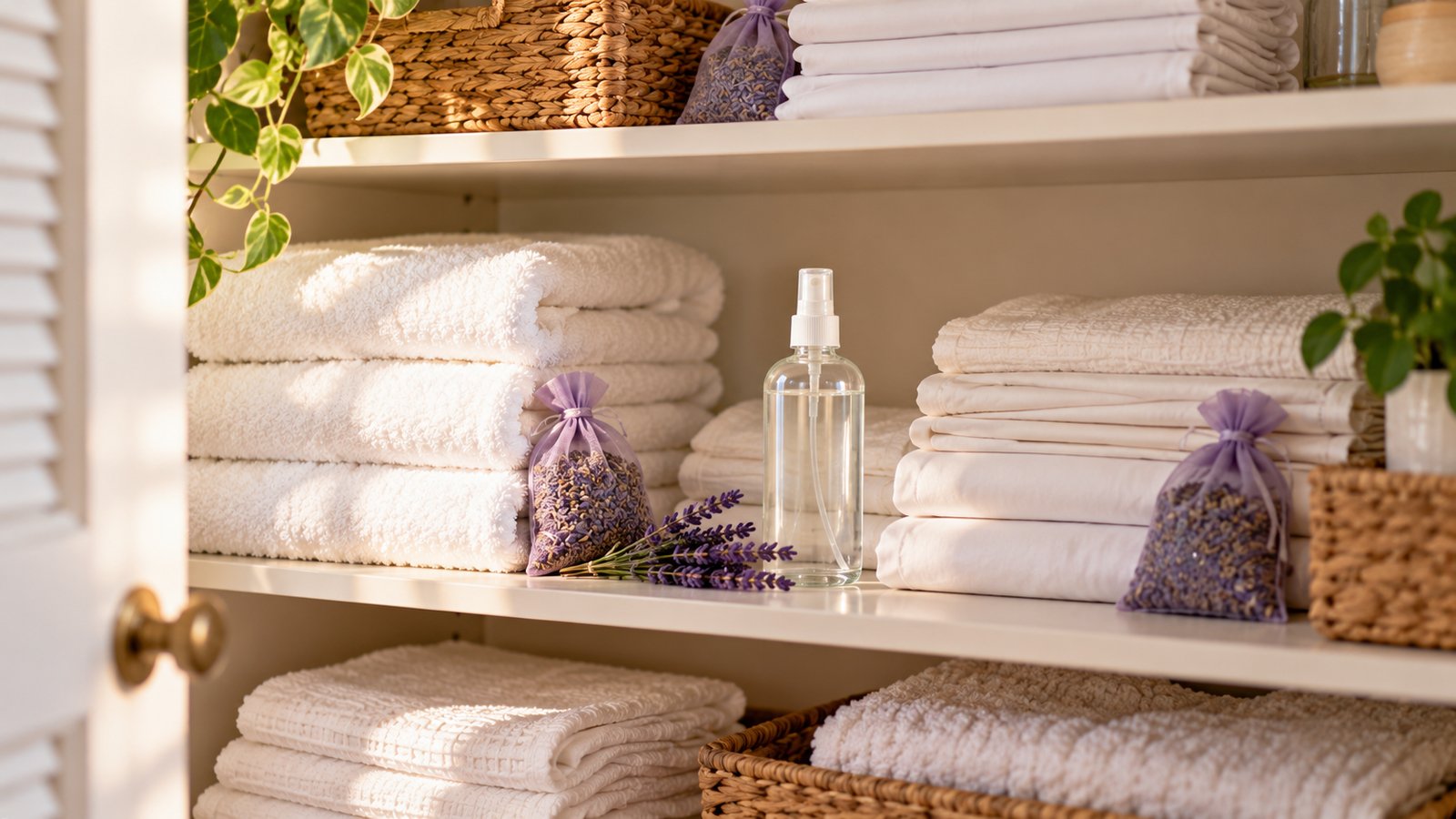
Lavender is a traditional linen scent. A linen spray needs a solubilizer or a high-proof alcohol base, because oil and water separate. Spray lightly and let fabric dry before use, and keep sprays away from pets’ bedding.
Blending partners
Lavender pairs well with citrus oils such as sweet orange and bergamot (bergaptene-free if used on skin), woody oils such as cedarwood, and resin oils such as frankincense. It also softens sharper oils like peppermint and eucalyptus in a diffuser blend.

How Much to Use: Dilution Guide
Lavender is gentle compared with spice or citrus oils, but it still needs dilution on skin. The Tisserand Institute’s guideline ranges apply:
- Face products: 0.5 to 1.2 percent, roughly 1 to 3 drops per 10 mL of carrier.
- Body and massage oils: 1 to 3 percent, roughly 3 to 9 drops per 10 mL of sweet almond, jojoba or fractionated coconut oil.
- Bath and wash-off products: 2 to 4 percent, mixed into a dispersant.
- Small-area rollerballs: up to about 3 to 5 percent for most adults.
For a 10 mL rollerball, fractionated coconut oil is the easiest base because it stays liquid and has no scent of its own, while sweet almond oil gives more glide for massage (skip it for anyone with a tree nut allergy). These drop counts assume about 30 drops per milliliter, the average the Tisserand Institute uses; real droppers vary from about 20 to 40 drops per milliliter. For children, NAHA recommends lower dilutions in the range of 0.5 to 2.5 percent depending on age and purpose.
Is neat lavender safe?
Many people dab undiluted lavender on skin because they have heard it is the one oil that does not need diluting. NCCIH warns that topical lavender products can cause allergic skin reactions in some people, and the Tisserand Institute advises diluting virtually all oils for skin use. Repeated neat application is one of the ways people become sensitized.

What the Research Says
Lavender is one of the most studied essential oils, but the quality of that research is mixed. NCCIH’s lavender fact sheet, last updated in February 2025, summarizes it this way.
Anxiety
Studies suggest that a specific lavender oil product taken by mouth might help anxiety, including anxiety with some symptoms of depression. NCCIH notes that the research has limitations, including small samples, limited independent funding and testing, and a lack of participant diversity. That evidence applies to a standardized oral capsule, not to drops of essential oil from a bottle, which should not be swallowed.
Sleep and stress
NCCIH says it is unclear whether lavender aromatherapy helps anxiety, stress, depression symptoms, some types of pain, sleep quality or insomnia. Some people report an improved sense of quality of life from it. In other words, a lavender diffuser at bedtime is a reasonable comfort ritual, but it is not a proven sleep treatment.
Headaches
Headache relief is one of the most searched lavender uses. In a small 2012 placebo-controlled trial in European Neurology, 47 people with migraine inhaled lavender essential oil for 15 minutes at the start of an attack; the lavender group reported a larger drop in headache severity than the group given an unscented placebo. That is encouraging but limited, and NCCIH says it is unclear whether lavender aromatherapy helps some types of pain. Sniffing lavender is a reasonable comfort measure, yet it is not a substitute for migraine care, and frequent or severe headaches deserve a doctor’s visit. Some people with migraine find that strong scents trigger attacks, so headache relief from lavender is very individual.
Depression
Preliminary reports suggest oral lavender capsules or lavender tea might reduce depression symptoms in some people, but NCCIH urges caution in interpreting them, and topical lavender does not seem to affect depression. Depression can be serious; anyone struggling with it should talk with a health care provider.
A broader aromatherapy finding
NCCIH’s aromatherapy page describes a study in which people under stress were exposed to lemon or lavender scent. Lemon had a positive effect on mood, but neither scent changed stress indicators, immune markers or pain control. Expect lavender to make a room smell pleasant, and treat bigger promises with skepticism.
Lavender Around the House: Linen Sprays, Cleaning and Bugs
Linen and room sprays with witch hazel
Many homemade linen sprays use equal parts distilled water and witch hazel with about 1 percent lavender essential oil, roughly 30 drops per 100 mL. Most drugstore witch hazel contains some alcohol, often around 14 percent, which helps but is not enough to dissolve the oil completely, so add a solubilizer or shake well before every spray. Mist linens lightly from a distance, let them dry before use and keep sprays away from pets’ bedding and birds.
As a natural cleaning agent
Lavender is a popular addition to homemade cleaners mixed with vinegar or diluted Castile soap; use one or the other, since vinegar and soap curdle each other. Laboratory studies have found that lavender oil has some antimicrobial activity in a dish, but that is not the same as disinfecting a kitchen counter. For a natural cleaning agent that simply smells good, lavender works well; for real germ control, use a product registered with the Environmental Protection Agency (EPA) as a disinfectant and follow its label.
As an insect repellent
Lavender often appears in natural insect repellent sprays, and some lab studies suggest it may deter certain insects for a short time. The Centers for Disease Control and Prevention (CDC), however, recommends EPA-registered insect repellent products containing DEET, picaridin, IR3535, oil of lemon eucalyptus, para-menthane-diol (PMD) or 2-undecanone, especially where mosquitoes or ticks spread disease. A lavender spray is fine for a backyard evening, but rely on a registered repellent for hiking or travel.

Safety: Who Should Be Careful
Skin reactions and allergy
Topical lavender can cause allergic reactions, according to NCCIH. Research published in the journal Contact Dermatitis found that lavender oil lacks natural protection against oxidation and forms strong contact allergens when exposed to air, largely from the oxidation of linalool and linalyl acetate. Old, poorly stored lavender oil is therefore more likely to cause a reaction than a fresh bottle. Patch test new blends on the inner forearm and wait 24 hours.
Children
NCCIH reports a few cases of breast tissue swelling in children who used topical products containing lavender, while noting that it is unclear whether lavender was responsible, since the condition has many causes. Use low dilutions for children, keep bottles locked away and ask a pediatrician before using lavender oil on babies.
Pregnancy and breastfeeding
NCCIH says little is known about whether lavender is safe during pregnancy or breastfeeding. NAHA lists properly diluted true lavender among oils that appear safe in pregnancy, but recommends avoiding Lavandula stoechas. Ask a midwife or doctor before use.
Medications and surgery
NCCIH notes theoretical reasons to suspect lavender might interact with sedative drugs or herbs, which matters if you have surgery coming up. Tell your health care provider about any lavender products you use.
Swallowing
Poison Control advises keeping all essential oils away from children and calling 1-800-222-1222 if someone swallows one. Do not induce vomiting, because oil that reaches the lungs can cause pneumonia.
Pets
The ASPCA advises never applying essential oils to pets, keeping bottles out of reach and using diffusers only briefly in areas pets cannot access. Avoid diffusing around birds and pets with breathing problems.
Lavender Essential Oil vs Other Lavender Products
Shops sell lavender in many forms, and they are not interchangeable.
Lavender-infused oil
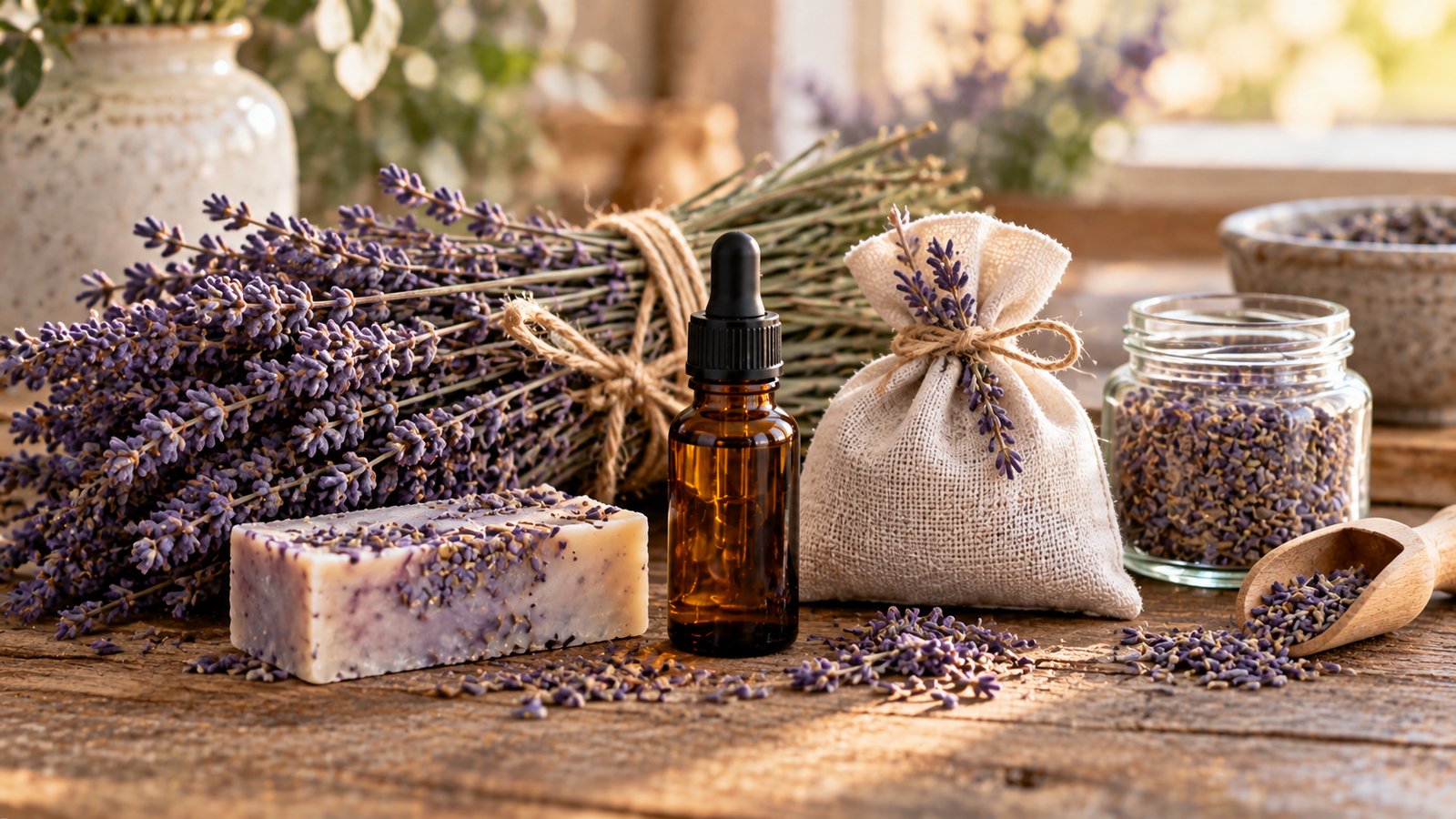
An infused oil is made by steeping dried lavender flowers in a carrier oil, such as sunflower, olive or jojoba, for several weeks and then straining it. It has a soft scent and nothing like the concentration of an essential oil, so it is often used on its own as a massage or bath oil. Use fully dried flowers, because water from fresh plant material can let mold grow in the jar, and label the bottle with the date.
Lavender hydrosol
Lavender hydrosol, the water left over from distillation, is far milder than the essential oil and is commonly used as a linen or room mist. It usually contains no preservative unless one is added, so keep it cool and discard it if it turns cloudy or smells off.
Dried lavender
Dried lavender buds are a traditional filler for sachets, drawer bags and eye pillows. Squeeze a sachet to refresh the scent, and when it fades, a drop of essential oil on the fabric, not on skin, brings it back.
“Lavender 40/42” and fragrance oils
Soap and candle suppliers often sell “Lavender 40/42,” a lavender oil standardized so that its two main aroma compounds, linalool and linalyl acetate, sit at set levels around 40 and 42 percent; suppliers describe the exact numbers slightly differently. They explain that the target is reached by blending lavender or lavandin oils and often adding isolated linalool or linalyl acetate. It gives a consistent scent from batch to batch in soap, but it is not an unaltered, single-origin true lavender. Lavender fragrance oil is synthetic and a different product entirely. Look for the botanical name and the words “essential oil” if you want the distilled oil.
Natural lavender oil vs fragrance oil
Natural lavender oil is distilled from the flowering tops of the plant. Lavender fragrance oil is a blend made for scent, often partly or fully synthetic, and it is meant for candles and soaps rather than skin or aromatherapy. Labels such as “lavender scent” or “lavender fragrance” usually signal a fragrance oil. If you want natural lavender oil, look for the botanical name, the words “essential oil,” and a batch test report from the supplier.
Choosing a carrier oil for lavender
For skin blends, the carrier oil matters as much as the lavender. Jojoba suits face oils because it is stable and light, sweet almond oil suits massage (skip it with tree nut allergies), and fractionated coconut oil suits rollerballs because it stays liquid and has no scent of its own.

Buying and Storing Lavender Oil
What to look for
- The botanical name Lavandula angustifolia (or another named species if you want it).
- Country of origin and the plant part used (flowering tops).
- Batch testing by gas chromatography-mass spectrometry, which NAHA recommends asking suppliers about.
- A dark glass bottle with an orifice reducer.
- A price that makes sense. Lavender is not an expensive oil, but very cheap bottles may be lavandin or a blend sold under a vague label.
How to store it
Because lavender oxidizes and becomes more allergenic over time, storage matters. Keep the cap tight, store the bottle upright in a cool, dark cupboard, write the opening date on it and do not leave it open on a sunny windowsill. Discard lavender oil that smells sharp, flat or turpentine-like instead of fresh and floral.

Frequently Asked Questions
What is lavender essential oil good for?
Most people use it to scent a room, a body oil or a bath because they find the aroma calming. NCCIH says research on lavender aromatherapy for anxiety, stress and sleep is not conclusive, so think of it as a comfort scent rather than a treatment.
Can I put lavender oil directly on my skin?
Dilute it first. NCCIH notes lavender can cause allergic skin reactions, and the Tisserand Institute recommends about 1 percent for the face and 1 to 3 percent for the body.
Is lavender oil safe to diffuse around kids?
Brief diffusing in a ventilated room is generally low risk, but NCCIH notes lavender aromatherapy may cause headache or coughing in some people. Keep diffusers and bottles out of children’s reach.
Can I drink lavender essential oil?
No. The oral lavender products studied for anxiety are standardized capsules made for that purpose. Bottled essential oil is not meant to be swallowed, and Poison Control should be called if a child swallows any.
What is the difference between lavender and lavandin oil?
Lavandin is a hybrid that produces more oil and contains more camphor, giving it a sharper smell. True lavender, Lavandula angustifolia, is softer and is the species used in most research.
What is the difference between English lavender and French lavender?
English lavender is a common name for true lavender, Lavandula angustifolia, even though much of the oil is distilled in France. “French lavender” is used loosely for other species, such as Lavandula stoechas or Lavandula dentata, so check the botanical name rather than the common name.
Can I add lavender oil to Epsom salts?
Yes, but mix the oil into a carrier oil or solubilizer first. Salt does not disperse essential oil, so drops added straight to salts can float on the bathwater undiluted.
Is lavender-infused oil the same as lavender essential oil?
No. Infused oil is a carrier oil that has soaked up some scent from dried flowers, so it is mild and can be used on its own. Essential oil is a concentrated distillate that needs dilution.
What is Lavender Aspic?
Lavender aspic is the French name for spike lavender, Lavandula latifolia. Its oil is higher in 1,8-cineole and camphor than true lavender and smells sharper and more camphoraceous.
Is lavender oil from France better than oil from Bulgaria?
Not automatically. Both countries grow true lavender, and quality depends on the plant, the growing conditions and the distillation. Check the botanical name and a batch test report rather than the country alone.
Sources: National Center for Complementary and Integrative Health (Lavender fact sheet, February 2025; Aromatherapy); Sasannejad and colleagues, European Neurology 2012 (lavender inhalation for migraine); Centers for Disease Control and Prevention (choosing an insect repellent); U.S. Environmental Protection Agency (disinfectant registration); National Association for Holistic Aromatherapy (safety guidelines, pregnancy table); Tisserand Institute (dilution ranges and drop size); Hagvall and colleagues, Contact Dermatitis (lavender oil autoxidation); ISO standards for lavender and lavandin oils; Poison Control, National Capital Poison Center; ASPCA Animal Poison Control Center; René-Maurice Gattefossé, Aromathérapie (1937), as described by NAHA (What Is Aromatherapy); supplier product descriptions of Lavender 40/42; botanical synonyms per Kew Plants of the World Online (Lavandula angustifolia); Tisserand Institute guidance on bath use and dispersants. This article is for general education and is not medical advice; BBC News, The sweet smell of success: How Bulgaria took the lead in lavender (2020); AOP Huile essentielle de lavande de Haute-Provence (growers’ association information on true lavender altitude and PDO status).


