| ✨Hey there! This post may contain affiliate links, meaning we earn a commission if you make a purchase through our links, at no cost to you. Please read our disclosures for more info. |
Quick answer: most everyday blends need far less essential oil than people expect. The Tisserand Institute’s guideline ranges are 0.2 to 1 percent for sensitive skin, 0.5 to 1.2 percent for the face, 1 to 3 percent for body oils and lotions, 2 to 4 percent for bath and wash-off products, and 2 to 10 percent only for short-term spot treatments or small-area rollerballs. Assuming about 30 drops per milliliter, that is roughly 3 drops per 10 mL for each 1 percent.
Essential oils are concentrated plant extracts, and a single drop can hold the aromatic compounds of a surprising amount of plant material, so the dose that makes a blend pleasant on skin is small. Get the percentage right and a massage oil or face serum feels lovely. Get it wrong and the same oils can cause redness, burning or an allergy that lasts for years.
This dilution chart pulls together the published guideline ranges, translates each dilution ratio into a plain percentage, converts them into drop counts for common bottle sizes and explains the math so you can work out any recipe yourself. For the bigger picture, including what essential oils are, how to buy them and how to use them around children and pets, start with our essential oils guide for beginners. This article is general education and not medical advice; if you have a skin condition, are pregnant or take medication, ask a doctor or pharmacist before using essential oils on your skin.

What Dilution Means and Why It Matters
A dilution is the share of a finished product that is essential oil. In a 2 percent body oil, 2 parts of every 100 are essential oil and 98 are carrier oil, lotion or other base. Robert Tisserand, co-author with Rodney Young of the reference book Essential Oil Safety (second edition, 2014), explains on the Tisserand Institute site that working in percentages is useful because a percentage can be converted to any unit, whether drops, milliliters, ounces or grams.
Why dilute at all
Skin reactions to essential oils depend on concentration. The National Association for Holistic Aromatherapy (NAHA) describes three main kinds: irritation, which shows up quickly as redness or burning; sensitization, an allergic response that can make you react to that oil for many years; and phototoxicity, where certain citrus oils cause burns or dark patches after sun exposure. Higher concentrations raise the risk of all three. Skin irritation is the most common of these and usually fades once you stop using the blend, while sensitization is the one to fear, because it tends to be permanent.
Dilution also makes oils go further. A 10 mL bottle of lavender essential oil used neat disappears quickly; diluted to 2 percent, the same bottle can scent many batches of body oil.
More is not better
Tisserand makes an important point: raising the concentration always increases risk, but beyond a certain level it stops increasing benefit. Going from 5 to 10 percent rarely makes a blend work better, while it does make a reaction more likely. A sensible rule is to start at the low end of a range and only increase if you need to.

The Dilution Chart: Safe Percentage Ranges by Use
The Tisserand Institute groups everyday uses into six ranges. They are guidelines rather than strict rules, and they apply to most oils except those with specific restrictions, which are covered further down.
- Sensitive skin, impaired skin barrier or reaction-prone skin: 0.2 to 1 percent.
- Facial products and deodorants (face, underarms and other sensitive areas): 0.5 to 1.2 percent.
- Body oils, massage oils and lotions: 1 to 3 percent. Tisserand notes this range has been used by aromatherapists for body massage for more than 50 years and matches typical fragrance levels used by the cosmetic industry in commercial personal care products, from body lotions to topical creams.
- Bath products and wash-off products such as body wash and soap: 2 to 4 percent.
- Short-term spot treatments, such as blemishes, on a small area: 2 to 10 percent. Tisserand cites clinical trials using 5 percent tea tree oil gel for acne.
- Rollerballs for small areas and muscle aches: 3 to 10 percent, with 1.5 to 5 percent often effective for muscle pain, according to the research Tisserand summarizes.
NAHA’s own guidance lines up with this. It says most aromatherapy oil-based blends fall between 1 and 5 percent, which does not usually present a safety concern, and that reactions become more likely as concentrations rise.
Leave-on vs rinse-off
Products that stay on the skin, such as face oils, body butters and topical creams, sit at the lower end. Products that are washed off quickly, or are spread through a full bath, can go a little higher because contact time and concentration on the skin are lower. Even then, essential oils do not dissolve in water, so NAHA recommends mixing them into a dispersant such as a bath gel, vegetable oil or solubilizer before adding them to the tub.
What about diffusers?
Diffusers are not measured as a skin dilution. Ultrasonic diffusers mix oil with water and the amount is set by the manufacturer’s directions, usually a few drops for the size of the tank. Our article on using essential oils in a humidifier explains why a humidifier is not a substitute for a diffuser.

Drop Counts by Bottle Size
Drops are an approximate measure, because drop sizes depend on the oil’s thickness, the dropper insert and even the angle you hold the bottle. The Tisserand Institute reports that tests of different oils and dropper styles found anywhere from about 20 to 40 drops per milliliter, and its charts assume an average of 30 drops per milliliter. The counts below use the same assumption and are rounded to practical numbers. If you want more accuracy, check your own drop sizes once by counting how many drops fill a 1 mL measuring syringe or pipette.
5 mL (about 1 teaspoon)
- 0.5 percent: about 1 drop.
- 1 percent: 1 to 2 drops.
- 2 percent: 3 drops.
- 3 percent: 4 to 5 drops.
- 5 percent: 7 to 8 drops.
10 mL (a standard rollerball)
- 0.5 percent: 1 to 2 drops.
- 1 percent: 3 drops.
- 2 percent: 6 drops.
- 3 percent: 9 drops.
- 5 percent: 15 drops.
15 mL (half an ounce)
- 0.5 percent: about 2 drops.
- 1 percent: 4 to 5 drops.
- 2 percent: 9 drops.
- 3 percent: 13 to 14 drops.
- 5 percent: 22 to 23 drops.
30 mL (1 fluid ounce)
- 0.5 percent: 4 to 5 drops.
- 1 percent: 9 drops.
- 2 percent: 18 drops.
- 3 percent: 27 drops.
- 5 percent: 45 drops.
60 mL (2 fluid ounces)
- 0.5 percent: 9 drops.
- 1 percent: 18 drops.
- 2 percent: 36 drops.
- 3 percent: 54 drops.
Two things are easy to forget. First, these totals cover all the essential oils in the bottle combined. A 2 percent blend of lavender essential oil and sweet orange in 10 mL is about 6 drops altogether, perhaps 4 of lavender and 2 of orange, not 6 of each. Second, very small batches are hard to measure accurately, so mixing 30 mL and using it over time is often more precise than trying to make a 0.5 percent blend in 5 mL.

How to Calculate Any Dilution
Once you know the formula, you never need a chart again. Using the 30-drops-per-milliliter assumption:
- Multiply the bottle size in milliliters by 30 to get the total number of drops the bottle holds.
- Multiply that number by the percentage you want, written as a decimal (2 percent is 0.02).
- Round to a whole number of drops.
Put another way, drops of essential oil equal milliliters of carrier multiplied by the percentage multiplied by 0.3. A 50 mL lotion at 1.5 percent works out to 50 times 1.5 times 0.3, or about 22 drops.
Converting from ounces and teaspoons
One US fluid ounce is about 30 mL, and one teaspoon is about 5 mL. A tablespoon is about 15 mL. Those conversions are close enough for home blending.
Weight vs volume
Some recipes use grams, especially for balms and lotions made on a kitchen scale. Tisserand advises sticking to one system for the whole recipe: either measure everything by weight or everything by volume, never a mix of the two.
Beware of ratios
Recipes sometimes say “1 part essential oil to 4 parts carrier.” The Tisserand Institute points out that ratios like this are easy to misread and can be dangerously strong. One part in four is 25 percent, and one part to four is 20 percent, both far above any everyday skin range. Convert ratios into percentages before you mix.

Oils That Need Lower Limits
The ranges above work for most oils, but some carry their own maximums, so check the safety information for any oil you have not used before. The International Fragrance Association (IFRA), the cosmetic industry’s self-regulating fragrance body, sets limits for certain oils and constituents, and the Tisserand Institute notes that its own range table does not override them. When an oil has its own maximum, that number wins over any general dilution chart.
Strong skin irritants
NAHA lists several oils as dermal irritants, including bay, cinnamon bark and leaf, clove bud, citronella, cumin, lemongrass, lemon verbena, oregano and thyme (thymol type). Quoting aromatherapist Kurt Schnaubelt, NAHA notes that diluting these oils enough to avoid irritation may require concentrations much lower than normal. For most home users, the simplest approach is to keep them out of skin blends entirely or use them only in a diffuser.
Known sensitizers
Cassia, cinnamon bark and Peru balsam appear on NAHA’s list of dermal sensitizers that are not recommended for massage blends. Oxidized citrus and pine-family oils are on the same list, which is a good reason to store oils carefully and throw out old bottles.
Phototoxic essential oils
Expressed (cold-pressed) bergamot, lemon, lime and bitter orange oils can cause burns when skin is exposed to sunlight. Tisserand notes that IFRA’s safe limit for lemon oil, set to avoid phototoxicity, is 2 percent. NAHA advises staying out of the sun and tanning beds for at least 24 hours after applying photosensitizing oils, and lists bergaptene-free bergamot, distilled lemon and lime, mandarin and sweet orange as non-phototoxic alternatives.
These are the IFRA maximums for leave-on skin products that Tisserand and Young also use in Essential Oil Safety. They apply to the expressed (cold-pressed) oils, not to distilled or furocoumarin-free (FCF) versions:
- Bergamot, expressed: 0.4 percent, which is only about 1 drop per 10 mL.
- Cumin: 0.4 percent.
- Lime, expressed: 0.7 percent.
- Angelica root: 0.8 percent.
- Bitter orange, expressed: 1.25 percent.
- Lemon, expressed: 2 percent.
- Grapefruit, expressed: 4 percent.
If you use more than these amounts, Tisserand and Young recommend keeping the treated skin out of sunlight and tanning beds for 12 to 18 hours. Wash-off products such as soap and shampoo carry little phototoxic risk, because the oil does not stay on the skin. When you combine two phototoxic oils in one blend, their effects add up, so lower both.
Hot and cooling oils
Peppermint contains roughly 40 percent menthol, according to Tisserand, and NAHA lists it as a mucous membrane irritant. A 1 to 2 percent peppermint blend is plenty for most uses. Keep it well away from the eyes, and never use it on the face of a baby or young child, as the National Center for Complementary and Integrative Health (NCCIH) warns.

Children, Pregnancy, Health Conditions and Skin Types
Some people need lower dilutions than the standard chart suggests. The safety information below comes from NAHA, the Tisserand Institute and Poison Control, and it is a starting point rather than a substitute for advice from your own doctor.
Children
NAHA explains that infants, toddlers and young children are more sensitive to essential oils and recommends dilutions generally between 0.5 and 2.5 percent depending on age and purpose. It singles out wintergreen and birch (high in methyl salicylate), eucalyptus (high in 1,8-cineole) and peppermint (high in menthol) for special caution. Poison Control adds that eucalyptus oil should not be given to children under 2. For babies, the safest choice is to ask a pediatrician before using any essential oil on the skin.
Pregnant women and lactating women
NAHA follows the pregnancy guidelines of the International Federation of Professional Aromatherapists and publishes a list of oils to avoid throughout pregnancy, labor and breastfeeding, including aniseed, birch, camphor, hyssop, parsley seed, pennyroyal, sage, tansy, tarragon, thuja, wintergreen and wormwood. For oils that are considered appropriate, many aromatherapy teaching charts recommend that pregnant women keep skin blends to about 1 percent, roughly 3 drops per 10 mL. The same caution applies to lactating women, with one extra rule: keep oils off the breast and nipple area so a baby does not inhale or swallow them. Check with your midwife or doctor first.
Chronic illness, older adults and medications
Those same teaching charts place older adults and people living with a chronic illness or a weakened immune system in the 1 percent band. Some essential oil constituents can interact with medicines; for example, oils high in methyl salicylate, such as wintergreen and birch, are a concern for anyone taking blood thinners, as Tisserand and Young point out. If you have a chronic illness or take daily medication, show your blend’s ingredient list to a pharmacist.
Sensitive, older or damaged skin
Damaged, inflamed or diseased skin absorbs more and reacts more easily, NAHA says, and it advises never applying undiluted oils to it. Older adults may also have more sensitive skin, so a lower dilution can be wise. The Tisserand Institute’s lowest range, 0.2 to 1 percent, is meant for exactly these situations.
Matching dilution to skin types
Skin types change how a blend feels and how likely it is to cause trouble. Dry skin often does well with a richer carrier and a dilution at the low end of the body range. Oily or blemish-prone skin usually prefers a light carrier and the face range of 0.5 to 1.2 percent. Sensitive skin, or skin affected by eczema or rosacea, belongs in the lowest range of 0.2 to 1 percent, and some people find they cannot use essential oils on it at all.
Patch testing
Before using a new blend over a large area, apply a little to the inner forearm and wait 24 hours. If redness or itching appears, wipe the area with plain carrier oil, wash gently and do not use that blend again.
Dilution for Inhalers, Baths and Sprays
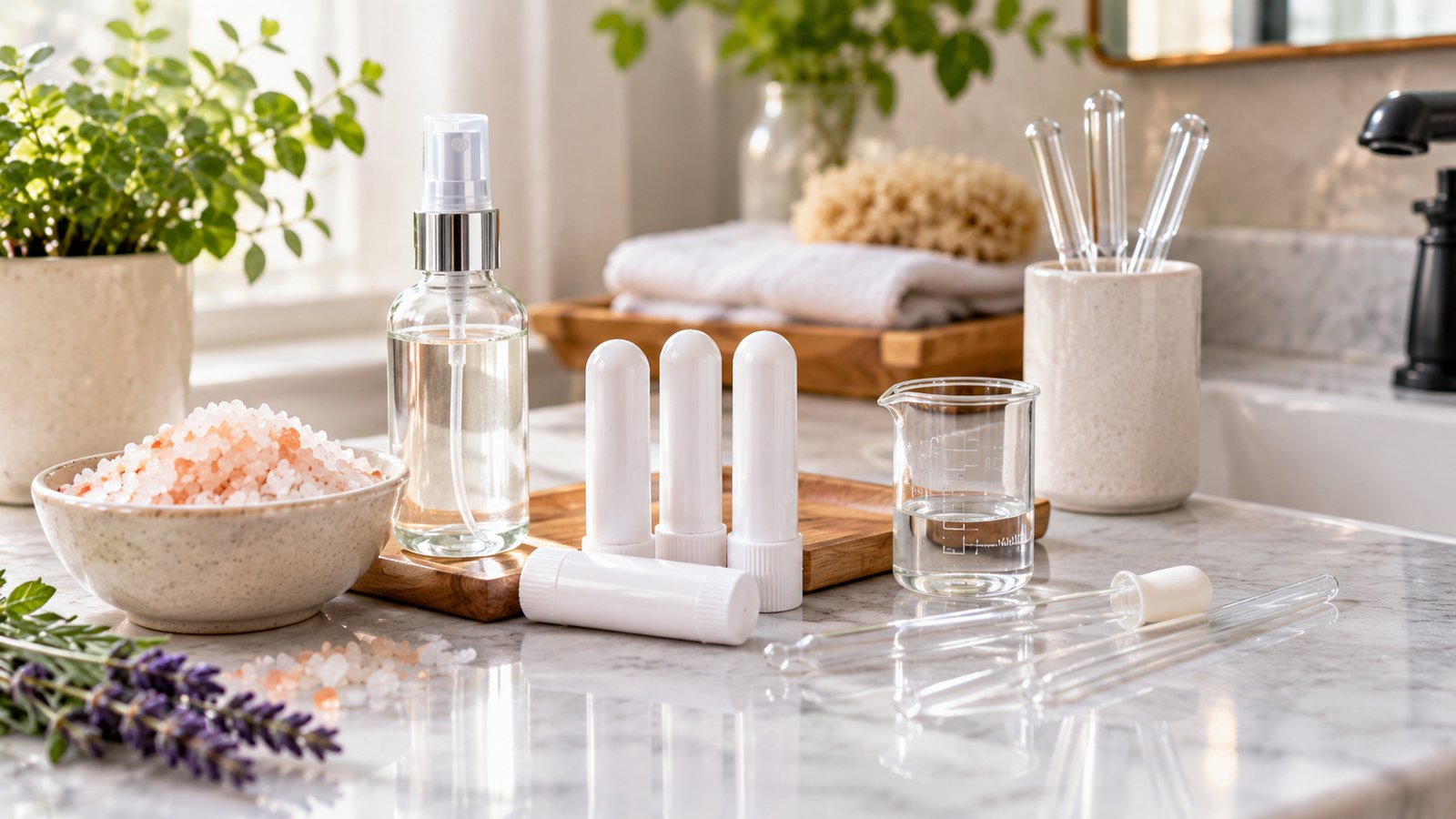
Not every use is a skin product, and not every use fits a percentage. These are the practical amounts behind the most common non-massage methods.
Nasal inhalers
Personal nasal inhalers hold a small cotton inhaler wick inside a tube. A sample clinical aromatherapy policy published by the Tisserand Institute suggests 15 to 20 drops of essential oil on the wick, with an optional 4 drops of jojoba or fractionated coconut oil to slow evaporation. The Tisserand Institute also advises discarding plastic inhalers after 2 to 3 weeks of use, because undiluted oils can degrade some plastics. Keep the tip just below the nostril rather than inside it, and keep inhalers away from young children.
Baths
Bath water spreads the oil out, but only if the oil is dispersed first. The same clinical policy suggests mixing 5 drops of essential oil into 1 teaspoon of liquid soap, such as unscented Castile soap, and swirling it into a full bath. Skip strong skin irritants in the bath altogether.
Room and linen sprays
For a spray, many recipes use about 1 percent essential oil, roughly 30 drops per 100 mL, premixed with a solubilizer or high-proof alcohol before water is added. Spray into the air or onto fabric, never directly onto skin, faces or pets.
Diffusers and steam
Diffusers do not need a dilution ratio; follow the manufacturer’s drop count for the tank size. For steam inhalation, 1 to 2 drops in a bowl of hot water is enough, and eyes should stay closed.

Common Dilution Mistakes
Treating each oil separately
The percentage covers the whole blend. Six drops each of three oils in a 10 mL rollerball is about 6 percent, not 2.
Trusting "1 drop per teaspoon" style shortcuts without checking
Rules of thumb vary between sources. One drop in 5 mL works out to about 0.7 percent at 30 drops per milliliter, which is fine for a face oil but weak for a spot treatment. Do the quick math instead of guessing.
Using a "pure" oil neat because the label says it is safe
No label phrase changes how concentrated an essential oil is. Tisserand has written about reports of reactions after people applied undiluted blends to their faces.
Shaking oil into water
Sprays and baths need a solubilizer or dispersant. Without one, the oil floats and lands on skin in concentrated droplets.
Forgetting about the carrier
A rancid carrier oil can irritate skin on its own. Choose a fresh, stable base; jojoba and fractionated coconut oil keep well, and richer bases such as shea butter suit balms for dry skin.
Adding more when nothing seems to happen
Essential oils are not medicines with dose-response guarantees. If a 3 percent body oil does not help sore muscles, a 10 percent version is more likely to cause irritation than relief. See a health professional for persistent pain or skin problems.

Frequently Asked Questions
What is a safe essential oil dilution for the face?
The Tisserand Institute suggests 0.5 to 1.2 percent for facial products, which is about 1 to 3 drops per 10 mL of carrier. Sensitive skin may do better at the lower end.
How many drops of essential oil per ounce of carrier oil?
At about 30 drops per milliliter, 1 fluid ounce (30 mL) needs about 9 drops for 1 percent, 18 drops for 2 percent and 27 drops for 3 percent.
Is 5 percent dilution safe?
Five percent is within the Tisserand Institute’s range for short-term spot treatments and small-area rollerballs, but it is higher than recommended for the face or for all-over body use.
What dilution should I use for children?
NAHA recommends roughly 0.5 to 2.5 percent for children depending on age and purpose, with extra caution for peppermint, eucalyptus, wintergreen and birch. Ask a pediatrician before using essential oils on babies.
Do I need to dilute essential oils for a diffuser?
No dilution percentage applies; follow the diffuser maker’s instructions for the number of drops, run it in a ventilated room and keep sessions short.
Sources: Tisserand Institute (Dilution for essential oils; How big is a drop?; Essential oil dilution chart; Phototoxicity: essential oils, sun and safety; Essential oil inhalation; sample clinical aromatherapy policy); Tisserand R and Young R, Essential Oil Safety, 2nd edition (Churchill Livingstone, 2014); International Fragrance Association (IFRA) standards; National Association for Holistic Aromatherapy (safety guidelines and dermal reaction tables); National Center for Complementary and Integrative Health (peppermint oil); Poison Control, National Capital Poison Center (eucalyptus oil). This article is for general education and is not medical advice.