

| ✨Hey there! This post may contain affiliate links, meaning we earn a commission if you make a purchase through our links, at no cost to you. Please read our disclosures for more info. |
Quick answer: essential oils are concentrated aromatic extracts, usually steam-distilled or cold-pressed from plants. Use them by diffusing for short periods or by diluting them in a carrier oil before they touch your skin, typically around 1 percent for the face and 1 to 3 percent for the body, according to the Tisserand Institute. Never swallow them unless a qualified professional directs it, keep bottles locked away from children and pets, and treat any health claim with care: the National Center for Complementary and Integrative Health (NCCIH) says the research on most aromatherapy uses is still limited.
In this guide
- What Essential Oils Are (and What They Are Not)
- How Essential Oils Work: Smell, Skin and Breath
- Safety First: The Rules That Matter Most
- Dilution Made Simple
- Carrier Oils: The Other Half of the Bottle
- How to Use Essential Oils: Diffusing, Inhalation, Topical and Bath
- Popular Essential Oils: An A to Z of Common Oils and Their Cautions
- Blending Basics
- Buying Quality Essential Oils
- Storage and Shelf Life
- Myths vs Evidence
- Frequently Asked Questions
- Related Guides
Small amber bottles of lavender, peppermint and tea tree oil now sit in kitchens, bathrooms and nightstands everywhere. They smell wonderful, and many people find that a familiar scent makes a room feel calmer or a long afternoon feel brighter. They are also far stronger than most people realize. One drop of an essential oil can represent the aromatic compounds from a surprising amount of plant material, which is why the same bottle that freshens a room can irritate skin or poison a curious toddler.
This guide is the starting point for everything about essential oils on For the Feels. It covers what these oils are, the safety rules that matter most, how dilution works, how to pick a carrier oil, the main ways to use them, what to look for when buying and how to store a collection so it lasts. Throughout, the facts come from named sources such as NCCIH, the National Association for Holistic Aromatherapy (NAHA), the Tisserand Institute, Poison Control and the ASPCA. Nothing here is medical advice; if you are pregnant, nursing, managing a health condition or taking medication, talk with your doctor or pharmacist before using essential oils.

Contents
hide
What Essential Oils Are (and What They Are Not)
An essential oil is the volatile, aromatic portion of a plant, captured in concentrated form. NCCIH describes essential oils as “very concentrated oils containing substances that give a plant its characteristic odor or flavor.” They come from flowers (lavender, rose), leaves (peppermint, eucalyptus, tea tree), resins (frankincense, myrrh), woods (cedarwood, sandalwood), seeds and roots, and citrus peels.
Most are produced by steam distillation. Plant material sits in a still, steam passes through it and carries the aromatic molecules out, and the vapor is cooled so the oil separates from the water. Citrus oils such as sweet orange, lemon and bergamot are usually cold-pressed, or “expressed,” from the peel instead. A third group, called absolutes (jasmine is the classic example), is made with solvents and is better treated as perfumery material than as an everyday home oil. Our look at how essential oil distillers work covers the equipment side in more detail. The same idea explains the price differences between oils: rose oil (Rosa damascena) needs several thousand kilograms of petals to yield one kilogram of oil, while citrus oils are pressed in bulk from fruit peel left over from juice production.
Why "oil" is a slightly misleading word
Despite the name, essential oils are not fatty like olive or sunflower oil. They are mixtures of small, volatile molecules such as linalool, limonene, menthol and 1,8-cineole. That is why they evaporate, why they smell so strong, and why they do not leave a greasy mark the way a cooking oil does. It is also why they need a fatty “carrier” oil before they go on skin.
What they are not
Essential oils are not the same as fragrance oils, which are blends of synthetic and natural aroma chemicals designed for candles and soaps. They are not infused oils, where herbs steep in a vegetable oil. And they are not dietary supplements just because they come from plants. In the United States, the Food and Drug Administration (FDA) decides how an aromatherapy product is regulated by its intended use: a product sold only to make you smell nice is treated as a cosmetic, while a product that claims to treat a condition, ease pain or help you sleep is treated as a drug.
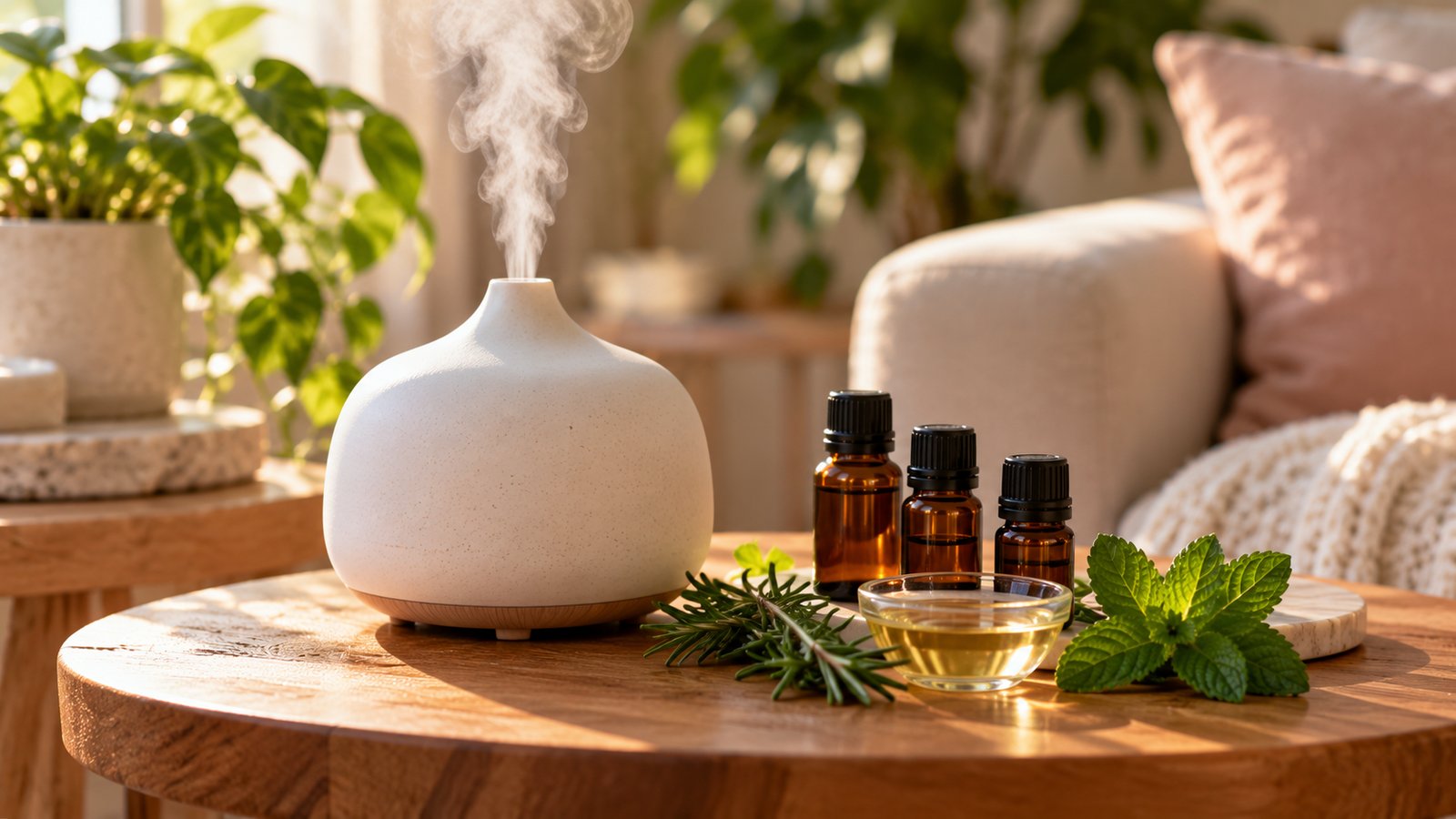
How Essential Oils Work: Smell, Skin and Breath
Essential oils reach the body by three main routes: the nose, the skin and the lungs. Knowing which route an application method uses makes it easier to choose the right amount and the right precautions.
Smell and the limbic system
Smell is the most direct of the senses. Odor molecules bind to receptors high inside the nose, and the signal travels to the olfactory bulb, a part of the central nervous system that connects with brain areas grouped as the limbic system, including the amygdala and hippocampus, which handle emotion and memory. That wiring helps explain why a whiff of lavender oil can call up a memory or change how a room feels within seconds. It does not prove a health effect, though. Researchers still debate how much of aromatherapy’s influence on mood comes from these pathways and how much comes from expectation and pleasant associations.
Breathing it in
Some of the molecules you inhale travel deeper into the respiratory system, and small amounts can be absorbed into the bloodstream through the lungs. For most adults, short, gentle exposure is low risk. Concentrated vapor is another matter: NAHA notes that long exposure to strong vapor can cause headaches and nausea, and menthol- and cineole-rich oils can affect the breathing of babies and small children.
Through the skin
Essential oil molecules are small and fat-soluble, so a portion of what you apply passes into the skin, while much of the rest evaporates. Warm skin, broken skin and covering the area all increase how much gets through, which is one reason dilution and a patch test matter so much.
Choosing an application method
Each application method trades strength for convenience. Diffusing and aroma sticks rely on the nose, steam inhalation adds warm moisture, a room spray scents the air briefly, and massage oils, balms and baths add skin contact. The sections below cover each one, along with the dilution that suits it. If you live with a health condition such as asthma, epilepsy or a skin disorder, ask your doctor which method, if any, is sensible for you.

Safety First: The Rules That Matter Most
Natural does not mean harmless. Poison Control (the National Capital Poison Center) puts it bluntly: misuse of essential oils can cause serious poisoning. The good news is that most problems are preventable with a short list of habits.
Keep them away from children and pets
Small bottles look like toys, and the oils smell like candy or mint. Poison Control advises that if you keep essential oils at home with young children, they should be locked up, out of sight and out of reach. Some oils are especially dangerous in small amounts: Poison Control notes that swallowed wintergreen oil acts like a large dose of aspirin, eucalyptus oil can cause seizures, and camphor can trigger seizures within minutes. If anyone swallows an essential oil, call Poison Control at 1-800-222-1222 or use its online tool, and do not try to make the person vomit, because oil inhaled into the lungs can cause pneumonia.
Pets need the same care. The ASPCA Animal Poison Control Center warns that concentrated oils on fur or paws can cause unsteadiness and depression, that concentrated tea tree oil can cause problems with only seven or eight drops, and that oils should never be applied directly to pets. A diffuser used briefly in a room the animal cannot enter is unlikely to cause trouble, according to the ASPCA, but avoid diffusing around birds or pets with breathing problems.
Dilute before skin contact
Undiluted oils are the most common cause of skin reactions. NAHA lists three main kinds: irritation (redness or burning that shows up quickly), sensitization (an allergic reaction that can become lifelong once it develops) and phototoxicity (burns or dark patches when certain citrus oils meet sunlight). Diluting in a carrier oil, avoiding broken or inflamed skin and rotating oils instead of using the same one every day all lower the risk.
Patch test new oils
Before using a new blend widely, apply a small amount of the diluted mix to the inner forearm and wait 24 hours. Redness, itching or swelling means that blend is not for you. Wash the area with a little carrier oil or a gentle soap and stop using it.
Respect sunlight, eyes and mucous membranes
Expressed bergamot, lemon and lime oils are on NAHA’s list of photosensitizers. NAHA advises staying out of the sun or tanning beds for at least 24 hours after applying them to skin. Never put essential oils in or near the eyes; if a drop gets there, NAHA suggests wiping the closed lid with a cloth soaked in a fatty oil and flushing with cool water.
Pregnancy, children and medications
Pregnancy is a contested area, and NAHA follows the International Federation of Professional Aromatherapists guidelines. NAHA lists several oils to avoid throughout pregnancy, labor and breastfeeding, including aniseed, birch, camphor, hyssop, parsley seed, pennyroyal, sage, tansy, tarragon, thuja, wintergreen and wormwood. For children, NAHA recommends lower dilutions in the range of 0.5 to 2.5 percent depending on age and purpose, and extra care with menthol-rich peppermint, cineole-rich eucalyptus and methyl salicylate oils such as birch and wintergreen. NCCIH adds that peppermint oil should never be applied to the face of an infant or young child, because inhaling menthol can affect their breathing. Anyone on prescription medicine should ask a pharmacist first, since NCCIH notes that lavender, for example, may theoretically interact with sedatives.

Dilution Made Simple
Dilution is the single most useful skill in using essential oils well. A dilution is just a percentage: a 2 percent blend is 2 parts essential oil and 98 parts carrier.
The Tisserand Institute groups everyday uses into six ranges, which work well as a starting framework:
- Sensitive or damaged skin: 0.2 to 1 percent.
- Face products and deodorants: 0.5 to 1.2 percent.
- Body oils and lotions: 1 to 3 percent.
- Bath and wash-off products: 2 to 4 percent.
- Short-term spot treatments, such as acne: 2 to 10 percent.
- Rollerballs for small areas and muscle aches: 3 to 10 percent.
Turning percentages into drops
Drops are never exact. The Tisserand Institute reports that drop counts in published tests ranged from roughly 20 to 40 drops per milliliter, and its own charts assume about 30 drops per milliliter. On that basis, 1 percent in a 10 mL rollerball is about 3 drops, 2 percent is about 6 drops, and 3 percent is about 9 drops. In a 30 mL (1 fluid ounce) bottle, 1 percent is about 9 drops and 2 percent about 18 drops.
Start at the low end of a range and increase only if needed. Robert Tisserand makes the point that pushing a concentration higher always raises risk, but past a certain point it does not add benefit. Be wary of ratios like “1 part oil to 4 parts carrier,” which the Tisserand Institute notes works out to 20 to 25 percent and is far too strong for almost any skin use.
Our upcoming dilution chart will lay out drop counts for every common bottle size, and you will find it linked in the related guides at the end of this page once it is live.

Carrier Oils: The Other Half of the Bottle
A carrier oil is a fatty plant oil (or, in jojoba’s case, a liquid wax) that dilutes essential oils and spreads them over the skin. It also sets the feel of the finished blend: light and quick-absorbing, or rich and cushioning.
The four most popular carriers
- Jojoba: technically a liquid wax made mostly of long-chain wax esters rather than a true triglyceride oil. It resists going rancid, feels light, and suits face blends.
- Sweet almond: a classic massage oil with a soft, slightly nutty feel. Skip it for anyone with a tree nut allergy.
- Coconut oil: virgin coconut oil turns solid below roughly 24 to 25 degrees Celsius (about 76 degrees Fahrenheit), so it works best in balms and whipped blends.
- Fractionated coconut oil: coconut oil processed to remove the long-chain fats, leaving liquid medium-chain triglycerides (often listed as caprylic/capric triglyceride). It stays liquid, has almost no scent and is popular for rollerballs.
Other carriers worth knowing
Grapeseed and sunflower oils are light and inexpensive, apricot kernel oil is gentle for massage, and richer options such as avocado oil or shea butter suit very dry skin. Our guide to the benefits of shea butter explains how to use it in balms. Whichever you choose, buy small amounts, smell them before use and toss any that smell sharp, crayon-like or stale, which are signs of rancidity.
How to Use Essential Oils: Diffusing, Inhalation, Topical and Bath
Diffusing
Diffusers spread aroma into a room. Ultrasonic diffusers mix a few drops with water and release a fine mist; nebulizing diffusers atomize the oil without water and are much stronger; passive diffusers (reed sticks, clay pendants) simply let the oil evaporate. NAHA notes that inhalation carries a very low risk for most people, but cites Tisserand and Balacs on the one realistic problem: prolonged exposure, perhaps an hour or more, to high vapor levels can cause headaches, nausea and lethargy. A practical approach is to diffuse in a ventilated room, keep sessions well under an hour and then take a break. Aroma atomizers, the nebulizing type, release undiluted oil and are noticeably stronger than ultrasonic models, so shorter sessions make sense with them.
Humidifiers are a different appliance from diffusers, and many manufacturers say not to add oils to them. Our article on whether you can put essential oils in a humidifier explains why.
Direct inhalation
A drop on a tissue, a cotton wick in a personal inhaler tube (often sold as aroma sticks), or a bowl of hot (not boiling) water for steam inhalation are simple options. For steam inhalation, one or two drops are plenty; lean over the bowl with a towel draped loosely, keep your eyes closed and stop after a few minutes. Do not use menthol- or cineole-rich oils near the faces of small children, and skip steam inhalation altogether for anyone with asthma unless their doctor agrees.
Room spray
A room spray is a quick alternative to a diffuser. Because essential oils will not mix with plain water, blend them into a solubilizer or high-proof alcohol before adding water, shake before each use and mist into the air rather than onto skin, pets or polished wood.
Topical use
Massage oils, body oils, balms and rollerballs are the most common skin uses. Always dilute, follow the ranges above, avoid broken skin and patch test first.
Baths
Essential oils do not mix with water; they float on top and can land undiluted on skin. NAHA advises mixing them first with a dispersant such as a natural bath gel, a vegetable oil or a solubilizer, and avoiding strong irritants like bay, clove, cinnamon bark, lemongrass and thyme in the bath altogether.
Swallowing
NAHA does not support the indiscriminate internal use of essential oils, and Poison Control warns that several common oils are dangerous when swallowed. Leave internal use to clinicians and to products that are formulated and labeled for it, such as enteric-coated peppermint capsules.

Popular Essential Oils: An A to Z of Common Oils and Their Cautions
The plant extracts below are among the most widely sold. Botanical names are included because they are the only reliable way to know what is in the bottle, and each oil will get its own detailed guide in this series.
- Bay laurel (Laurus nobilis): a spicy, herbal leaf oil rich in 1,8-cineole. Check the label carefully, because West Indian bay (Pimenta racemosa) is a different, more irritating oil and is the “bay” on NAHA’s list of skin irritants.
- Bergamot: bright citrus scent. Expressed bergamot is phototoxic; look for “bergaptene-free” or “FCF” versions for skin use.
- Cedarwood oil: woody and grounding. Atlas cedarwood (Cedrus atlantica) is a true cedar, while Virginian cedarwood (Juniperus virginiana) actually comes from a juniper. Both are popular base notes in blends.
- Cinnamon bark oil (Cinnamomum verum): warm and spicy, but one of the strongest skin irritants and sensitizers. Tisserand and Young’s reference book Essential Oil Safety sets a maximum skin concentration of just 0.07 percent, so it is best kept to diffuser blends.
- Eucalyptus oil (usually Eucalyptus globulus or Eucalyptus radiata): fresh and camphoraceous. Poison Control advises no use in children under 2, no use during pregnancy or breastfeeding, and never swallowing it.
- Frankincense: a resin oil with a long ceremonial history. Undiluted use has been linked to skin reactions in reports gathered by the Tisserand Institute.
- Jasmine oil: almost always sold as an absolute, made with solvents rather than distilled, and priced accordingly. It is a perfumery material that can cause skin allergy, so use it sparingly and well diluted.
- Lavender oil (Lavandula angustifolia): soft, floral and the most popular starter oil. NCCIH says aromatherapy with lavender is considered possibly safe but may cause headache or coughing, and topical lavender may cause allergic skin reactions.
- Lemon oil: expressed lemon oil is phototoxic, while distilled lemon oil is not, according to NAHA.
- Lemongrass oil (Cymbopogon flexuosus or Cymbopogon citratus): a sharp, lemony grass oil high in citral. NAHA lists it as a skin irritant, and Tisserand and Young recommend keeping it to about 0.7 percent on skin.
- Peppermint: cooling and sharp, roughly 40 percent menthol according to Robert Tisserand. NAHA lists it as a mucous membrane irritant, and NCCIH warns against using it on the faces of infants and young children.
- Rose oil (Rosa damascena): rose otto is steam-distilled and rose absolute is solvent-extracted. Both are among the most expensive oils sold, which makes rose a frequent target for adulteration.
- Rosemary oil (Salvia rosmarinus, formerly Rosmarinus officinalis): herbal and bracing. Its camphor- and cineole-rich types call for the same care around young children as eucalyptus.
- Spearmint oil (Mentha spicata): sweeter and gentler than peppermint because it contains far less menthol, though it still needs dilution.
- Sweet orange oil (Citrus sinensis): a cheerful, low-cost citrus oil that NAHA lists as non-phototoxic. Like all citrus oils it oxidizes quickly once opened, so buy small bottles of orange oil and use them within a year or so.
- Tea tree (Melaleuca alternifolia): popular for blemish care. Poison Control calls it poisonous if swallowed and advises against using it in or around the mouth.
- Ylang-ylang (Cananga odorata): rich, sweet and floral. It is a known skin sensitizer that the fragrance industry restricts, and Tisserand and Young suggest a skin maximum of 0.8 percent. In a 2008 study in the International Journal of Neuroscience, people who smelled ylang-ylang felt calmer but did worse on memory and speed tasks than people in an unscented room, while peppermint was linked to better memory and alertness.
Older oil profiles on this site go into individual plants such as palo santo essential oil and star anise essential oil; read them alongside the safety rules on this page.

Blending Basics
Blending is where essential oils become personal. Perfumers describe scents as top notes (bright, fast to evaporate, such as citrus and peppermint), middle notes (the body of a blend, such as lavender and geranium) and base notes (deep and slow, such as cedarwood, frankincense and vetiver). A balanced room blend often uses more top and middle notes with a smaller amount of base.
Five steps for a first blend
- Pick a purpose and a method, for example a relaxing evening diffuser blend.
- Choose two or three oils you already like on their own.
- Mix a tiny test batch in drops (for example 3 drops of one, 2 of another, 1 of a third) on a cotton pad and smell it over 20 minutes as it changes.
- Adjust one oil at a time and write down the ratio that works.
- Only then scale it up, and if the blend is going on skin, calculate the total drops so the whole blend stays within the dilution range for that use.
Remember that the dilution percentage applies to the total of all essential oils in the bottle, not to each oil separately. In a 10 mL bottle, a 2 percent blend has about 6 drops in total, not 6 drops of each.
Pairings that tend to work
Lavender with sweet orange, cedarwood with bergamot (bergaptene-free for skin), peppermint with a little lavender, rosemary oil with lemon in a diffuser, and frankincense with sweet orange are common, forgiving combinations. Spicy oils such as clove and cinnamon are strong irritants on skin, so keep them to diffuser blends in very small amounts.

Buying Quality Essential Oils
Quality varies widely, and adulterated oils raise the chance of a reaction, as NAHA points out. A few checks help.
- Look for the botanical (Latin) name, such as Lavandula angustifolia rather than just “lavender,” because several plants share common names. Lavandin, for example, is a hybrid that smells similar but contains noticeably more camphor.
- Check the plant part, the extraction method and the country of origin.
- Ask whether the supplier can provide a gas chromatography-mass spectrometry (GC/MS) report for the batch. NAHA recommends buying from suppliers who test this way.
- Expect dark glass bottles with orifice reducers and clear safety warnings.
- Be skeptical of the phrase “therapeutic grade.” Both NAHA and the Tisserand Institute describe it as a marketing term that no governing body certifies.
- Compare prices. Rose otto, sandalwood and neroli are expensive to produce, so a very cheap bottle with one of those names deserves suspicion.

Storage and Shelf Life
Heat, light and oxygen break essential oils down. NAHA notes that oxidized citrus oils and oxidized oils from the pine family are more likely to cause skin sensitization, so old bottles are not only weaker but can be riskier.
- Store bottles tightly capped, upright, in a cool, dark cupboard; a dedicated wooden box works well.
- Write the opening date on each bottle.
- Use citrus and pine-family oils sooner rather than later, since NAHA flags their oxidized forms as skin sensitizers, and discard any oil whose smell has turned sharp or turpentine-like.
- Keep the head space small by moving long-term oils into smaller bottles as you use them.
- Store everything away from flames; NAHA reminds users that essential oils are highly flammable.
- Keep bottles locked away from children and pets, as covered in the safety section.

Myths vs Evidence
Essential oils attract big promises online, and many product pages list long strings of therapeutic benefits. Here is how several common claims hold up against the public evidence summaries.
"Lavender is proven to cure anxiety and insomnia"
NCCIH reports that a specific lavender oil product taken by mouth might help anxiety, but the studies have limitations, and it says it is unclear whether lavender aromatherapy helps anxiety, stress, sleep quality or insomnia. Enjoying the scent is reasonable; treating a medical condition with it alone is not.
"Peppermint oil works for everything digestive"
NCCIH says a small amount of research supports enteric-coated peppermint oil capsules for irritable bowel syndrome in adults, and the American College of Gastroenterology recommended it for overall IBS symptoms in a 2021 guideline. That evidence applies to those capsules, not to drops of bottled oil.
"Pure oils can go straight on skin"
The Tisserand Institute argues the opposite and points to reports of reactions after undiluted application. Dilution lowers risk and, past a point, stronger blends do not work better.
"Diffusing is always harmless"
Inhalation is low risk for most adults, but the ASPCA advises against diffusers around birds or pets with breathing problems, and NCCIH notes that lavender aromatherapy may cause headache or coughing in some people.
"Aromatherapy has no effect at all"
The truth sits in the middle. NCCIH describes small studies with some promising results, such as inhaled peppermint oil for chemotherapy-related nausea, alongside many questions that research has not yet answered. The honest view is that essential oils can be pleasant and occasionally useful, as long as nobody treats them as a replacement for medical care.
More Guides in This Series
- Essential Oil Dilution Chart
- Peppermint Essential Oil
- Tea Tree Oil
- Frankincense and Myrrh Essential Oils
- Essential Oils and Pets
- Essential Oil Diffuser Types Compared
- How to Make an Essential Oil Roller Blend Safely
- Citrus Essential Oils and Sun Sensitivity
- Eucalyptus Essential Oil

Frequently Asked Questions
Are essential oils safe to use every day?
Diffusing in short sessions in a ventilated room is low risk for most adults, according to NAHA. For skin use, NAHA advises against applying the same oils every day for long periods, because repeated exposure raises the chance of developing an allergy.
What is the safest way for a beginner to start?
Begin with one or two gentle, widely used oils such as lavender or sweet orange, diffuse them briefly, and when using them on skin dilute them to about 1 percent and patch test first.
Can I put essential oils directly on my skin?
The Tisserand Institute and NAHA both advise against undiluted application for nearly all oils. Mix them into a carrier oil, lotion or balm at the dilution suited to the area.
How many drops of essential oil go in a 10 mL rollerball?
Using the Tisserand Institute’s assumption of about 30 drops per milliliter, 1 percent is about 3 drops, 2 percent about 6 drops and 3 percent about 9 drops in a 10 mL roller bottle.
Are essential oils safe around cats and dogs?
Never apply them to pets or leave bottles where they can reach them. The ASPCA says brief diffusing in a room the animal cannot enter is unlikely to cause problems, but avoid diffusers around birds and pets with breathing problems.
Do essential oils expire?
Yes. Oxidation changes their scent and can make them more irritating. Store them cool, dark and tightly capped, and replace oils that smell sharp or stale.

Related Guides
These pages go deeper on parts of this essential oils guide. New guides on dilution, carrier oils, lavender, peppermint, tea tree, diffusers, roller blends and pet safety will be added here as they go live.
Sources: National Center for Complementary and Integrative Health (aromatherapy, lavender and peppermint oil fact sheets); National Association for Holistic Aromatherapy (safety guidelines, dermal reactions, pregnancy table); Tisserand Institute (dilution ranges, drop size, children’s dilutions); Poison Control, National Capital Poison Center (essential oils, eucalyptus oil, tea tree oil); ASPCA Animal Poison Control Center (essential oils around pets); U.S. Food and Drug Administration (aromatherapy product regulation). This article is for general education and is not medical advice.
