| ✨Hey there! This post may contain affiliate links, meaning we earn a commission if you make a purchase through our links, at no cost to you. Please read our disclosures for more info. |
Quick answer: kyanite is an aluminum silicate mineral (Al2SiO5) that forms long, bladed crystals, most famously in deep blue with streaky color. It has a rare property: its hardness is about 4.5 to 5 along the length of a crystal and about 6.5 to 7 across it. In crystal tradition, blue kyanite is associated with communication, calm and the throat chakra, and black kyanite “fans” with grounding. These are beliefs, not scientific findings. Kyanite splits easily, so handle it gently, avoid ultrasonic cleaners and sudden temperature changes and clean it with a soft, damp cloth.
Kyanite is one of the most striking stones in a crystal collection. A good blade is long and flat, streaked in shades from pale sky to deep sapphire blue, and it often shimmers with a pearly sheen along its surface. It is also one of the most interesting minerals to geologists, thanks to an odd physical property and the clues it gives about how rocks form.
This guide covers what kyanite is, the traditions attached to it, how to care for it and how to avoid fakes. For an overview of crystal meanings, cleansing and care across all stones, see our crystal meanings guide.
Sources: Mindat.org mineral database (kyanite); Gemological Institute of America (GIA) gem encyclopedia; Cornelis Klein and Barbara Dutrow, Manual of Mineral Science, 23rd edition (Wiley); Virginia Department of Energy, Geology and Mineral Resources (kyanite in Virginia); Minerals Education Coalition (kyanite and mullite uses). Crystal meanings below reflect tradition and belief, not proven effects. Checked October 2026.

What Kyanite Is
Kyanite is a silicate mineral with the chemical formula Al2SiO5, meaning it is built from aluminum, silicon and oxygen. It crystallizes in the triclinic system and usually forms long, flat, blade-like crystals, often in radiating clusters or embedded in rock.
The name comes from the Greek word kyanos, meaning dark blue. An older name, disthene, comes from Greek words meaning “two strengths,” a nod to its unusual hardness.
Two hardnesses in one crystal
Most minerals have roughly the same hardness in every direction. Kyanite does not. Mineralogy references, including Mindat and standard textbooks such as Klein and Dutrow’s Manual of Mineral Science, give its hardness as about 4.5 to 5 on the Mohs scale when scratched parallel to the length of the crystal, and about 6.5 to 7 when scratched across it.
In practical terms, a steel knife may scratch a kyanite blade along its length but not across it. This property, called anisotropic hardness, is one of the classic tests mineral students learn.
A geologist’s pressure gauge
Kyanite shares its exact chemical formula with two other minerals, andalusite and sillimanite. These three are polymorphs: the same atoms arranged in different crystal structures. Which one forms depends on the temperature and pressure the rock experienced.
- Kyanite forms at relatively high pressure.
- Andalusite forms at lower pressure.
- Sillimanite forms at high temperature.
Because of this, geologists use these minerals to estimate the conditions under which metamorphic rocks formed. Finding kyanite in a schist tells them the rock was once buried deep in the crust.
Where kyanite comes from
Kyanite occurs in metamorphic rocks, especially schists and gneisses, and in some pegmatites and quartz veins. Notable sources include Brazil, Nepal, India, Kenya, Tanzania, Switzerland and the United States. Virginia has long been a center of industrial kyanite mining, according to the Virginia Department of Energy’s geology division.
Industrial uses
Most kyanite mined worldwide is not destined for jewelry. When heated to high temperatures, kyanite converts to mullite, a material that withstands extreme heat. The Minerals Education Coalition notes that kyanite and mullite are used in refractory products such as kiln linings and furnace bricks, and in high-performance ceramics, including porcelain.

Colors of Kyanite
| Color | What causes it | Notes |
|---|---|---|
| Blue | Trace iron and titanium | The classic color; often uneven and streaky |
| Black | Inclusions, often graphite or iron minerals | Typically forms fan-shaped clusters (“witch’s broom”) |
| Green | Trace elements such as iron or vanadium | Less common; sometimes pale and translucent |
| Orange | Manganese | Discovered in Tanzania in the late 2000s; uncommon |
| Gray, white, colorless | Low trace elements | Common in industrial-grade material |
Blue kyanite often shows color zoning, with darker blue concentrated along the center or edges of a blade. Fine, transparent blue kyanite from Nepal or Brazil can be faceted and can look remarkably like sapphire.

Kyanite Meaning in Crystal Tradition
The meanings in this section come from modern crystal-healing tradition and metaphysical literature. They are beliefs about symbolism and intention, not scientifically demonstrated effects. Kyanite should never replace medical or mental health care.
Blue kyanite
In crystal tradition, blue kyanite is associated with communication, honesty and calm self-expression. It is commonly linked to the throat chakra, and some practitioners use it during meditation or before conversations where they want to speak clearly. Its striped, linear crystals are often described symbolically as “aligning” energy.
Black kyanite
Black kyanite fans are associated with grounding and protection in crystal practice. Their broom-like shape inspired the folk name “witch’s broom,” and some people place them near entrances or use them in meditation as a symbol of sweeping away negativity.
Green and orange kyanite
Green kyanite is linked by practitioners with nature and the heart, and orange kyanite with creativity and motivation. These associations are newer and less standardized than those for blue kyanite.
“Kyanite never needs cleansing”
A common claim in crystal books is that kyanite does not hold negative energy and never needs to be cleansed. This is a belief within crystal tradition, not something that can be measured. If you follow cleansing rituals, choose methods that suit kyanite’s fragility, such as sound, moonlight or smoke, rather than soaking it in water or salt. Our guide to how to cleanse crystals compares methods.
Kyanite, zodiac and birthstones
Kyanite is not a traditional birthstone on modern Western birthstone lists. Some crystal guides associate it with Taurus, Libra or Aries, but these pairings vary from source to source. Our article on crystals for zodiac signs explains how these associations developed.

How People Use Kyanite
Collectors and crystal practitioners tend to use kyanite in a few common ways. None of these require special equipment, and all of them work with the stone’s fragile structure rather than against it.
- Display. A single long blue blade on a small stand or in a shallow dish shows off its color and striations. Natural light brings out the sheen along cleavage surfaces, but avoid placing it where it gets very hot.
- Meditation. Some people hold a blade or place it nearby during meditation as a focus object, particularly when working on intentions related to speaking or listening.
- Desk or workspace. Because blue kyanite is associated with clear communication in crystal tradition, people sometimes keep it near a desk or phone.
- Crystal grids. Long blades work well as “pointers” connecting stones in a grid layout.
- Jewelry. Raw kyanite pendants and faceted earrings are popular. Choose protective settings, and take pieces off before exercise, cleaning or gardening.
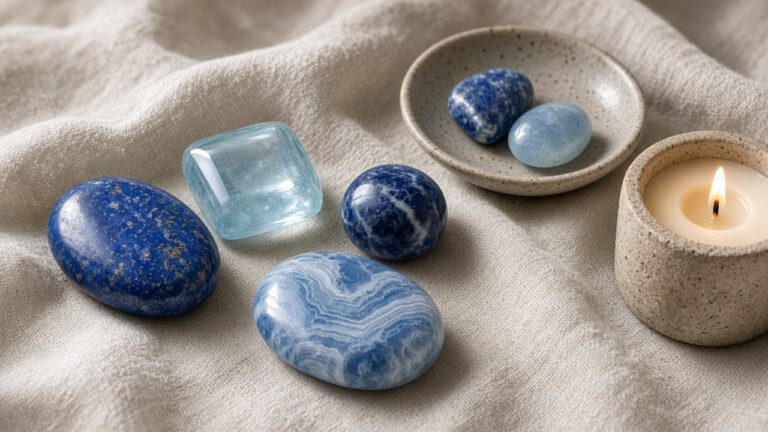
- Pairing with other stones. Practitioners often combine blue kyanite with other blue stones, such as aquamarine or lapis lazuli, or with clear quartz.
Whatever the use, the practical rule is the same: keep blades supported, away from hard surfaces and away from harder stones that can scratch or chip them.

Caring for Kyanite
Kyanite’s biggest weakness is not its hardness but its cleavage. It has perfect cleavage in one direction and good cleavage in another, which means blades can split along flat planes if knocked, dropped or stressed.
Do
- Handle blades by their edges and support them underneath. Long blades can snap if lifted from one end.
- Clean with a soft, slightly damp cloth, then dry it immediately. For grime, use lukewarm water with a drop of mild soap and rinse quickly.
- Store it separately, wrapped in a soft cloth or in a padded box, away from harder stones such as quartz, which can scratch it.
- Keep raw blades in a protected spot rather than a busy shelf or a bag.
Avoid
- Ultrasonic and steam cleaners. Vibration and heat can open cleavage planes.
- Sudden temperature changes. Do not move kyanite from a hot windowsill to cold water.
- Long soaks. Raw kyanite is often embedded in or coated with other minerals that may loosen. It is not dissolved by water, but extended soaking offers no benefit. See our guide to which crystals cannot go in water for stones that need even more care.
- Salt baths and harsh chemicals. Salt can lodge in fractures, and acids or cleaners can damage associated minerals or treatments.
Kyanite jewelry
Faceted and cabochon kyanite is beautiful, but its directional hardness and cleavage make it better suited to pendants and earrings than to rings and bracelets that take daily knocks. Protective settings, such as bezels, reduce the risk of chips.

How to Spot Fake Kyanite
Rough kyanite is relatively inexpensive and plentiful, so outright fakes are less common than with many stones. The bigger risks are look-alikes, glass imitations of faceted stones and misidentification.
Common look-alikes
| Stone | How it differs from kyanite |
|---|---|
| Blue sapphire | Much harder (9 on the Mohs scale) in every direction; no perfect cleavage; much more expensive |
| Blue tourmaline (indicolite) | Hardness about 7 to 7.5; striated, often triangular-section crystals rather than flat blades |
| Iolite | Hardness 7 to 7.5; strong color change from blue-violet to gray or yellow when turned |
| Blue topaz | Hardness 8; usually even, bright color from treatment |
| Blue glass | Uniform color, may contain round gas bubbles, no blade structure or cleavage |
Checks you can do at home
- Look at the structure. Natural blue kyanite usually shows a flat, bladed habit, fibrous striations along its length and streaky, uneven color.
- Look for sheen. Cleavage surfaces often have a pearly or vitreous luster.
- Watch for bubbles. Under a 10x loupe, round gas bubbles or swirl marks point to glass.
- Check the color. Perfectly even, vivid blue in a cheap stone is a red flag for glass or dye.
- Ask for identification. For expensive faceted kyanite or anything sold as “sapphire,” ask for a report from an independent gem lab.
Do not try a scratch test on a stone you care about. Kyanite’s lower hardness along its length means a test could damage it, and the result can be misleading because of the directional difference.
Treatments
Most kyanite on the market is untreated. Some rough material is coated, oiled or polished to improve its appearance, and some low-grade material may be dyed. Ask the seller directly whether the stone has been treated.

Buying Kyanite
- Raw blades are inexpensive and are the most popular form for collectors and crystal practitioners. Look for good color and intact edges.
- Black kyanite fans are fragile; check for cracks and loose fibers before buying.
- Tumbled kyanite is more durable for carrying, but tumbling can remove the blade structure that makes it distinctive.
- Faceted kyanite is priced by color, clarity and size. Fine, transparent blue stones from Nepal command higher prices.
For blue stones in general, our guide to blue crystals and their meanings compares kyanite with lapis lazuli, sodalite, aquamarine and other blue stones.

Kyanite at a Glance
| Property | Detail |
|---|---|
| Chemical formula | Al2SiO5 (aluminum silicate) |
| Crystal system | Triclinic |
| Mohs hardness | About 4.5 to 5 along the length; 6.5 to 7 across |
| Cleavage | Perfect in one direction, good in another |
| Colors | Blue, black, green, orange, gray, colorless |
| Luster | Vitreous to pearly |
| Key sources | Brazil, Nepal, India, Kenya, Tanzania, United States |
| Traditional associations | Communication, calm, throat chakra (belief) |
| Care | Gentle handling; soft damp cloth; no ultrasonic or steam |

Frequently Asked Questions
What is kyanite good for?
In crystal tradition, blue kyanite is associated with communication, honesty and calm, and black kyanite with grounding. These are beliefs rather than proven effects. Industrially, kyanite is used to make heat-resistant refractory and ceramic products.
Why does kyanite have two hardnesses?
Its crystal structure is much stronger in one direction than the other. It measures about 4.5 to 5 on the Mohs scale along the length of a blade and about 6.5 to 7 across it.
Can kyanite go in water?
Brief rinsing is fine, but long soaks, salt water and sudden temperature changes are best avoided because kyanite splits easily along cleavage planes.
How can you tell if kyanite is real?
Natural kyanite usually forms flat, striated blades with uneven, streaky color and a pearly sheen. Glass imitations tend to have even color and may show round bubbles under magnification.
Is kyanite the same as sapphire?
No. Faceted blue kyanite can look like sapphire, but sapphire is a variety of corundum with a hardness of 9 in all directions, while kyanite is softer along its length and cleaves easily.
Does kyanite need to be cleansed?
Crystal tradition often says kyanite never needs cleansing. If you choose to cleanse it, use gentle methods such as sound or moonlight rather than soaking.