| ✨Hey there! This post may contain affiliate links, meaning we earn a commission if you make a purchase through our links, at no cost to you. Please read our disclosures for more info. |
Quick answer: amethyst is the purple variety of quartz (silicon dioxide, Mohs hardness 7). Its color comes from traces of iron plus natural radiation. Spiritual traditions link it with calm, clear thinking and sobriety, and it is the traditional February birthstone. Keep it out of strong sunlight and heat, because both can fade or change its color.
Few stones carry as much history in a single color as amethyst. The ancient Greeks gave it a name that means “not drunk,” and for centuries it was worn as a charm against overindulgence. Today it sits on bedside tables, in jewelry boxes and in meditation corners, usually as a polished palm stone, a tumbled pebble or a cluster of points.
This guide separates two kinds of information and keeps them apart. The first is mineral science: what amethyst is made of, why it is purple, where it forms and how to look after it, drawn from the Gemological Institute of America (GIA) and the mineral database Mindat. The second is tradition: what people across cultures have associated with the stone. The traditions are shared as beliefs and customs, and the science is shared as science.
One of the world’s most popular crystals is amethyst. These beautiful gemstones have been used by many people for thousands of years. In crystal tradition the stone’s healing properties are believed to be exceptionally powerful, and that belief can be traced back to the ancient Greeks.
It doesn’t matter whether you’ve always wanted to learn about amethyst crystals or whether you simply love purple gems, you will find out everything you need to know about amethyst here. Below we look at the stone’s properties, history, science, care and the traditional healing benefits people associate with amethyst.
In short, this page brings together two voices: the traditional, hand-written lore that crystal lovers have passed along, and the mineral science behind the stone. Each is labeled so you can tell which is which.
What Amethyst Is Made Of
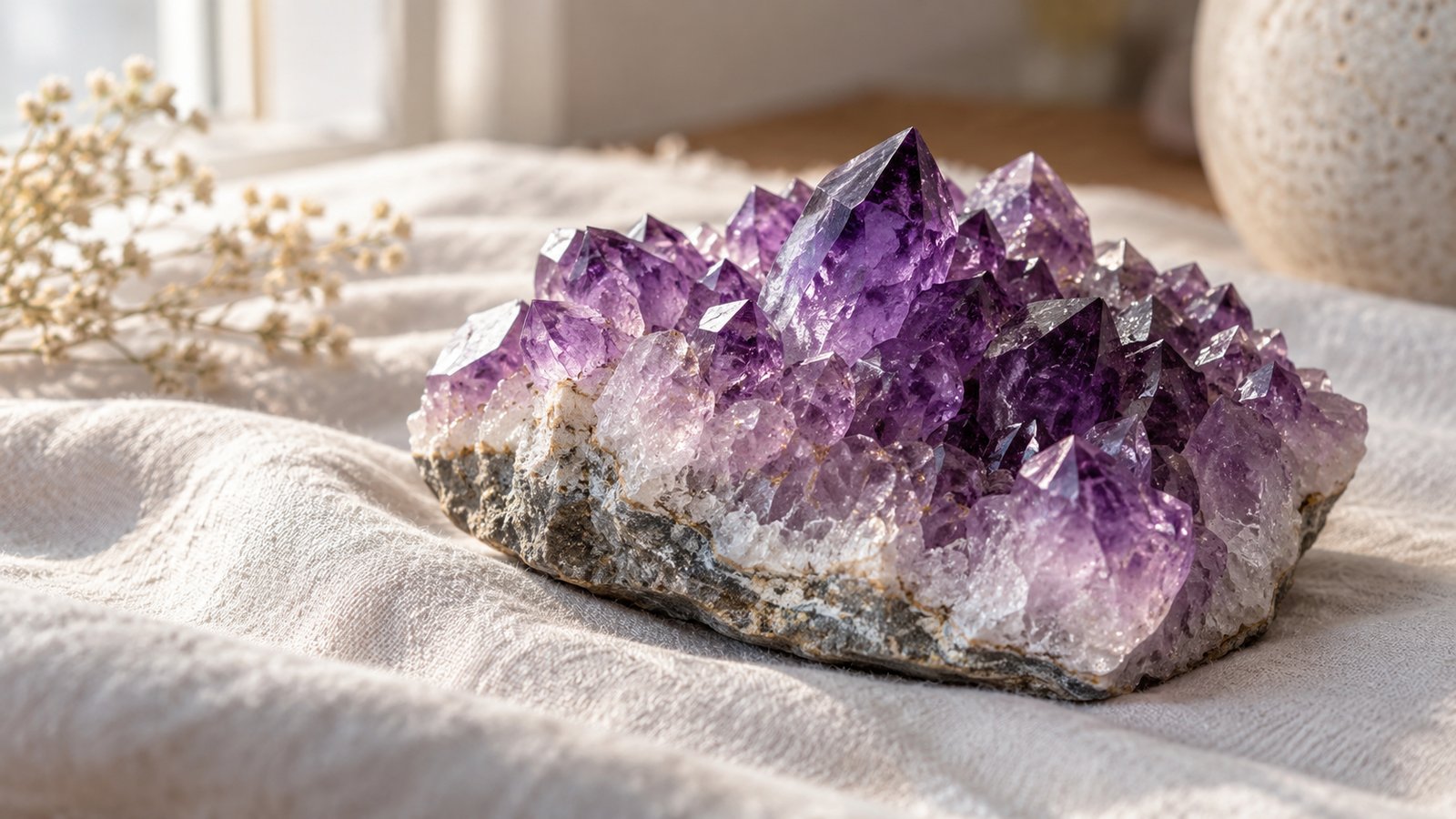
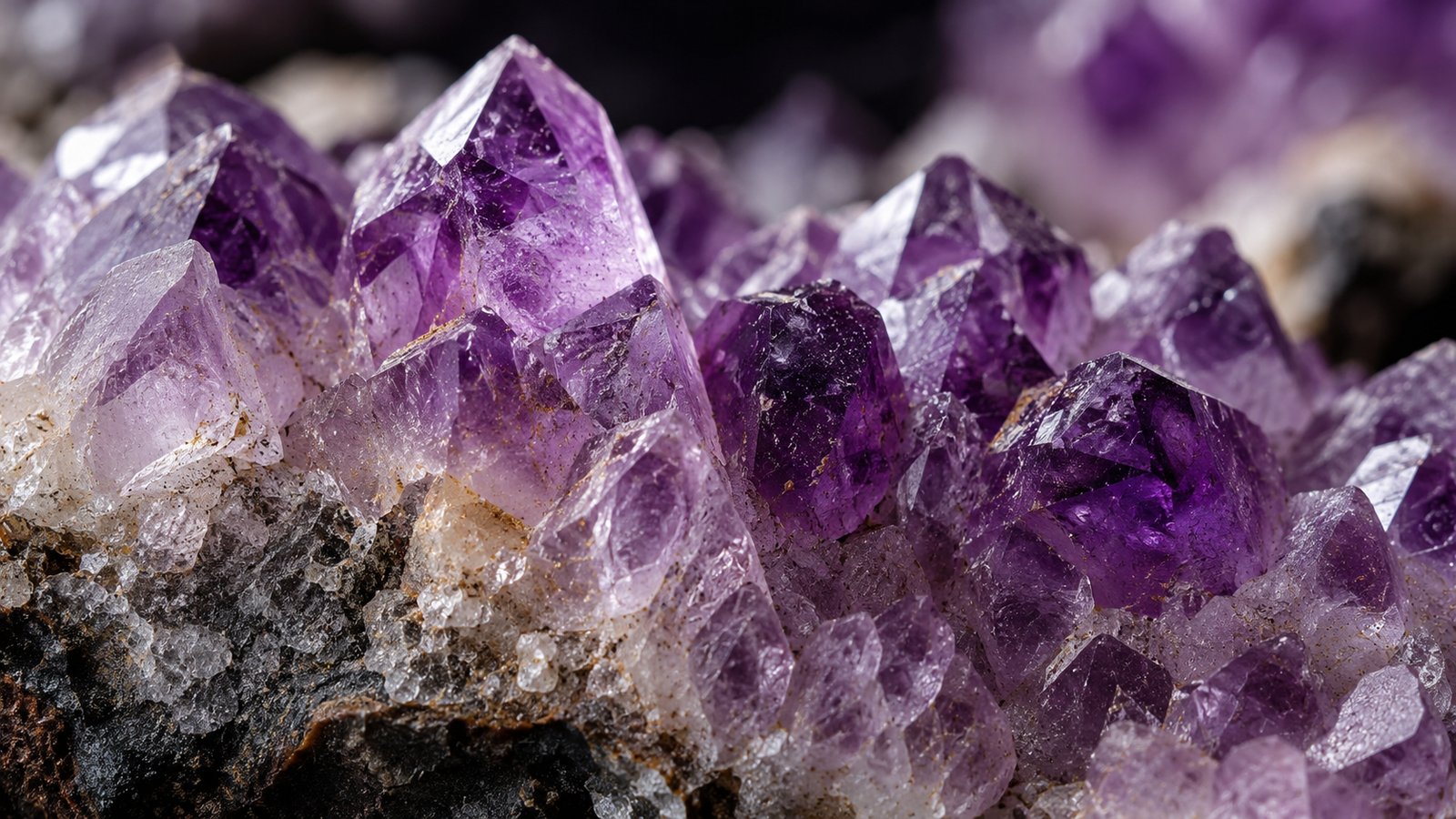
Amethyst is a variety of quartz, the mineral with the chemical formula SiO2. GIA lists its Mohs hardness as 7, which is hard enough to resist everyday scratching from dust and most household surfaces. Its specific gravity is about 2.66, and it forms six-sided crystals that often end in a point.
Quartz in its pure form is colorless. Amethyst gets its purple from a small amount of iron built into the crystal structure, combined with natural radiation from surrounding rock over geological time. Mindat explains that the radiation changes the iron atoms and creates what mineralogists call a color center, which absorbs some light and lets violet through. The iron content is tiny, in the range of 10 to 100 parts per million, yet it is enough to produce deep color.
Color is rarely even. In many crystals the purple concentrates in zones near the tips, and some stones show angular bands of darker and lighter violet. GIA describes the finest color as a strong reddish purple to purple with no visible zoning, but a stone with soft, uneven color is still real amethyst.
Amethyst, Ametrine and Citrine
Heat changes everything. Mindat notes that when amethyst is heated above roughly 300 to 400 degrees Celsius, the violet fades and the stone often turns yellow, orange or brown, resembling citrine. Much of the golden “citrine” sold in shops starts life as heated amethyst, which is a good reason to ask sellers how a golden stone was made. In Bolivia, amethyst and citrine sometimes grow together in one crystal, and GIA calls these half-purple, half-yellow stones ametrine.

Amethyst Properties and Characteristics
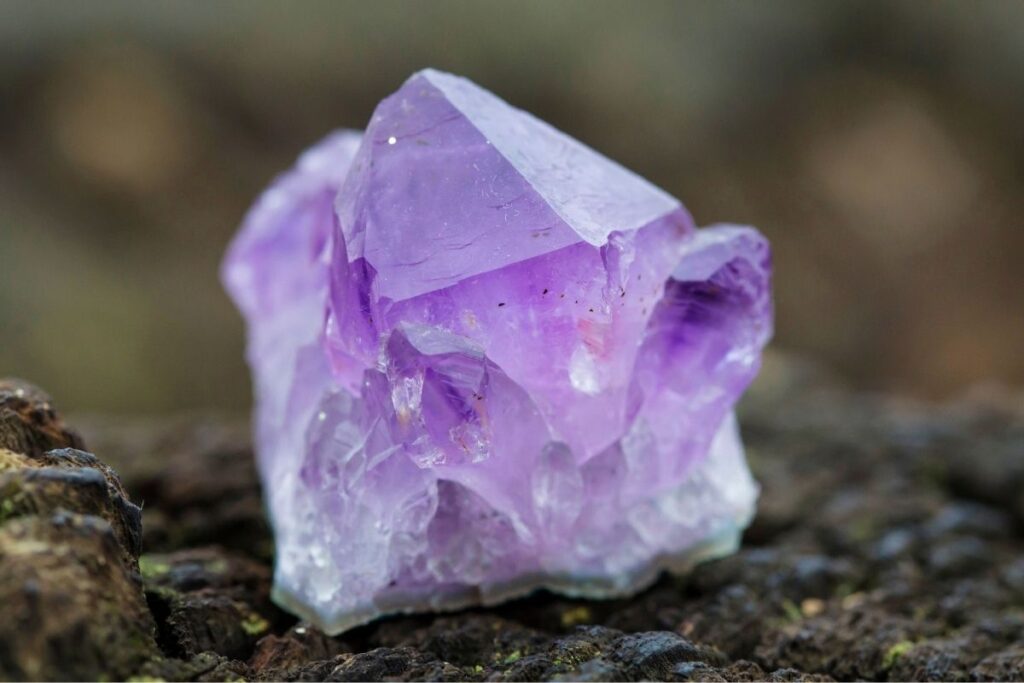
This gemstone is commonly recognized by its stunning purple marbled look. In crystal tradition it is believed to hold properties that help protect the wearer from negative energy.
Many people who hold this gem dear say they experience soothing dreams and a calming energy when they keep the crystal with them.
Traditionally, the stone is said to bring a sense of peacefulness and clarity, letting the mind feel free and relaxed. You may find amethyst in a variety of types ranging from purple to reddish hues. Other variants of the crystal include lavender amethyst and Canadian amethyst.
Where Amethyst Forms and Where It Is Found
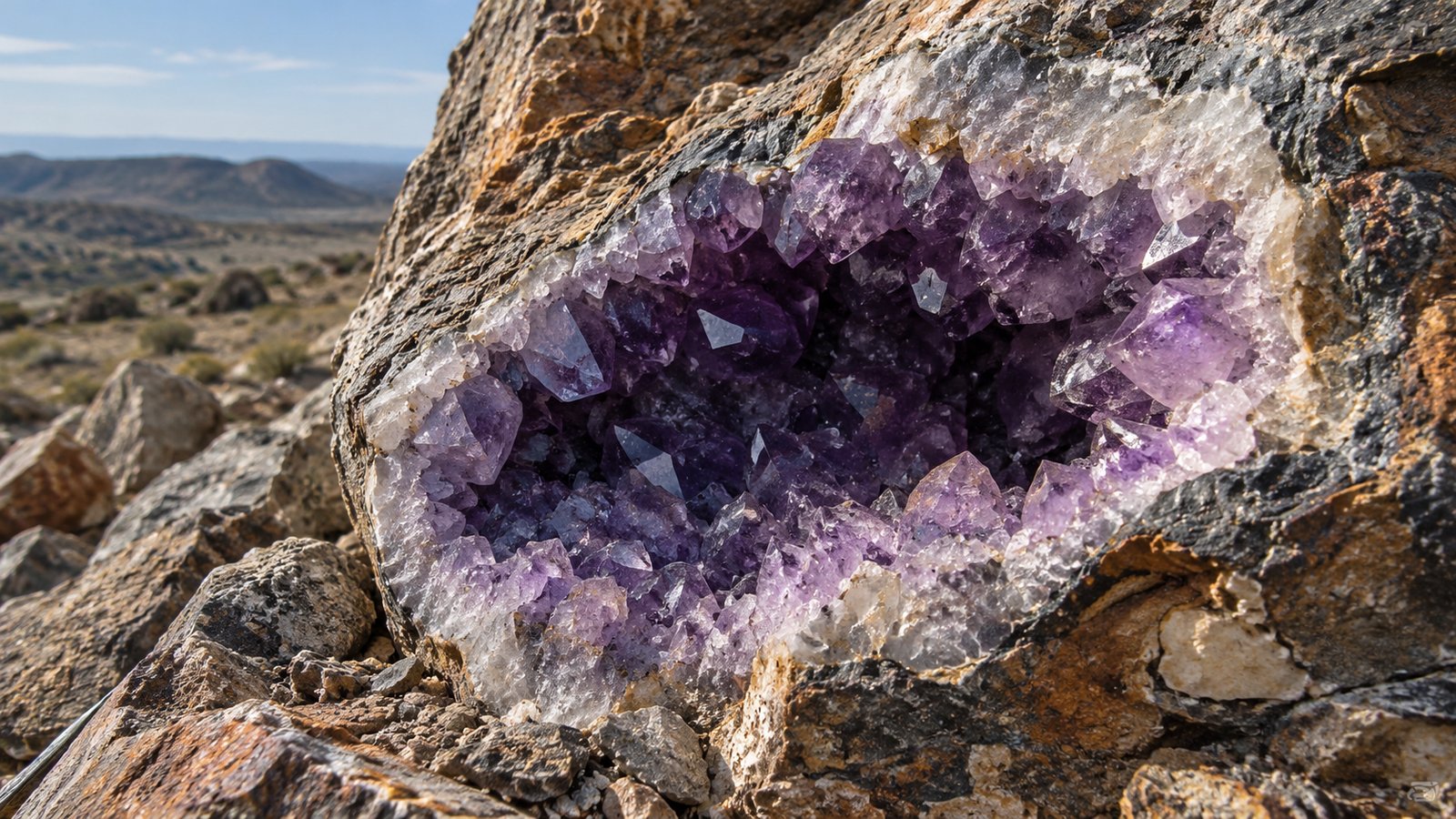
Amethyst crystallizes in cavities inside volcanic rock, where mineral-rich water leaves quartz behind layer by layer. The result can be a geode: a hollow rock lined with crystals. GIA mentions Brazilian geodes so large that a person can stand inside them.
The Gem Society lists Brazil, Bolivia, Uruguay and Zambia as the main sources today. Brazil produces large crystals and big geodes, usually with moderate color. Stones from Uruguay and Zambia tend to be smaller and more deeply colored, which collectors often prefer. Amethyst also occurs in the United States, Madagascar and Russia, where Siberian material was famous for deep color in earlier centuries.
Until the nineteenth century amethyst was priced alongside ruby and emerald, according to GIA. After the discovery of large deposits in Brazil it became far more available, which is why a polished amethyst today costs a fraction of what a royal collector once paid.
Where To Find Amethyst Geodes
Amethyst can actually be found all around the world. However, most famously there are deposits in Brazil. It is likely that you are unable to dig up your own amethyst geodes, so we recommend finding your local independent crystal shop to source your amethyst.
Be careful when buying amethyst online, as it may affect the authenticity of the gemstone, and you may not experience the traditional benefits we have covered today. (The section on how to spot fake amethyst below will help if you do shop online.)
By visiting a crystal shop you will be able to talk to someone who is well informed about crystals and spirituality who can guide you through the process of finding the right crystal for you.
If you believe that amethyst is the gem for you, then head out to your local spiritual shop and see what types of amethyst they have on offer. They may actually have several different varieties for you to choose from, each with its own unique traditional properties and benefits.
What Amethyst Means in Crystal Traditions
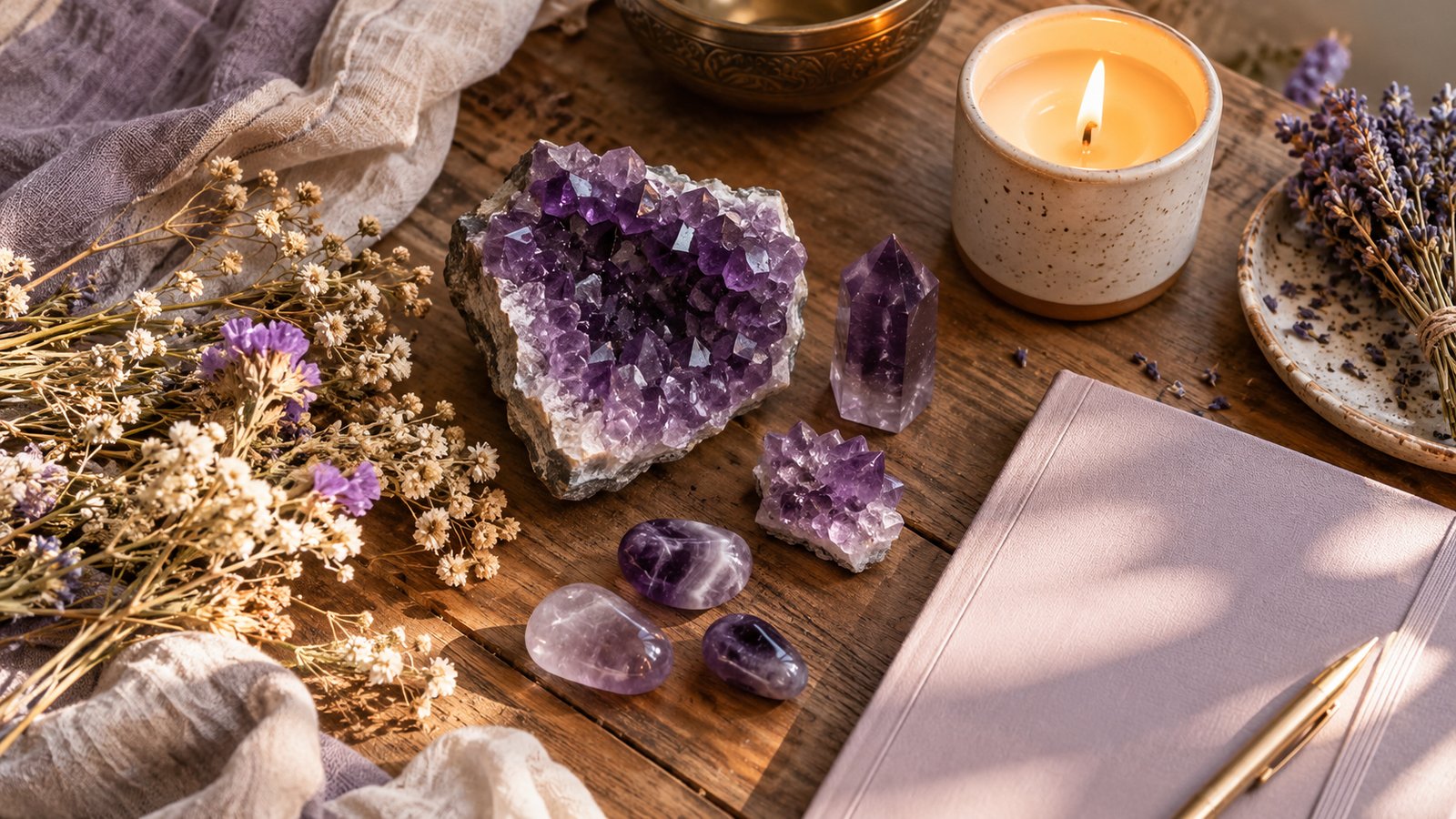
Crystal traditions assign meanings to stones, and amethyst has some of the longest-running associations. These are traditional beliefs, and different cultures emphasize different themes.
- Calm and clear thinking. Many crystal practitioners keep amethyst nearby while meditating or journaling and describe it as a stone for quiet focus.
- Sobriety and self-restraint. This is the oldest link, from the Greek word amethystos. Ancient writers described drinking cups carved from amethyst, supposedly so the drinker would stay clear-headed.
- Spiritual awareness. Chakra systems place amethyst with the crown chakra at the top of the head, the energy center associated with reflection and connection.
- Sleep and rest. A common modern practice is placing a piece on a nightstand as part of a bedtime routine. Whether the routine feels restful is a matter of personal ritual.
Greek mythology tells of Amethyst, a young woman turned to clear quartz by the goddess Diana to protect her from Dionysus, the god of wine, who then poured wine over the stone and stained it purple. The story is a myth, not geology, but it shows how the stone earned its link with wine and restraint. The stone also has a long church connection: amethyst has traditionally been set in the rings of bishops, where its purple matched ideas of piety and humility.
Astrology and birthstone lists add another layer. Amethyst is the traditional birthstone for February, and many crystal guides pair it with Aquarius and Pisces. For a fuller look at how different traditions match stones to signs, see the guide to crystals for zodiac signs.
Science gives amethyst a second kind of beauty. Like all quartz, it is built from a continuous framework of silicon and oxygen: each silicon atom bonds to four oxygen atoms, and each oxygen is shared between two silicons, which is where the formula SiO2 comes from. The framework spirals, giving quartz its trigonal symmetry. Because the structure has no center of symmetry, quartz is piezoelectric, meaning squeezing it produces a small voltage. That property is why quartz oscillators keep time in watches, as explained in the clear quartz guide. Amethyst shares all of it, and its purple is simply that structure plus a trace of iron.
What Healing Properties Does Amethyst Have in Crystal Tradition?
Most wearers of amethyst keep the crystal close so that they can enjoy the healing properties that tradition says it contains. Amethyst is considered to be a very protective and powerful gemstone.
It is believed that it can help prevent psychic attacks as well as transmuting energies and turning them into love. In this tradition it protects the person from many different kinds of harm, such as stress and hostility from others.
This crystal is traditionally considered a natural tranquilizer, said to relieve strain, soothe irritability, balance moods and reduce stress. It is also said to support sobriety by easing the urge to indulge in things like alcohol and drugs.
Those who use amethyst often say their mind feels put at ease, their memory feels sharper and their motivation gets a boost.
In crystal lore, amethyst is said to ease pain and support the immune system, helping the body feel stronger. Amethyst has a wide range of traditional benefits from spiritual to emotional to physical. Let’s take a deeper look at some of these in more detail.
Spiritual Benefits of Amethyst
Amethyst is widely recognized as a problem-solver gem and is credited with an array of spiritual benefits. It is considered a spiritual stone because of its reputation for helping those who wear it feel calm and content.
This purple gem is said to promote spiritual awareness and enhance an individual’s state of consciousness. You may find it easier to enter a meditative state when wearing this crystal.
The high frequencies of the gem are said to purify the aura of negative energy and create a light protective shield around oneself.
If you’re someone who wants protection from evil thoughts, tradition says this gemstone can help provide just that. People also describe an improved memory and a stronger sense of wisdom.
When wearing amethyst, people also say they are able to face more difficult situations than they normally would, thanks to what they describe as increased intellectual power.
Many report making more informed decisions and thinking more clearly. The gemstone is said to work on a very deep emotional level, helping a person feel more emotionally intelligent.
For those who are grieving the loss of a loved one, many find this stone a comforting companion, one that offers clarity as they enter a safe and supported healing journey.
Mental Benefits of Amethyst
As well as spiritual benefits, amethyst also carries a plethora of traditional mental benefits. The person who wears amethyst may find themselves feeling a renewed sense of creativity.
Their imagination may feel a little more sparked as their intuition increases. This benefit is said to help an individual assimilate new ideas and thoughts. You may find it much easier to act on those pipe dreams by keeping amethyst near.
On top of this, your mental focus may feel renewed. Many people say they enter a state of flow much quicker by keeping amethyst near.
Amethyst is also known in tradition to help the user feel like they can think more clearly and make clearer decisions. It is said to increase your intellectual prowess, which can in turn improve your ability to make sensible and clear decisions.
Emotional Benefits of Amethyst
Amethyst is traditionally seen as particularly useful for anyone who needs emotional support, especially if you are feeling overworked, overwhelmed or stressed. You may feel your mental anxieties ease, as well as any physical tension. If you’re easily angered, amethyst is a favorite crystal for easing that fury.
You can use amethyst to help you reflect on what might be behind your negative thoughts, behavior and habits. Tradition holds that these negative habits can create an emotional imbalance within your mind and body that may leave you feeling run down or congested.
In crystal tradition, amethyst is described as supportive for anyone working through addiction, and is said to counteract the effects of alcohol, drugs and other toxins.
Amethyst is often referred to as a “soul stone” because of its reputation for comforting and calming one’s mind and body. This crystal is said to work best when held during a meditative state, especially when reflecting on oneself and one’s current situation.
If you’re working through grief because of a loss, many people say this gemstone helps them move through those emotions so they can come out stronger on the other side.
Physical Benefits of Amethyst
Some people have claimed that amethyst has had a positive physical effect on them. They say they have felt the effects on their immune system, and that amethyst helped them ward off small illnesses such as colds and flus.
The reasoning offered is that by keeping the body and mind calm, you won’t feel the effects that being overworked and stressed has on your body.
Others have claimed that when they wear amethyst there has been an improvement in the appearance of their skin. People have noticed that blemishes and other skin conditions seemed to reduce in appearance while wearing the purple gem.
On top of this, people have stated that their digestive health seemed to improve. They have also said that their headaches dissipated and that they felt much better than they would have without wearing amethyst.
It is important to note that this is what others have claimed and you should not rely solely on amethyst to help you overcome any physical ailments.

Amethyst Chakra Information
Amethyst is more commonly known as an air element. As we’ve discussed earlier, it is said to provide an individual with a calming sense of positivity. The gem is said to be compatible with your seventh chakra.
This chakra is also referred to as your crown chakra. The crown chakra is traditionally pictured as purple, which matches the color of this stunning gemstone. It is also commonly referred to as the bliss chakra because of its association with aligning your consciousness with wisdom.
Once you open up your crown chakra, tradition says you are able to feel the benefits of connecting with your best self. The potential that your crown chakra holds is amazing. It is said to help you access incredible truths.
However, it is recommended that you begin with aligning your lower chakras before you attempt to align your crown chakra. This is because you may struggle to find a sense of calm and center without balancing the others first.
Brief History of Amethyst
The name of the crystal ‘Amethyst’ comes from the ancient Greek word ‘amethustos’, which can be translated as ‘not drunk’. Historically, the beautiful gemstone has served as a talisman, and many believed that it helped to curb the effects of alcohol.
This belief can be traced all the way back to 320 BC thanks to the poet Asclepiades, who was most likely influenced by the purple wine color of the gem.
Because of this belief, people continued to use amethyst as a way to be kept from inebriation. In fact, some people would crush up the amethyst crystal and put it into their wine.
Amethyst is believed to be one of the most precious gems in the world, a belief that stems from its antiquity. In the Priestly Breastplate, described in the Book of Exodus, amethyst was among the 12 gemstones featured.
From these gemstones, the birthstones were formed. Amethyst represents February as its birthstone. Religiously, amethyst has been used in the episcopal rings of bishops as a way to represent their abstinence from alcohol.
As well as this, amethyst has been a symbol of royalty. In various royal settings across the world, amethyst has featured as a gem that symbolizes regality. In fact, it was once held to the same standard as rubies and diamonds.

Amethyst Across Cultures
Documented history gives amethyst one of the longest records of any quartz. The Metropolitan Museum of Art holds Egyptian amethyst jewelry from the Middle Kingdom and early New Kingdom, including a string of amethyst ball beads excavated at Lisht and dated to about 1981 to 1295 BCE, and the Middle Kingdom necklace of Sithathoryunet from Lahun (about 1887 to 1813 BCE), which combines amethyst with gold, carnelian, lapis lazuli and green feldspar. The Wadi el-Hudi Expedition, an archaeological project, describes the mines at Wadi el-Hudi in Egypt’s Eastern Desert as the ancient world’s largest source of amethyst, worked during the Middle Kingdom when the stone became fashionable among officials and courtiers.
In Greece the stone gained its name. GIA traces amethyst to the Greek amethystos, “not drunk,” and records the old belief that wearing it prevented intoxication. The belief is tradition, but the word and its long use are well documented. Christie’s, in a collecting guide to ancient engraved gems, lists amethyst among the stones carved as signet intaglios in the Greek and Roman world, where the carved image could mark the owner’s identity or rank.
GIA also notes that amethyst was as costly as ruby and emerald until large Brazilian deposits were found in the nineteenth century, and its history of lore mentions the amethyst rings worn by Roman pontiffs. From Egyptian courtiers to church rings to modern pendants, the purple stone has been a marker of status, faith and personal meaning, and today many people add a quiet spiritual meaning of their own.

How to Use Amethyst Safely and Mindfully
Because amethyst is hard and stable, it suits almost any use. A few practical ideas follow, each described as a personal ritual rather than a treatment.
- Hold a tumbled stone during a few minutes of quiet breathing. The weight and cool surface give the hands something steady to focus on.
- Place a point or cluster on a desk, shelf or altar as a visual reminder to slow down.
- Wear amethyst jewelry as a keepsake. A ring or pendant suits daily wear because of its hardness, though settings can still be damaged by hard knocks.
- Use it in a grid or layout with other stones, as described in the green crystals guide, if you enjoy that practice.
Amethyst pairs naturally with habits you already value, such as a regular bedtime, a few minutes of quiet breathing or a gratitude page. The stone gives those routines a visible anchor.

How to Care for and Cleanse Amethyst
Amethyst is tough, but it has two weaknesses. Mindat reports that ultraviolet light destroys its color centers, so prolonged exposure to sunlight slowly fades it. A window ledge with all-day sun is the wrong place for a favorite piece. Heat does the same job faster, so keep stones away from radiators, hot cars and jewelry cleaning steam.
- Physical cleaning: wipe with a soft damp cloth and mild soap, then dry. Quartz is not harmed by water.
- Ultrasonic cleaners: use only on clean, flawless stones. Cracks or filled fractures can worsen.
- Storage: keep pieces apart from harder gems such as sapphire and diamond, which can scratch quartz, and wrap points to protect the tips.
- Energy cleansing: many people smudge with smoke, set stones on a windowsill overnight or use sound. Moonlight works better than sun for amethyst. The full range of methods appears in the guide on how to cleanse crystals.

How to Spot Fake Amethyst
Amethyst is common and inexpensive, so fakes are less about fraud and more about misnaming. Still, a few checks help.
- Glass. Purple glass often shows round gas bubbles, swirl marks or a too-perfect even color. Real amethyst commonly shows angular color zoning, and sometimes tiny feather-like fractures.
- Other purple minerals. Purple fluorite can resemble amethyst but is much softer, with a Mohs hardness of 4, so it scratches easily.
- Heated or irradiated material. Gem labs treat quartz for color, and Mindat notes that heated amethyst is often incorrectly sold under the name citrine.
- Lab-grown amethyst. Synthetic amethyst is real quartz grown in a laboratory. It looks the same, and only a gemological lab can reliably tell it apart. A very low price on a flawless, deeply colored stone is a hint.
- Dyed stones. If color pools in cracks or rubs off on a cloth, the stone has been dyed.
For a purchase that matters, such as a ring, ask the seller whether the stone is natural, treated or lab-grown, and ask for that in writing. A reputable jeweler will answer plainly. A gemological laboratory report, such as one from GIA, settles the question for a fee.
Choosing a Piece of Amethyst
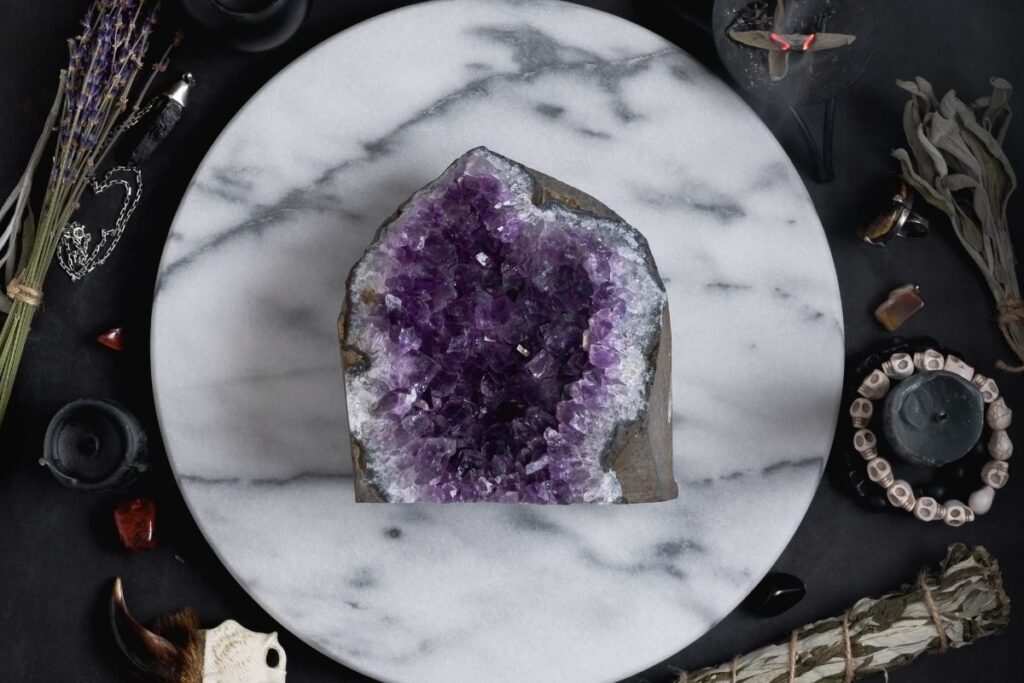
Form matters more than most buyers expect. A raw cluster shows how the mineral grows, with points rising from a rocky base. A geode half, sometimes called a cathedral geode when it stands tall, makes a striking shelf piece. Tumbled stones and palm stones are smooth and easy to carry. Faceted stones are cut for jewelry and show the most brilliance.
Look at color in daylight and in artificial light, since violet can shift toward gray or blue depending on the source. Check the base of a cluster for glue and the tips for chips. Small flaws are normal in natural crystals, so decide what matters to you: depth of color, size, or a pleasing shape. A buyer who asks where the stone was mined and whether it has been treated will learn plenty from the answer.
One last tip: buy from sellers who describe their stones plainly and accept returns. Honest listings name the mineral, the origin when known, and any treatment, and they do not promise outcomes from a crystal.

Frequently Asked Questions
Is amethyst a rock or a gemstone?
Amethyst is a mineral, specifically the purple variety of quartz. It is used as a gemstone when cut and polished, and as a specimen when left in natural crystal form.
Can amethyst go in the sun?
A short time in sun will not ruin it, but long, repeated exposure fades the color, according to Mindat. Moonlight cleansing is the safer choice.
How hard is amethyst?
It rates 7 on the Mohs scale, per GIA. That is harder than a steel knife blade and softer than topaz, sapphire and diamond.
Is amethyst the same as citrine?
Both are quartz, and both owe their color to iron. Heating amethyst can turn it yellow or orange, which is why some commercial citrine is heat-treated amethyst.
Which month is amethyst the birthstone for?
February.
Does amethyst have healing powers?
Healing properties belong to crystal tradition, where amethyst is described as calming and centering. Those are beliefs passed down through custom, and the stone is a lovely spiritual and decorative companion.
Is amethyst safe to put in water?
Plain quartz handles water well, so a quick rinse or damp wipe is fine for most pieces. Avoid soaking glued clusters, because the adhesive holding a base or a cut stone in a setting can weaken over time. Dry the piece with a soft cloth afterward.
Can amethyst be worn every day?
Yes, in most settings. Its hardness handles daily wear, though sunlight, heat and hard knocks are the main risks over many years.
What chakra is amethyst linked with?
Chakra traditions pair it with the crown chakra and, in some systems, the third eye. These are spiritual frameworks, not anatomy.