| ✨Hey there! This post may contain affiliate links, meaning we earn a commission if you make a purchase through our links, at no cost to you. Please read our disclosures for more info. |
Quick answer: rose quartz is the pink, usually cloudy variety of quartz (SiO2, Mohs hardness 7). Mineral research traces its color to microscopic pink fibers inside the crystal. Crystal traditions call it the stone of love and self-compassion. It can fade in strong light, so display it away from sunny windows.
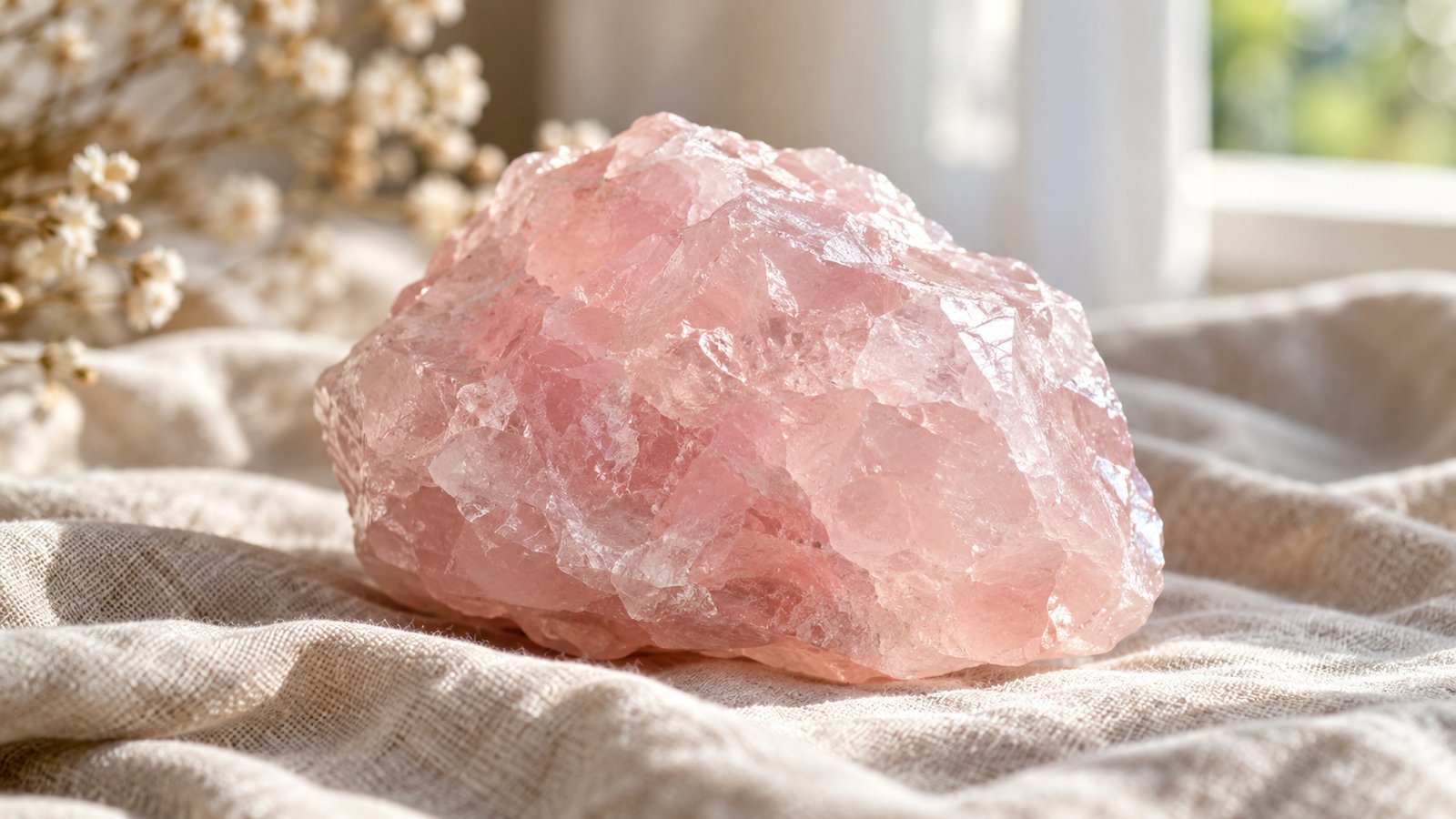
Pick up a piece of rose quartz and the first thing you notice is how soft it looks. The color is a muted blush, the surface is often milky, and the stone reads as gentle even though it is one of the harder minerals sold in crystal shops. That contrast is part of its appeal, and part of why it became the best-known pink stone in the crystal world.
Below, the science comes first: composition, the surprising reason for the color, and where the stone is found. After that comes tradition, with the meanings people attach to it, then care and the ways imitations appear. Spiritual meanings are traditional beliefs held by practitioners, and they are shared here as beliefs.
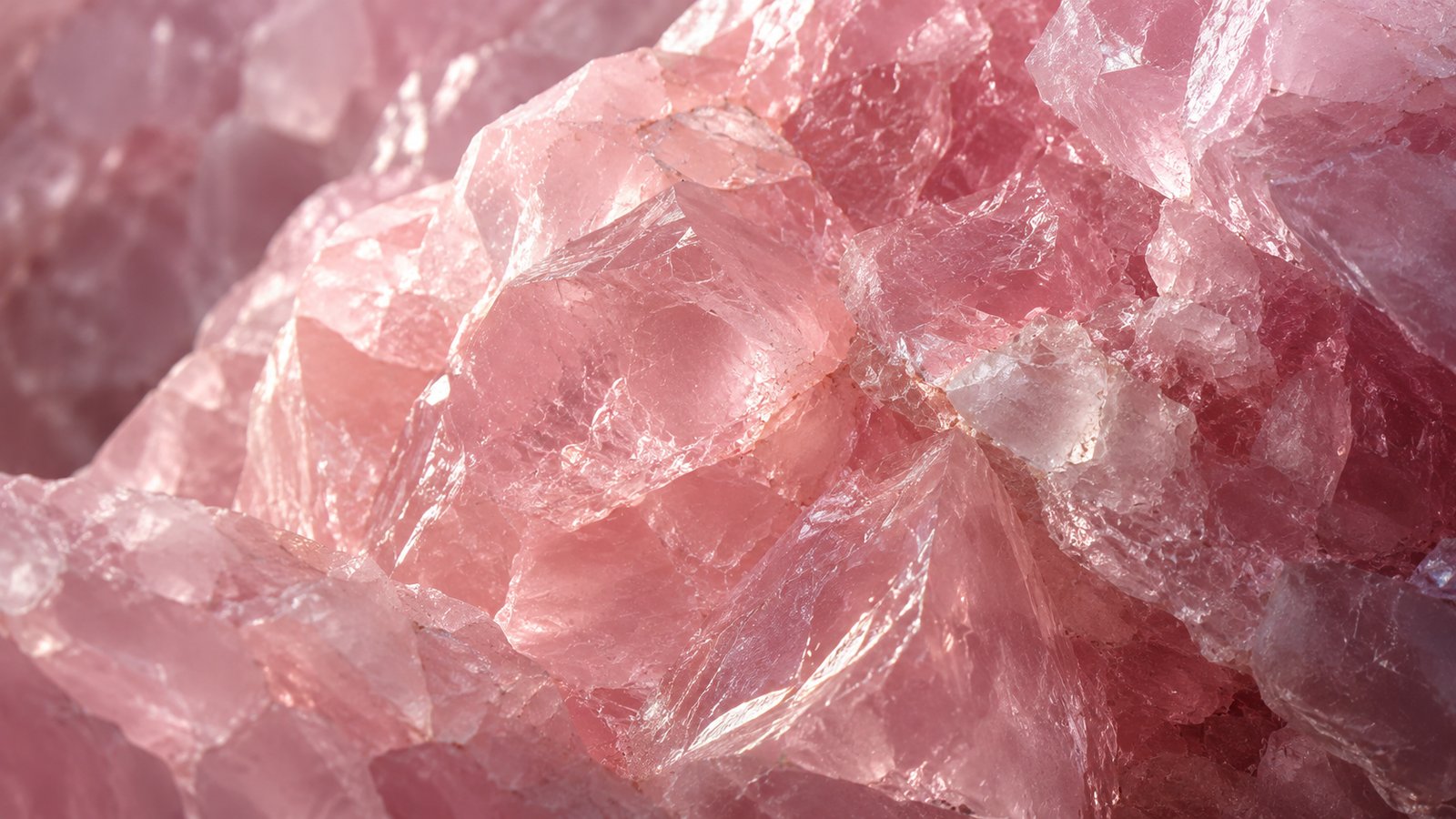
What Rose Quartz Is
Rose quartz belongs to the quartz family, with the formula SiO2, and rates 7 on the Mohs hardness scale. Most pieces appear as massive material, meaning solid chunks without the sharp six-sided points of clear quartz or amethyst. That is why rose quartz in shops is typically sold as tumbled stones, spheres, hearts and carved pieces rather than natural points.
Well-formed rose quartz crystals do exist but are rare. Researchers writing in the American Mineralogist and the International Gemmological Conference describe them as a separate material, sometimes called simply pink quartz, with a color that comes from a different cause and is less stable.
Why Rose Quartz Is Pink
For decades, scientists argued about the cause of the color. Proposed explanations included manganese, titanium and tiny rutile needles. The question was largely settled by work at the California Institute of Technology. Researchers extracted pink nanofibers, about 0.1 to 0.5 micrometers wide, from rose quartz collected at 29 localities around the world. They concluded that these fibers cause the color of massive rose quartz, and that they are related to the mineral dumortierite. The pink arises from a transfer of electrons between iron and titanium atoms inside the fibers, which absorbs light near 500 nanometers.
The same fibers explain the cloudy look. Light scatters as it passes through the quartz, so most rose quartz is translucent rather than glass-clear. Clear, transparent pink quartz that grows in true crystals gets its color from natural irradiation instead, and that color can fade.
Underneath the soft color sits the same crystalline framework as every other quartz: silicon and oxygen atoms linked in a repeating three-dimensional pattern. Mineralogists describe that structure as trigonal, and since it has no center of symmetry, quartz is piezoelectric, which is the property behind quartz watches and electronic oscillators. In rose quartz the pattern is simply hidden inside a cloudy mass instead of a sharp point. Seeing it this way adds another reason to hold the stone with curiosity: a precisely ordered atomic lattice, formed slowly underground, sits in your palm.
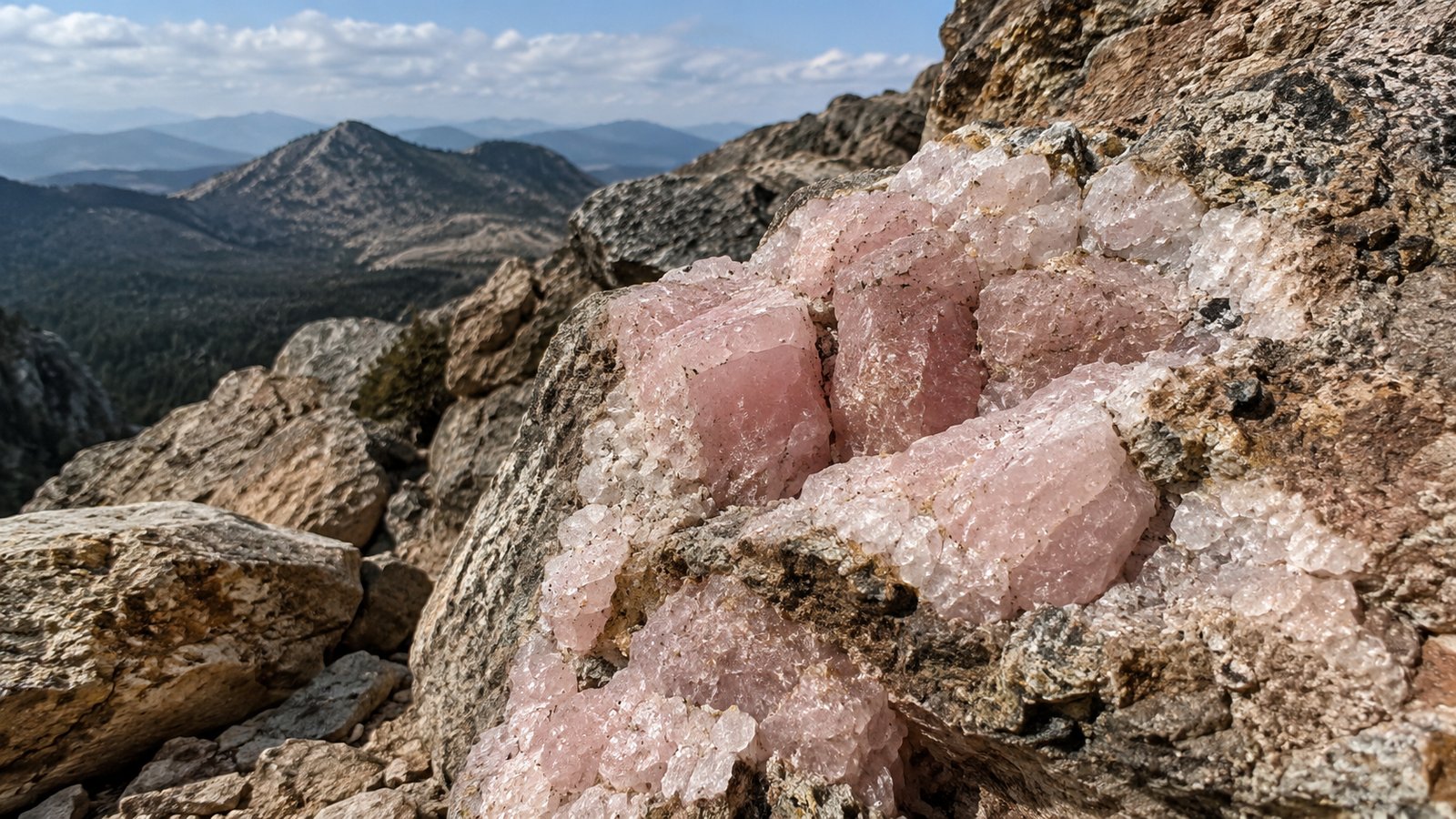
Where Rose Quartz Comes From
Massive rose quartz forms in the cores of granite pegmatites, coarse-grained rocks that crystallize slowly from the last molten fluids of a magma body. The Caltech studies sampled material from California, South Dakota, Brazil, Madagascar and Namibia, and the stone is also mined in other places. Brazil and Madagascar supply a large share of the stone sold in the crystal trade.
South Dakota holds a special place in the story. In South Dakota, rose quartz is the official state mineral, and the Black Hills, famous for pegmatites, have yielded it for generations. A piece from Madagascar may be a deeper pink than a South Dakota piece, but locality does not decide quality. Judge a specimen by color, how translucent it is, and how many cracks cut through it.
Some rose quartz displays a six-rayed star, a feature called asterism, when cut as a smooth dome. The star appears when light reflects from tiny aligned inclusions. Star rose quartz is less common than ordinary material and tends to attract collectors.
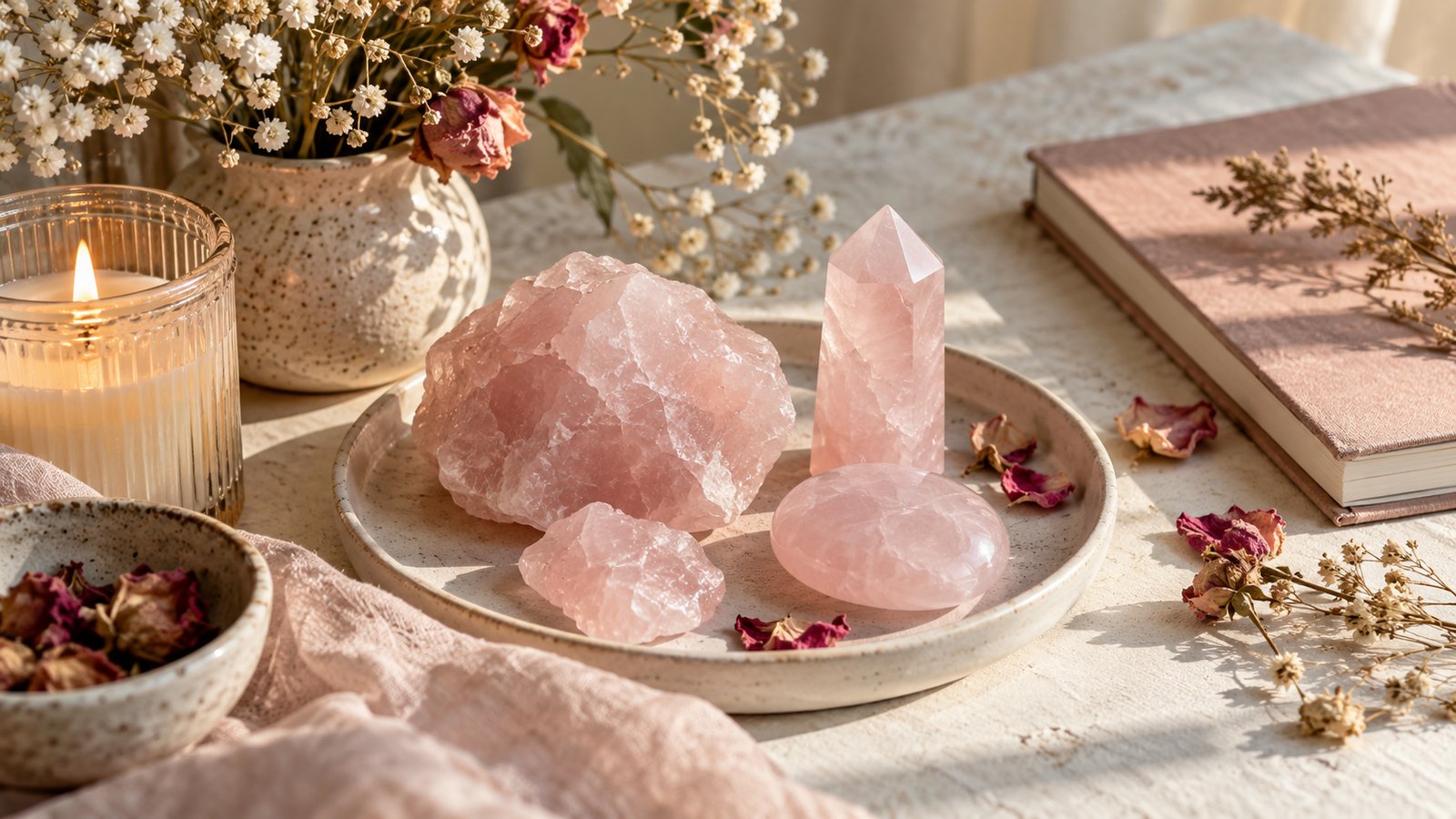
What Rose Quartz Means in Crystal Traditions
Crystal traditions group rose quartz with love, tenderness and emotional openness. These meanings are cultural, passed along through books, teachers and shared practice, rather than anything a laboratory measures.
- Self-love. Many practitioners keep rose quartz near a mirror or journal as a reminder to speak kindly to themselves. Our post on ways to improve your self esteem covers practical habits that pair well with that kind of ritual.
- Romantic and family love. Gifts of rose quartz hearts are common for weddings, anniversaries and Valentine’s Day.
- Friendship and forgiveness. Some traditions use it to symbolize softening a grudge.
- The heart chakra. Chakra systems associate pink and green stones with the center of the chest, a spiritual symbol for compassion. The green crystals guide covers the other stone family linked to that chakra.
Zodiac lists often connect rose quartz with Taurus and Libra, both ruled by Venus in traditional astrology, and you can compare more pairings in the guide to crystals for zodiac signs.
What do people get from it? Practitioners describe rose quartz as a focus object: a concrete reminder to pause, breathe and think about the people and values that matter. For some people that ritual is genuinely comforting, and that is reason enough to enjoy it.

Simple Ways to Work With Rose Quartz
- Morning intention. Hold a palm stone for a minute while you decide how you want to treat yourself and others that day.
- Evening reflection. Keep a piece on the nightstand and think of three kind things from the day.
- Meditation. Rest the stone on your chest while lying down, and focus on slow breathing.
- Home spaces. Place a heart or sphere in a shared room as a calm accent.
- Gifts. A small stone with a handwritten note is thoughtful, and it costs little.
A prompt for habits that already help is where rose quartz works best. Think of the stone as a small, pretty reminder to practice kindness.

Rose Quartz Across Cultures
GIA’s history of rose quartz reports beads dating to about 7000 BCE found in the region once known as Mesopotamia, in modern Iraq, and rose quartz jewelry made by the Assyrians around 800 to 600 BCE. GIA adds that the Romans used rose quartz as seals to mark ownership. The Metropolitan Museum of Art explains that cylinder seals, first used in Mesopotamia, served as marks of ownership or identification, were often cut from precious stones, and may have been believed to carry protective properties through the material itself. A Christie’s auction record describes a Neo-Assyrian rose quartz cylinder seal from the 8th to 7th century BCE, engraved with a deity between winged bulls.
Tradition adds a further layer. GIA records the belief that ancient Egyptians thought rose quartz could prevent aging, a story told in crystal lore that adds to the stone’s long association with beauty and love. Taken together, the documented record shows rose quartz was a valued, worked stone across several ancient societies, and the traditions show why people still reach for it as a symbol of affection.

Rose Quartz in Jewelry and Home Decor
At hardness 7, rose quartz can be worn in pendants, bracelets and earrings without much worry, but rings take more abuse and the stone’s internal cracks make it less suited to a ring worn every day. Beads, cabochons and carved hearts are the most common forms. Faceted rose quartz is available, though cutters must work around the cloudy interior, and the result is more subtle than a faceted amethyst.
At home, rose quartz fits softly into most color schemes. A bowl of tumbled stones on a coffee table, a sphere on a bookshelf or a raw chunk beside a plant all look natural. Bedroom decor is a popular choice, though bright afternoon sun can slowly bleach the color, so a shaded spot is better than a sunny sill. Stone stays cool in the hand, which many people enjoy on a hot day.
Bath and skincare products sometimes include rose quartz rollers and gua sha tools, which people use for facial massage and enjoy for the cool, smooth feel of the stone. A stone roller can crack if dropped, so wash it gently and store it carefully.

Caring for and Cleansing Rose Quartz
Rose quartz is durable, with one important weakness. The color of some material fades with long exposure to sunlight, so avoid leaving it on a bright windowsill for months. Heat can also change the color, so keep it away from stoves, radiators and cars parked in summer sun.
- Cleaning dust: use a soft, slightly damp cloth, then dry it.
- Washing: warm water and a drop of mild soap are fine for polished pieces.
- Avoiding impact: massive rose quartz often has internal fractures, so a drop onto tile can split it.
- Storage: wrap in soft cloth when traveling, away from harder stones such as sapphire.
- Energy cleansing: moonlight, sound, breath or a bowl of clean salt crystals are all common practices, and the how to cleanse crystals guide lists ten methods. Salt water can leave residue in cracks, so for rose quartz a dry method is the more careful option.

How to Spot Fake or Misrepresented Rose Quartz
Real rose quartz is inexpensive, which keeps outright fraud rare. The common problems are glass, dye and plastic.
- Glass: it can be too clear, too bright and too perfect. Real rose quartz is usually cloudy, with veils and mild color variation, though a very clear pink gem may be natural quartz of the rarer type.
- Dyed quartz: a stone with deep pink color concentrated in cracks and a paler interior has probably been dyed. Pink dye that rubs off on a damp cloth is another sign.
- Resin or plastic: these feel lighter and warmer in the hand than stone and can show tool marks or air bubbles.
- Pink minerals sold as rose quartz: rhodonite, pink opal, pink calcite and thulite can look similar. Calcite is much softer, with a Mohs hardness of 3.
- Treated stones: if a listing sells “rose quartz” at a price far below similar pieces, ask what it is.
A simple home check is to look at the stone against light. Real rose quartz usually shows a hazy, even glow. If a stone looks neon or has pink color pooled along fractures, be skeptical. For high-value jewelry, a gemological report from a lab such as GIA is the dependable answer. Hold any questionable stone up to a window and look closely at the edges, where pooled dye or glue lines show up.
Buying Tips
Buy from sellers who name the mineral and, when they can, the source country. Ask about dyeing, and avoid listings that promise cures. Prices for tumbled stones and small hearts are usually low, so a very high price should come with an explanation such as a large size, a star effect or a natural crystal form.
Rose Quartz Compared With Other Pink Stones
Pink minerals share a color, not a chemistry, and comparing hardness is one of the quickest ways to tell them apart in a catalog. Rhodochrosite, a manganese carbonate with banded pink and white patterns, rates only 3.5 to 4 on the Mohs scale and is easy to scratch. Rhodonite, a manganese silicate, ranges from 5.5 to 6.5 and usually carries black veins. Morganite, the pink variety of beryl, is a gem at 7.5 to 8 and far more expensive than any quartz. Kunzite, a pink-to-lilac spodumene, sits at 6.5 to 7 and is known for fading in light.
Each stone has its own traditions, so a seller who swaps one name for another is not just inaccurate. Someone who wants a particular meaning from a particular stone deserves the right mineral. Ask for the name of the mineral, not only the color.

Frequently Asked Questions
Is rose quartz a real crystal?
Rose quartz is a real mineral, but most pieces are massive rather than crystals with visible points. Natural crystals with faces do occur and are rare.
Why does rose quartz fade?
Some pink quartz owes its color to unstable color centers, and long exposure to light can bleach it. Keep treasured pieces out of constant sun.
Can rose quartz go in water?
Water does not harm quartz, so a rinse is fine. Dry it afterward, and avoid soaking carved or glued pieces.
Is rose quartz the same as pink quartz?
Researchers use the terms differently. The name usually means massive, cloudy material colored by dumortierite-related fibers. Pink quartz usually means rare, clearer crystals.
What is rose quartz the birthstone for?
Rose quartz is not part of the standard modern birthstone list. Some alternative lists give it for January or other months, so check which tradition a source follows.
Does rose quartz attract love?
That is a belief within crystal traditions, where rose quartz is the classic love stone. Treat it as a symbol and a ritual.
How hard is rose quartz?
It measures 7 on the Mohs scale, the same as other quartz, which makes it suitable for most jewelry with sensible care.
Which stones pair well with rose quartz?
People often combine it with clear quartz for amplifying intentions, or with green stones for the heart chakra. These pairings are a matter of personal taste.