| ✨Hey there! This post may contain affiliate links, meaning we earn a commission if you make a purchase through our links, at no cost to you. Please read our disclosures for more info. |
Quick answer: fluorite is calcium fluoride (CaF2), a glassy mineral that comes in nearly every color and is the reference mineral for Mohs hardness 4. It splits cleanly into eight-sided pieces and often glows under ultraviolet light, a property that gave us the word fluorescence. Crystal traditions link it with focus and mental clarity. It scratches easily, so it needs gentle care, and glass is the most common fake.
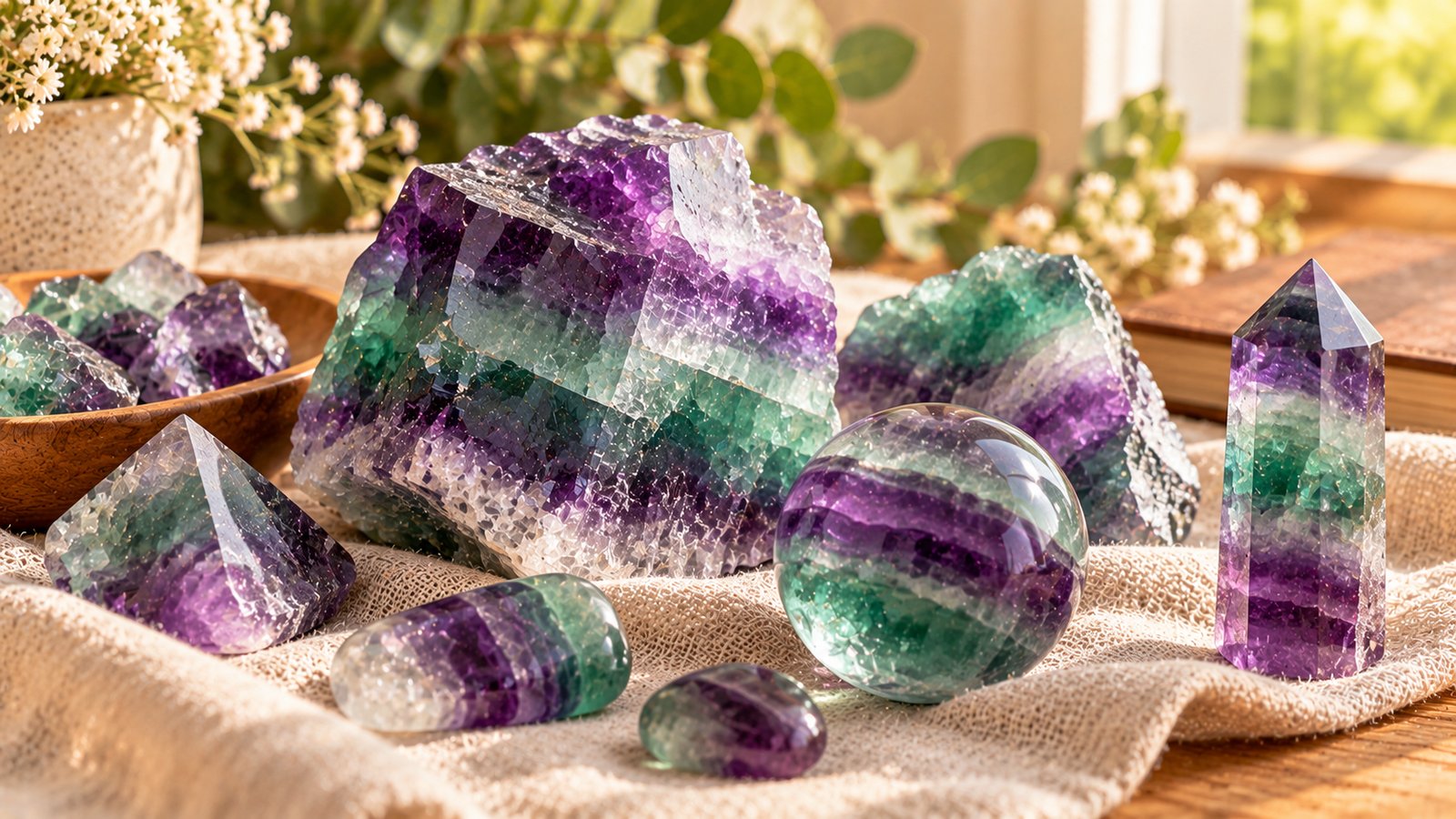
Few stones feel as playful as fluorite. One piece can hold purple, green, blue and clear bands side by side, like a slice of a sunrise that someone froze in glass. Cubes and octahedrons, with their flat, mirror-bright faces, look almost designed, and collectors love how natural crystals can resemble cut gems. That variety is what pulls people toward fluorite when they first see it in a shop window.
Behind the colors is a mineral with a long scientific record. The mineral gave its name to one of the most important concepts in physics, it supplies industry with fluorine compounds and its softness explains nearly every care instruction. This guide keeps science and tradition in separate sections, as in the rest of this series. The crystal meanings guide places it in the full set of stones covered on this site.
What Fluorite Is
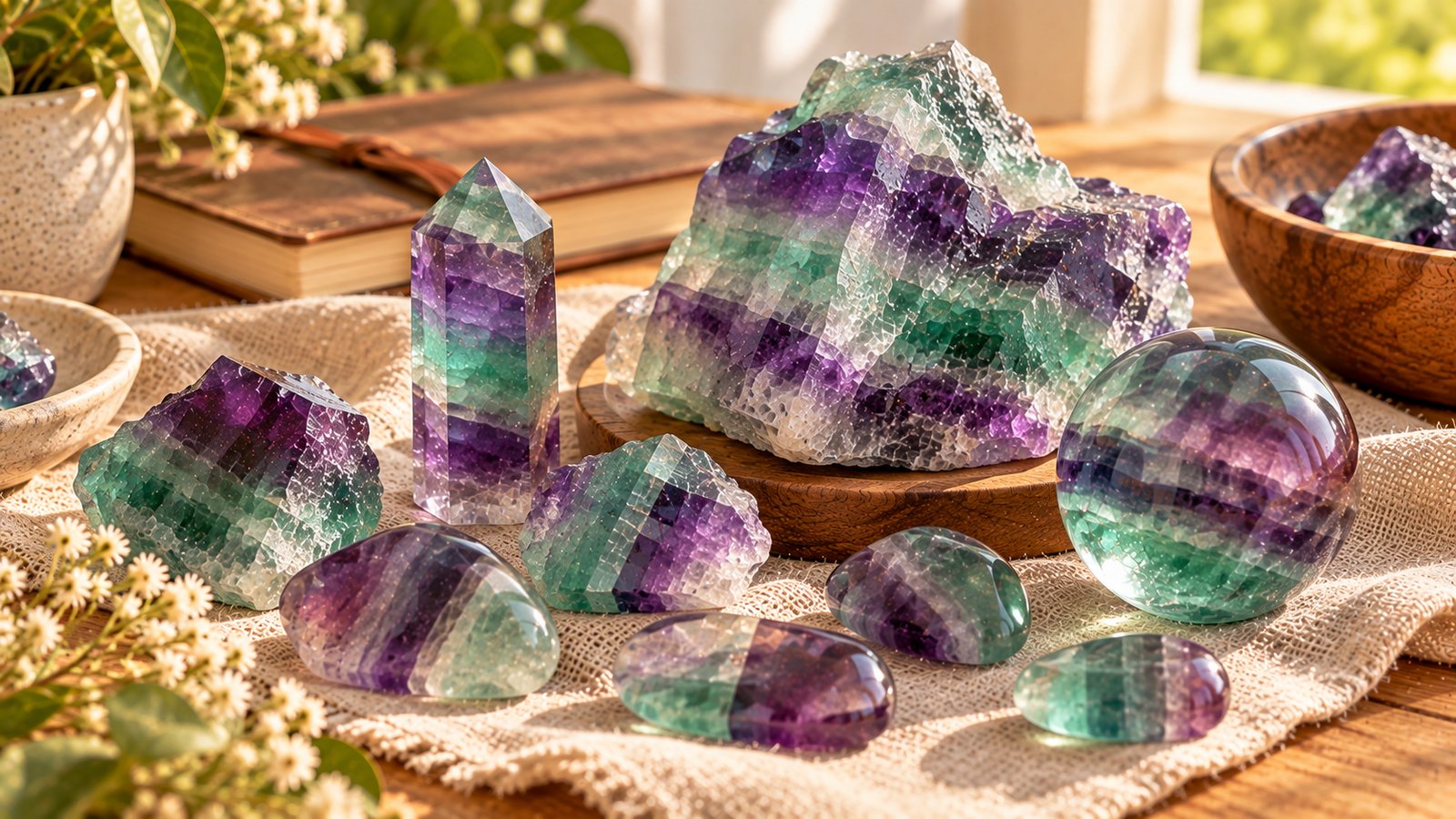
Chemically, fluorite is calcium fluoride, CaF2, a halide mineral, not a silicate, which makes it chemically different from quartz and most other popular crystals. Mineralogical references list a Mohs hardness of 4, and fluorite is the standard mineral for that point on the scale. That means a steel knife blade scratches it easily, and household dust containing quartz grit can leave fine scratches over time.
The second major feature is cleavage. Perfect cleavage in four directions means the crystal breaks along flat planes into pieces shaped like eight-sided octahedrons. Handbooks of mineralogy list this cleavage as a defining property. Natural crystals often grow as cubes, and many collectors keep both cube-shaped specimens and the octahedral fragments that result from breaking larger ones.
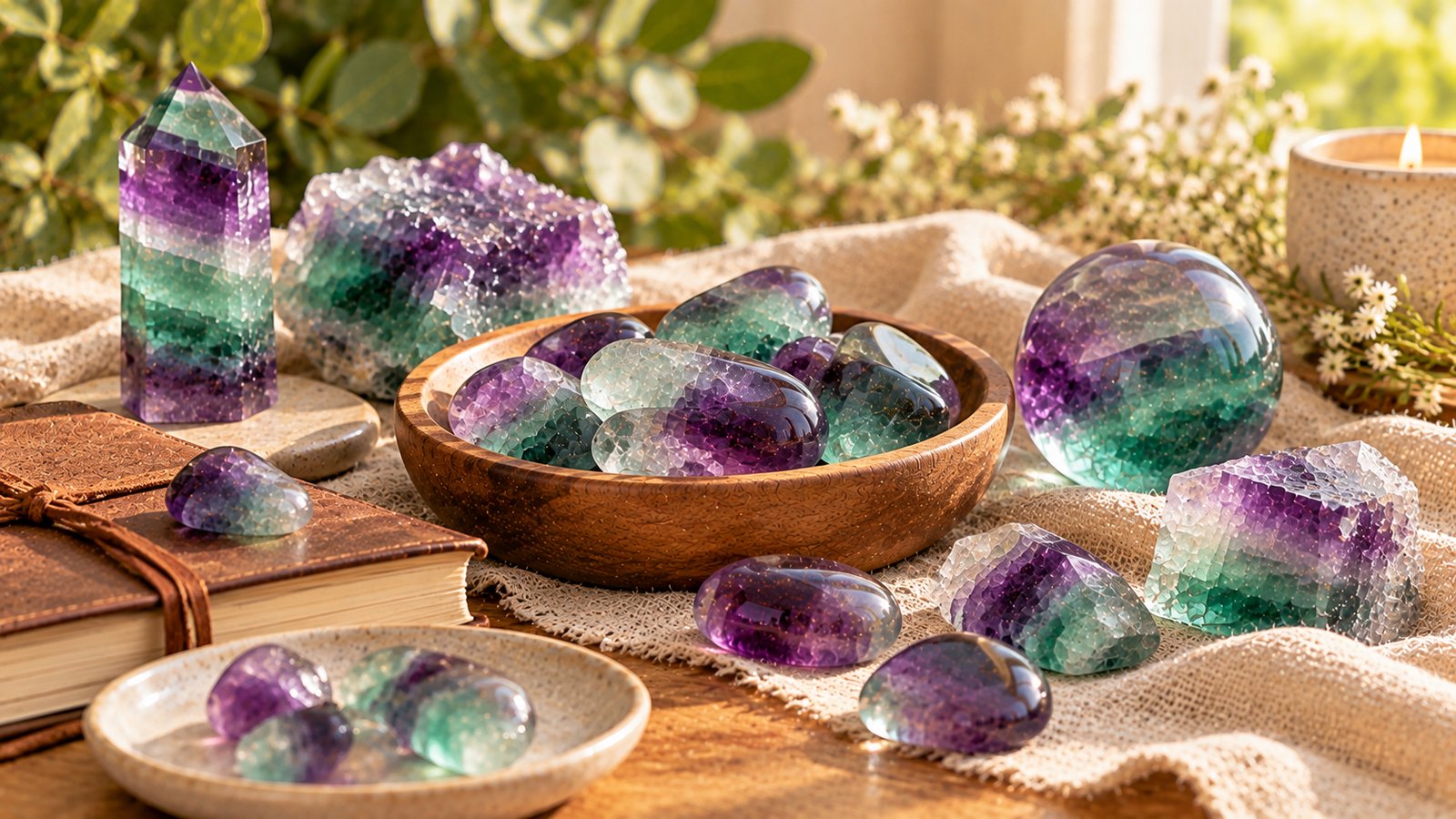
Crystals are usually transparent to translucent with a glassy luster. Pure fluorite is colorless, and the colors that make it famous come from trace impurities and from structural defects created by natural radiation. Purple, green, blue, yellow, pink and colorless crystals are all common, and bands of different colors reflect changes in the water that fed the growing crystal over time.
Fluorescence
The mineral is also the namesake of fluorescence. Mineral references explain that the term was coined by the physicist George Gabriel Stokes in 1852, after he observed that fluorite glowed in ultraviolet light. Many specimens show a violet or blue glow under a UV lamp, though color and strength depend on the locality and on trace elements in the crystal. A simple UV flashlight reveals this property, and many mineral museums feature fluorescent displays.
Why Fluorite Has So Many Colors
Pure calcium fluoride is colorless, so every tint has a cause. Trace amounts of rare earth elements, natural radiation damage to the crystal lattice and tiny vacancies where atoms are missing all create color centers, the same general mechanism that gives smoky quartz and amethyst their colors. Because conditions changed during growth, a single crystal may record several episodes in its bands. A purple zone, a green zone and a clear zone can be a record of the water chemistry around the crystal as it grew over thousands of years.
That growth history also explains why color is not a good way to tell different fluorites apart. Two pieces with the same shade may have formed under quite different conditions, and mineral collectors usually label them by locality rather than color alone.
Where Fluorite Comes From
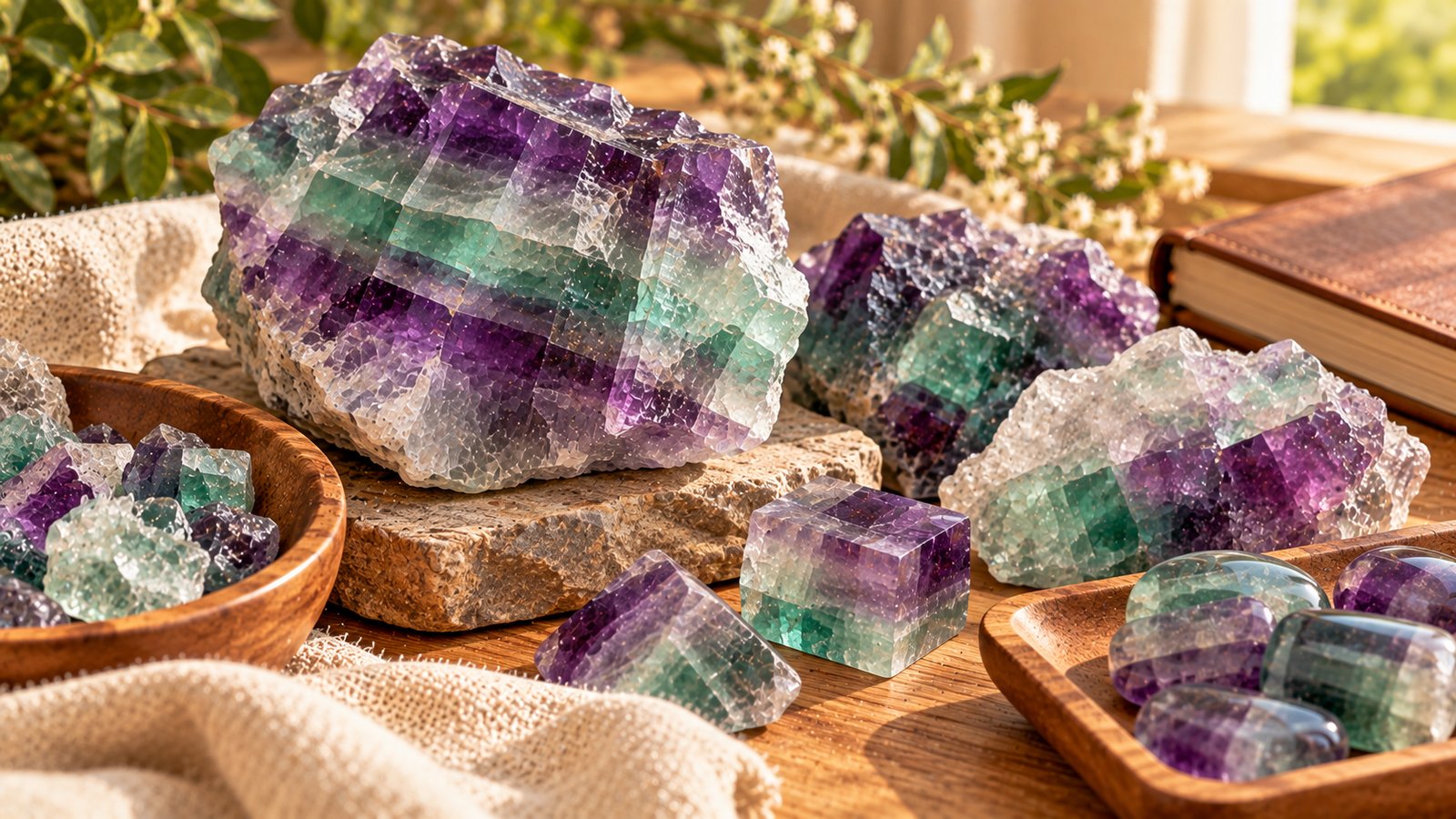
In nature, fluorite forms in veins where hot, mineral-rich water moves through rock, and it often grows alongside quartz, calcite and metal ores. Deposits occur across the world, with important sources in China, Mexico, Germany, Namibia and the United States, along with England and many other countries.
In the United States, Illinois designated fluorite as its state mineral in 1965, and the southern part of the state, around Rosiclare and Cave-in-Rock, was a major fluorspar mining district.
England’s Derbyshire is home to a unique banded variety called Blue John, found at Castleton. The stone is purple-blue and yellow with dramatic bands, quarried for ornaments, vases and jewelry since the eighteenth century. The deposit is limited, and it is mined in small quantities today, which is why genuine Blue John items are valued by collectors.
In the industrial world, fluorspar, the commercial name for fluorite, supplies the fluorine used in many chemicals and has long been used as a flux in metal smelting. Georgius Agricola, the sixteenth-century German mineralogist, described the use of fluor minerals to help metals melt, and the name fluorite derives from the Latin word fluere, to flow.
Fluorite in Historical Records
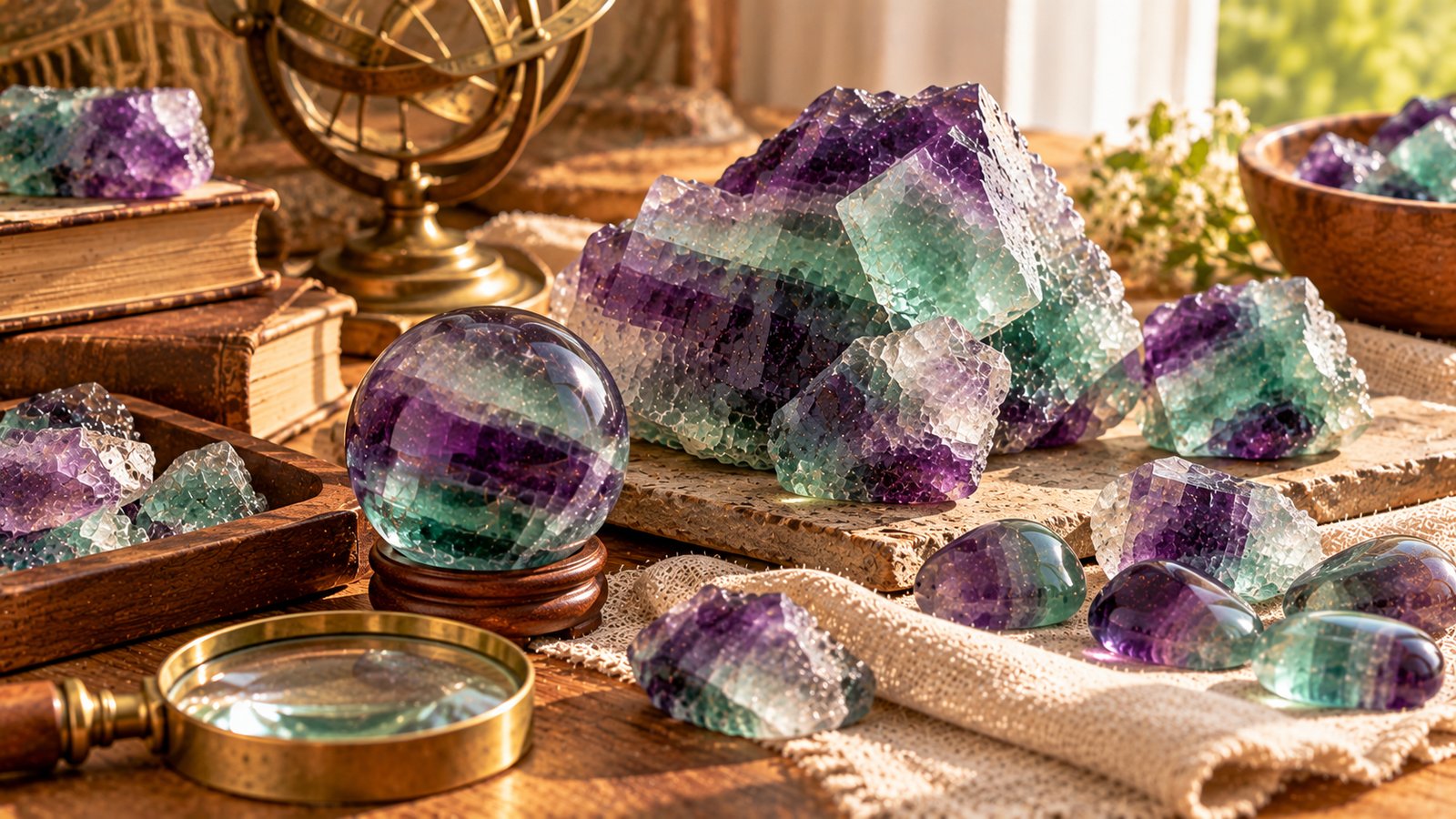
The first appearance of fluorite in written history comes from metallurgy rather than jewelry. Agricola’s writings describe stones that made smelting easier because they made slag flow, and later chemists realized that the same material was calcium fluoride. The word fluorine for the element, discovered later, came from the same root.
Carvers have worked the stone for centuries. Blue John vases and urns became fashionable decorations in eighteenth-century England, and large pieces can still be seen in country houses and museums. Carvers had to work carefully, often filling cracks with resin, because the stone’s cleavage makes it fragile.
Scientific history gave fluorite another claim to fame. Stokes’ study of its glow in the 1850s helped establish how some materials absorb one kind of light and emit another. Today, fluorescence is used in everything from medical imaging to security inks. Most of those applications use other materials, but the word began with this mineral.
Some websites claim that ancient Romans prized fluorite vessels known as murrhine cups. Scholars have debated what material murrhine was, and fluorite is only one proposal, so treat any definite claim with caution.
What Fluorite Means in Crystal Traditions
The ideas below are modern crystal traditions, not science and not medicine.
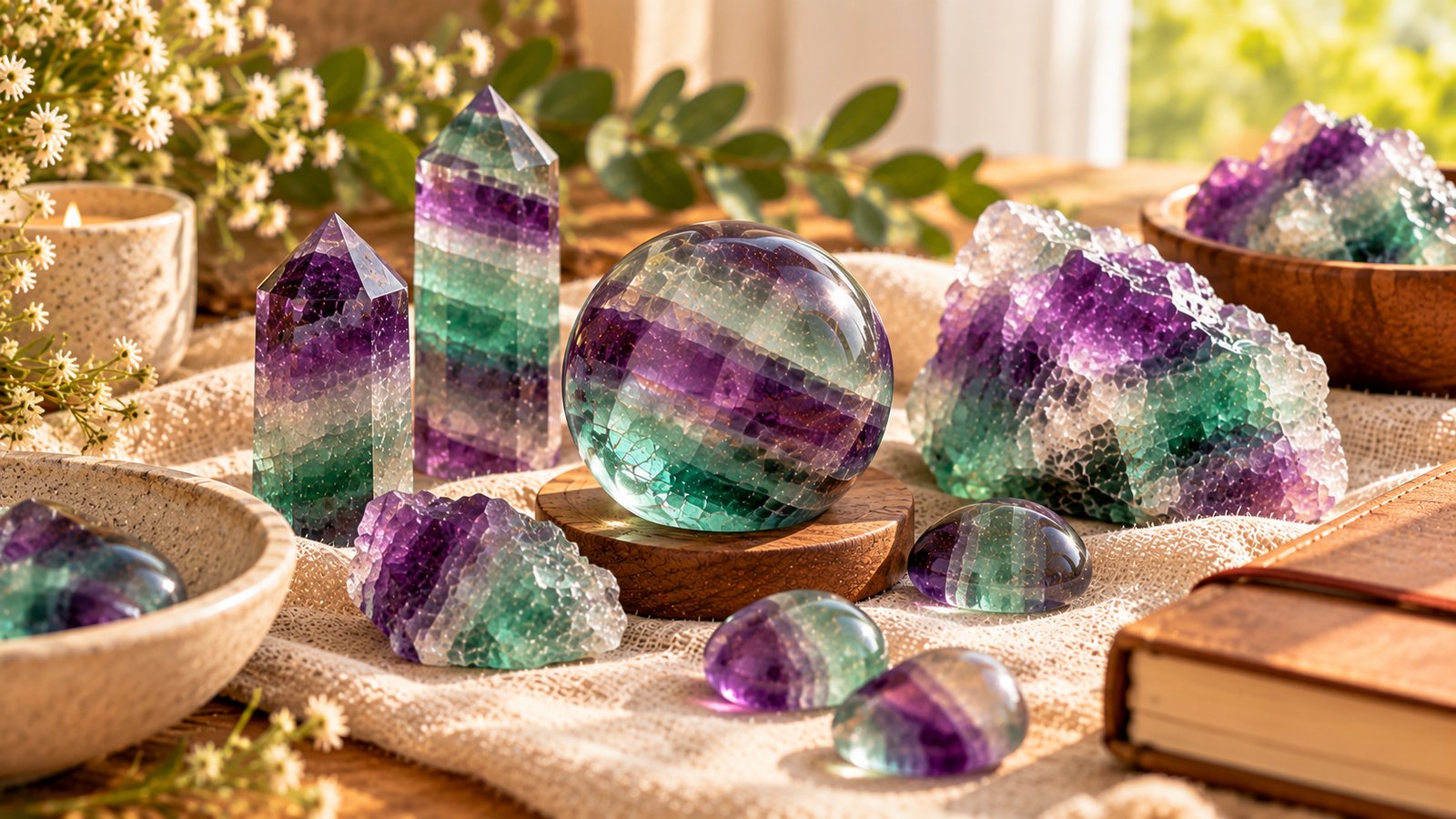
- Focus and mental clarity. Fluorite is often called the “genius stone” in crystal circles and is linked with study, organization and clear thinking.
- Order from chaos. The neat geometric crystal shapes lead people to link fluorite with structure and tidy habits.
- Creative balance. Rainbow fluorite’s bands are used as a visual metaphor for holding many ideas at once.
- Protection from distraction. Some practitioners keep a piece near a computer, though no stone blocks electronic devices or their effects.
- Emotional steadiness. Green and blue varieties are often chosen for calm.
No stone cures disease or treats attention problems, and this guide makes no such claim. If you struggle with focus, speak with a professional rather than relying on a stone.
Simple Ways to Work With Fluorite
Because the stone is linked with study and order, a “desk reset” fits it well.
- Clear the surface of your desk and keep only what you need for the next task.
- Place a fluorite cube or octahedron at the edge of your workspace where you can see it.
- Write the three tasks that matter most today, in order.
- Hold the fluorite for one slow breath, look at its colors and begin the first task.
- When you finish all three, put the stone back on the shelf as a signal that the session is over.
As a display piece, it looks beautiful on a window shelf with indirect light. For a calming group, try pairing it with selenite or clear quartz, and see the selenite guide for a sturdier companion stone.

Caring for Fluorite
Softness is the central fact of fluorite care. With a Mohs hardness of 4 and four directions of cleavage, it chips and cracks more easily than quartz.
- Handle crystals gently and avoid dropping them. A fall onto a hard floor can split a crystal along its cleavage planes.
- Wipe with a dry or slightly damp soft cloth. Skip scrubbing and abrasive cleaners.
- Avoid ultrasonic and steam cleaners, hot water and sudden temperature changes, which can crack it.
- Keep it away from acids and harsh chemicals, which can etch the surface.
- Store each piece in its own soft pouch or on a padded shelf. Harder stones, including quartz, will scratch it.
- Keep colored pieces out of strong, long sunlight. Some fluorite colors can fade with heat and light exposure, so a shaded shelf is a better choice.
A short rinse is tolerated, but long soaks are unnecessary and may harm polished or fractured pieces. The guide to crystals that cannot go in water explains how to decide for each stone. For cleansing, sound, smoke and moonlight are gentle choices, and the full list is in how to cleanse crystals.
A practical note on safety: do not grind, burn or heat fluorite at home. Fluorite contains fluorine, and grinding or heating any mineral specimen makes dust or fumes you should not breathe. Keep it to display and gentle handling.

How to Spot Fake or Misrepresented Fluorite
Because the mineral is common and inexpensive, the usual problem is glass.
- Colored glass. Molded glass in rainbow colors is often sold as fluorite, sometimes under names like “candy fluorite” or “lab fluorite.” Glass often shows tiny round bubbles and swirl marks. Genuine fluorite shows flat cleavage surfaces and often tiny angular fractures inside.
- Dyed quartz. Quartz is harder, with Mohs 7, and does not cleave. Dye may collect in cracks.
- Plastic or resin. Light, warm and easy to dent.
- Reconstructed or glued pieces. Some slices are glued into shapes. Look for seams, a different feel at joints and filler in cracks.
- Overly perfect carvings. Large, flawless, bright carved pieces at low prices are often glass or heavily treated material.
Natural fluorite shows a cleavage triangle pattern. Look closely at a broken or rough surface, and you may see flat, triangular steps. Natural pieces also tend to show internal bands that follow crystal growth, with sharp boundaries between colors. A UV flashlight can give a hint, since many natural pieces glow, though some glasses glow too, so UV light does not prove anything on its own.
You can compare hardness carefully by scratching an inconspicuous spot on a loose, cheap piece. A steel nail scratches fluorite, while quartz resists it. Do not test any piece you want to return, and do not test jewelry.
Display Ideas That Protect the Stone
Because fluorite is fragile, display decisions matter. A shallow wooden tray lined with felt keeps cubes from rolling off a shelf, and a small acrylic stand supports an octahedron without stress on its edges. Group several colors together in a shaded cabinet and you get the rainbow look without sun damage. Rotate pieces occasionally to check for new chips or cracks, and photograph valuable pieces so you have a record of their condition.
Buying Tips
Ask whether a stone is natural fluorite, and ask about the locality. Reputable mineral dealers list the mine or country. Be skeptical of listings promising a fixed “healing grade,” and compare prices with typical tumbled pieces. Prices are modest, so the price differences usually reflect crystal size, clarity and color rather than rarity.

Frequently Asked Questions
Is fluorite a real crystal?
Yes. Yes. Natural crystals, often cubes or octahedrons, make it a well-known collector’s mineral.
What is rainbow fluorite?
The name covers fluorite that shows bands of purple, green, blue and clear in one piece, caused by changes in chemistry as the crystal grew.
Can fluorite go in water?
A quick rinse is fine, but skip soaking and gem water. Dry it right away.
Does fluorite glow?
Many specimens fluoresce under UV light, and the word fluorescence came from this mineral, though not every piece glows.
Why does fluorite break so easily?
Perfect cleavage in four directions means a sharp knock can split it along flat planes. Handle it gently.
What is Blue John?
A banded, purple-blue and yellow fluorite found at Castleton in Derbyshire, England, and treasured for ornaments.
Is fluorite safe to keep at home?
Solid pieces are fine for display and handling. Avoid grinding, heating or putting powdered stone anywhere near food or drink, and wash your hands after handling rough specimens from a mine.