| ✨Hey there! This post may contain affiliate links, meaning we earn a commission if you make a purchase through our links, at no cost to you. Please read our disclosures for more info. |
Quick answer: garnet is not one mineral but a group of related silicate minerals that come in almost every color, with the deep red types the most familiar. GIA gives the group a Mohs hardness of 6.5 to 7.5 and names garnet as the January birthstone. Traditions link garnet with commitment, energy and protection on journeys. Common fakes are red glass, plastic and glued doublets.
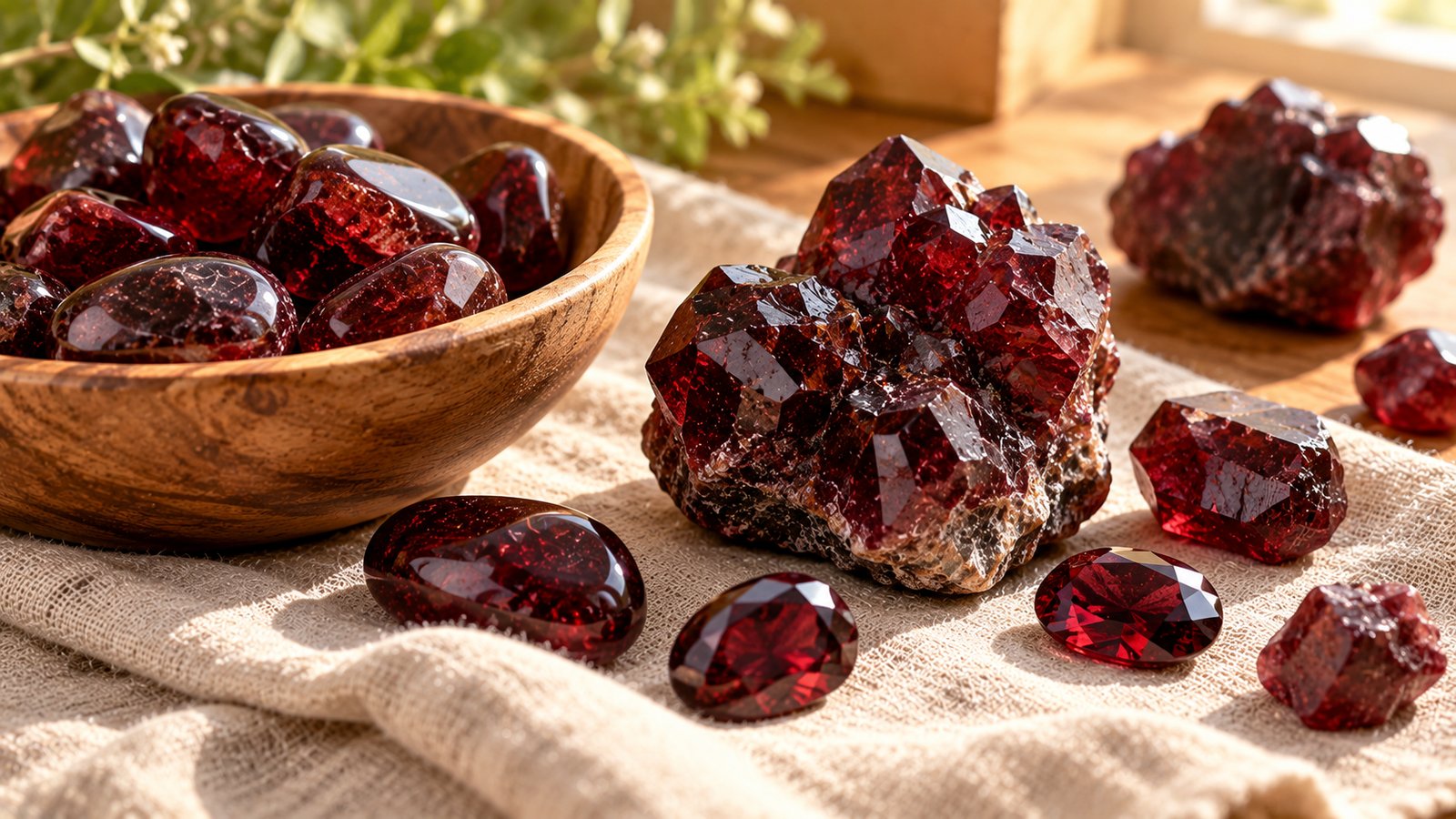
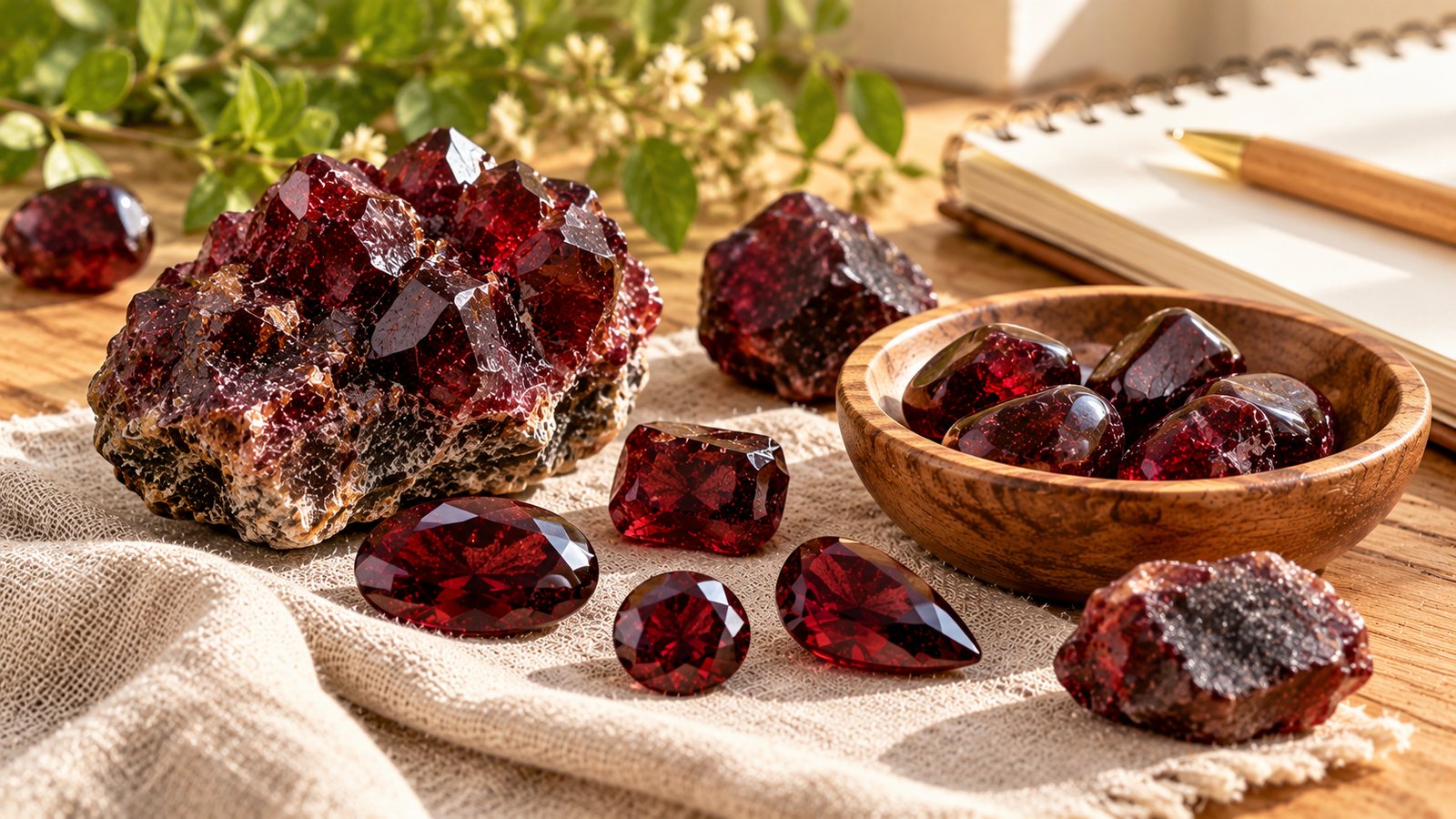
Open a drawer of old family jewelry and there is a good chance something in it is set with small, dark red stones that glow like pomegranate seeds. Those are garnets, and their steady, glowing red is the reason the stone has traveled with people for more than five thousand years. That glow is also the reason so many people want a piece of it in January, the month it represents.
What most buyers do not realize is that garnet is a whole family. Some garnets are red, but others are orange, pink, purple, bright green or even a rare color-changing blue. Below, you will find the family explained, the documented history, the traditional meanings labeled as tradition and plain advice for care and for spotting fakes. For the bigger picture of this site’s stone series, see the crystal meanings guide.
Contents
hide
What Garnet Is
The Gemological Institute of America (GIA) describes garnets as a set of closely related minerals forming a group, with gemstones in almost every color. All share a similar crystal structure but differ in chemistry. GIA lists the main species and formulas:
- Almandine, Fe3Al2(SiO4)3, the common deep red to purplish red garnet.
- Pyrope, Mg3Al2(SiO4)3, red and often very clean, with a classic cherry tone.
- Spessartine, Mn3Al2(SiO4)3, bright orange.
- Grossular, Ca3Al2(SiO4)3, which includes the green tsavorite and brownish-orange hessonite.
- Andradite, Ca3Fe2(SiO4)3, which includes the rare, highly dispersive green demantoid.
- Rhodolite, a pinkish red to purple blend of pyrope and almandine, (Mg,Fe)3Al2(SiO4)3.
GIA’s facts for the group include a Mohs hardness of 6.5 to 7.5, a specific gravity of 3.47 to 4.15 and a refractive index of 1.714 to 1.888. The group is singly refractive, which means it does not show the double image that many other gems display. The point matters when we get to identifying glass.
Hardness varies among species. Almandine and pyrope sit near 7 to 7.5, which makes them good for rings, while some of the softer varieties are better in earrings and pendants.
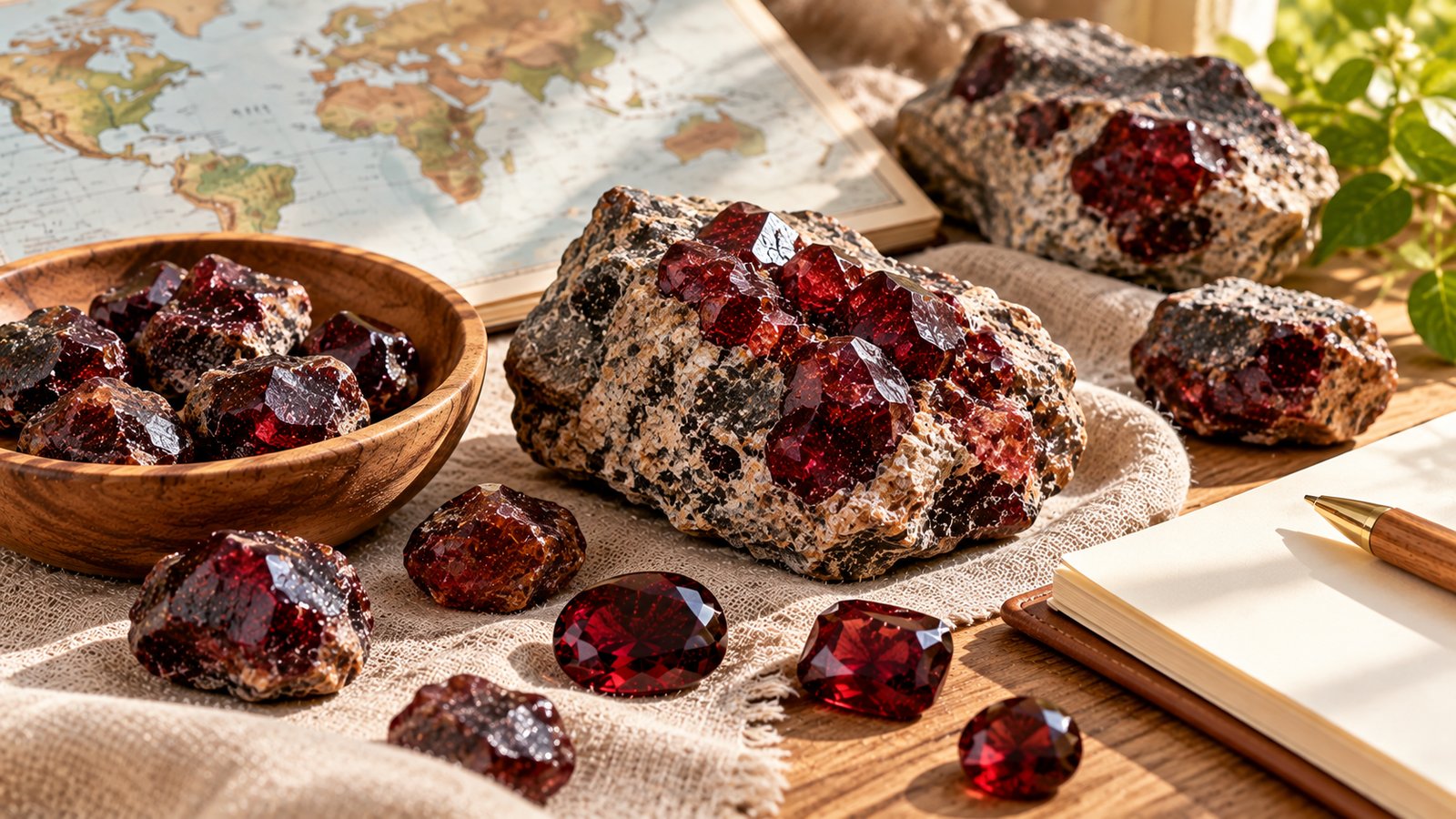
Crystal shape is distinctive. Crystals typically form 12-sided dodecahedrons or 24-sided trapezohedrons, and they look like small, rounded balls embedded in rock. A rock studded with these is called a garnet schist, and you may see it in mineral shops as a matrix specimen.
Color in garnet comes from the chemistry of the species. Iron gives the dark red of almandine, manganese gives the orange of spessartine, and trace chromium gives the green of demantoid, and chromium or vanadium gives tsavorite its color.
Rare and Unusual Garnets
A few garnets surprise even experienced collectors. GIA’s overview mentions garnets in greens, oranges, pinkish oranges, deep purplish reds and even some blues, and notes that blue garnet is among the rarest. Some garnets also show a color change, appearing one shade in daylight and another under warm indoor light. Others contain needle-like inclusions that create a four-rayed or six-rayed star when cut as a cabochon, and star garnet is the state gem of Idaho. These unusual types are collector stones, and they cost far more than the red garnets in a typical ring.
Because these rare stones are so valuable, they are also where most mislabeling happens. A seller who calls a pale green stone tsavorite should be able to name the species, show a lab report and explain the origin. Without those answers, treat the claim with caution.
Where Garnet Comes From
Geologists find garnet forming in many settings, most often in rocks that were changed by heat and pressure, such as schist and gneiss. Because the group is so large, sources are everywhere. Modern gem garnets come from places including India, Sri Lanka, Madagascar, Tanzania, Mozambique, Kenya, the United States, Brazil and Vietnam. A 2025 report in Gems and Gemology, cited on GIA’s garnet page, describes new red garnet production from northern Vietnam, which shows the supply is still changing.
Tsavorite takes its name from Tsavo National Park in Kenya, where GIA notes that Campbell Bridges mined the green garnet. Demantoid became famous through the work of the Russian jeweler Peter Carl Fabergé, whose intricate designs used it, according to GIA.
Industry uses garnet too. Because its grains are hard and break into sharp pieces, crushed garnet is used in sandpaper and abrasive blasting and in water-jet cutting, which is why the same mineral family that makes jewelry also shows up in hardware stores.
Garnet in History
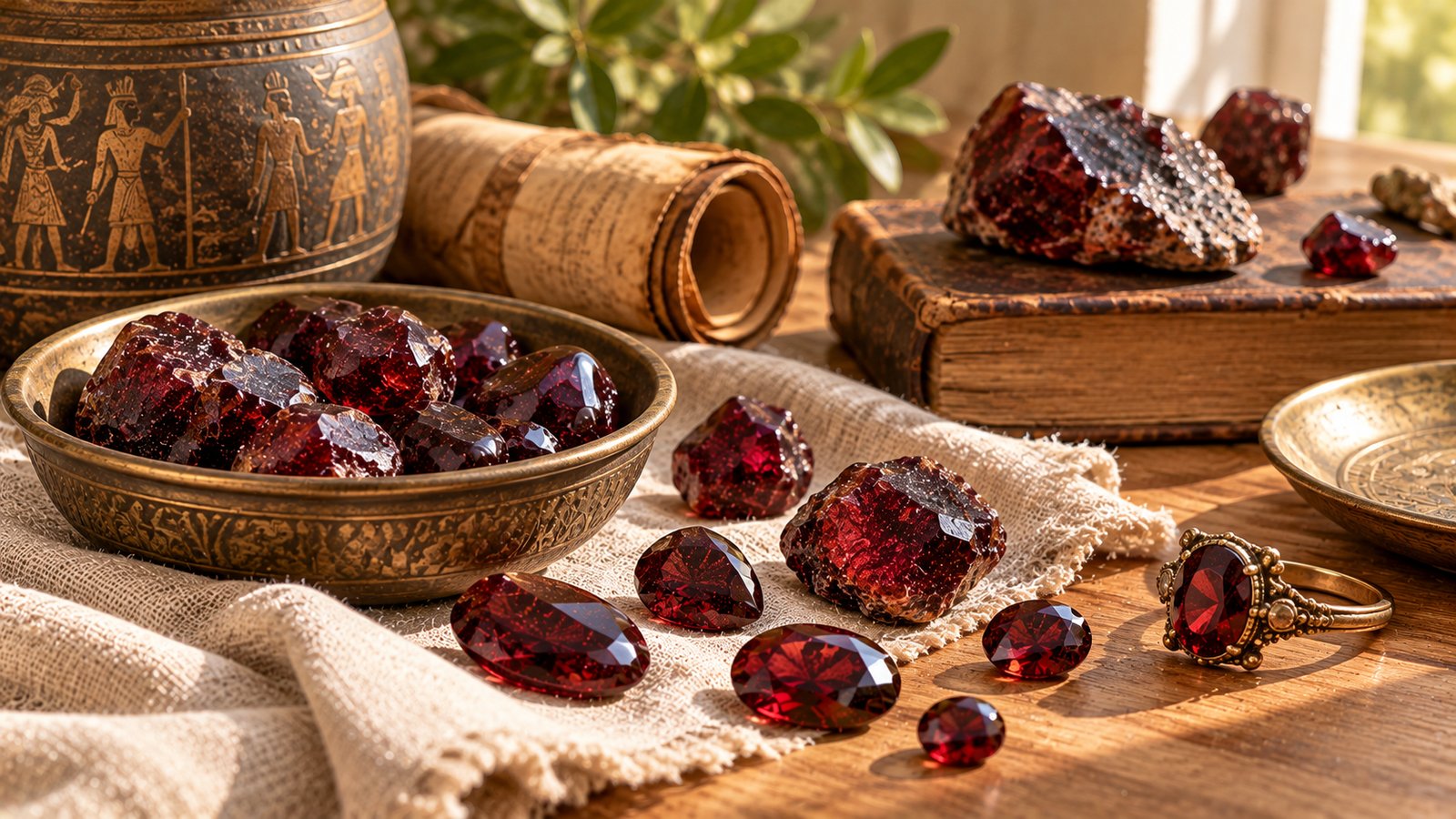
GIA highlights a red garnet bead necklace found in a grave in Egypt, dated to about 3800 BCE, which makes it more than 5,000 years old. Beads and inlays appear across the ancient world, in Egypt, in Mesopotamia and in the Mediterranean, and Roman signet rings often carried carved garnets.
Early medieval Europe made dazzling use of the stone. Anglo-Saxon and other early medieval metalworkers set thin slices of red garnet over patterned gold foil in a style called cloisonne, and museum researchers have traced the garnets in some famous hoards to sources as far away as India and Sri Lanka. The Sutton Hoo burial in England is the best-known example, and the British Museum displays garnet-set pieces from it.
The Victorian era loved Bohemian garnet, small dark red pyropes from what is now the Czech Republic, set in tight clusters that resemble pomegranate seeds. The name itself is widely traced to the Latin word for pomegranate, and in many languages the words for garnet and for the fruit are related. The visual link is part of the stone’s charm.
A famous folk story says that garnets lit Noah’s ark with their glow, a tale found in medieval lapidary books. The tale is a legend, not evidence, and it is shared here as folklore.
What Garnet Means in Crystal Traditions
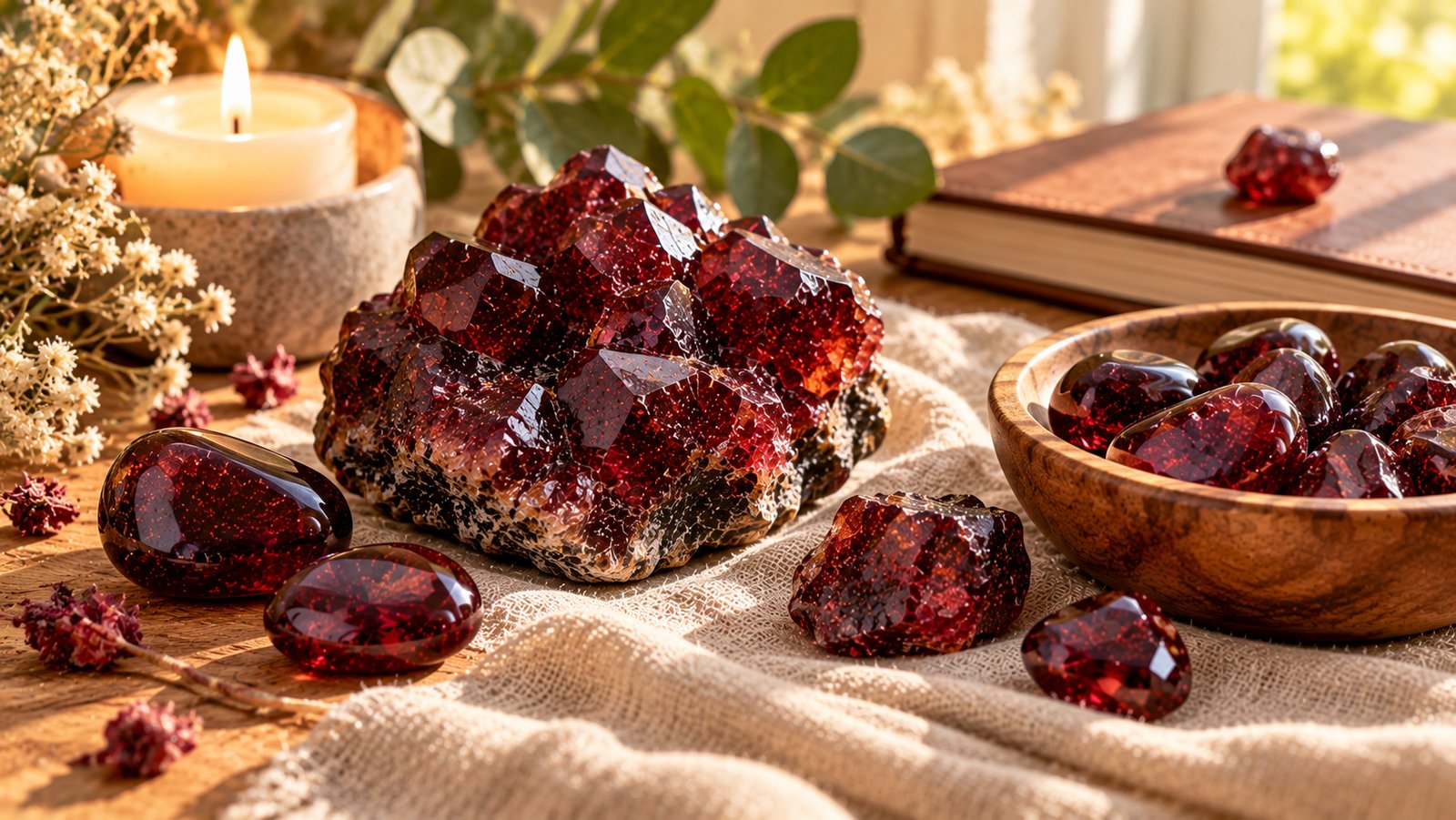
These meanings come from tradition and modern crystal practice, and none of them is medical.
- Commitment and devotion. Red garnet has been given as a token of love and friendship, and it is the stone for the second wedding anniversary according to GIA.
- Energy and drive. The deep red links garnet with courage and vitality in modern crystal lists.
- Protection on journeys. Folklore described garnet as a traveler’s talisman, and old travel stories often mention red stones as guardians.
- Grounding. Some practitioners associate red garnet with the root chakra, a modern system rather than an ancient one.
- Creativity and renewal. Orange spessartine and green demantoid are often linked with fresh starts in modern lists.
No garnet treats or cures illness, and this guide makes no such claim. Wearing garnet for sentimental reasons or simply because you like the color is reason enough.
Since January’s stone is garnet, many people also use it as an anchor for New Year goals. The zodiac crystals guide lists how different traditions pair garnet with Capricorn and Aquarius, which shows once again that the lists are conventions.
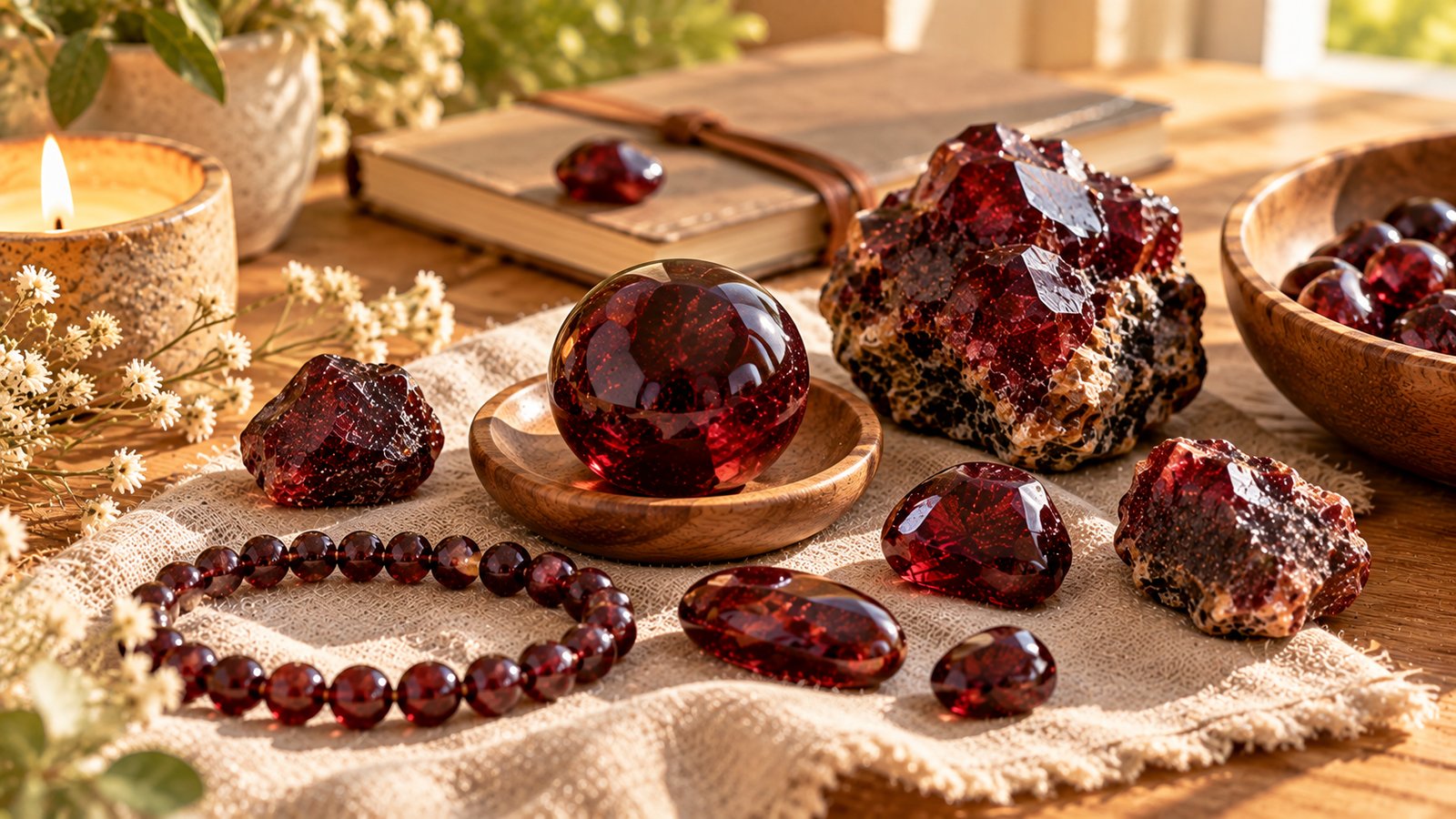
Simple Ways to Work With Garnet
A yearly intention ritual suits this stone well.
- Pick one goal for the year ahead and write it in a single sentence.
- Choose a garnet, whether a ring, a pendant or a small tumbled stone.
- Hold it while reading the sentence aloud, then place the stone on top of the paper.
- Break the goal into twelve monthly steps and write one beside each month.
- Each month, check the step and move the paper or stone to a visible spot.
The stone is simply an anchor for the calendar habit. For layouts, a garnet at the center of a small grid with clear quartz points makes a handsome focal piece, and the crystal grid guide shows simple patterns.
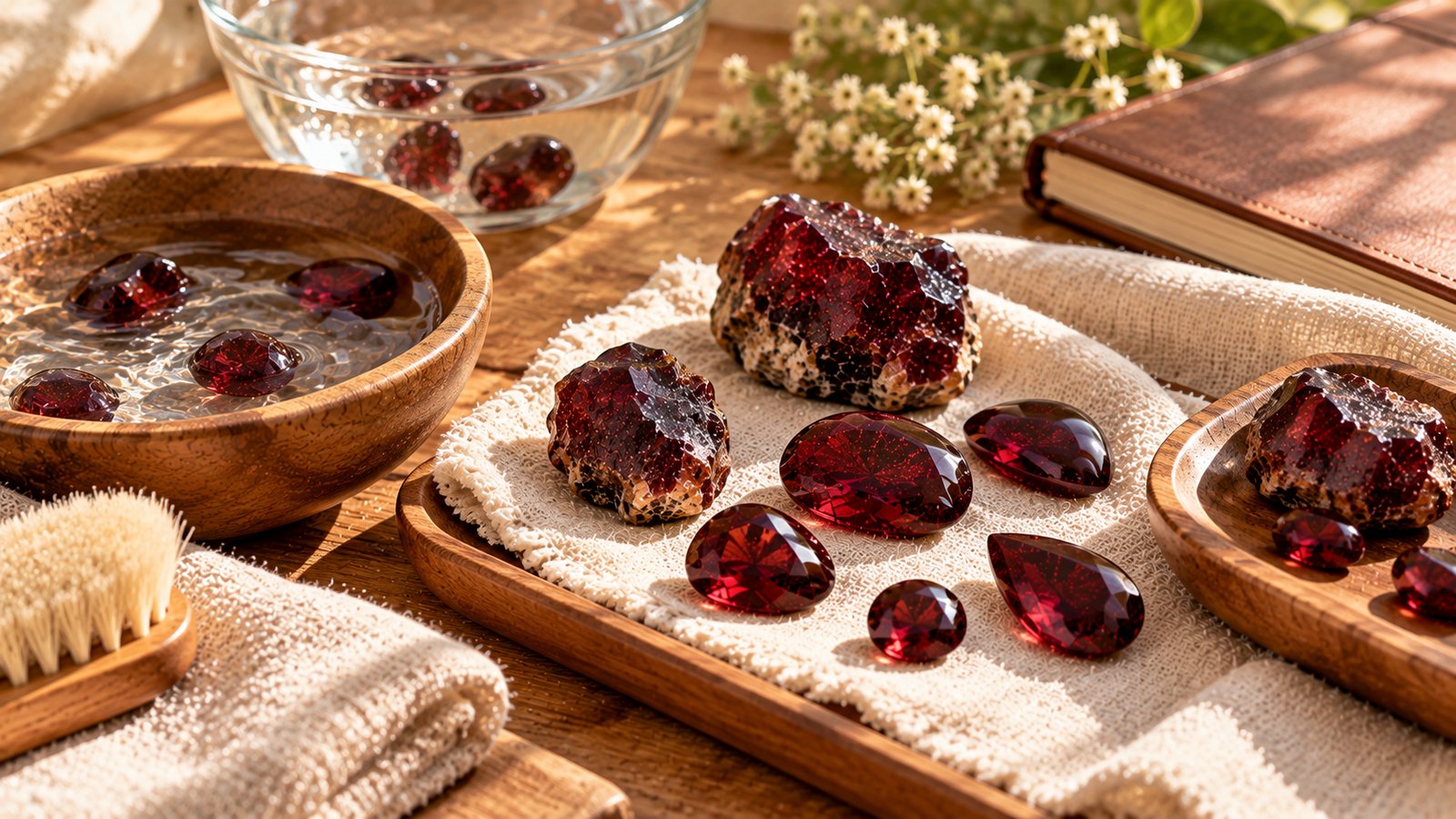
Caring for Garnet
Most garnets are tough, and they are among the easier gemstones to live with.
- Clean with warm water, mild soap and a soft brush, then rinse and dry.
- Ultrasonic cleaners are usually fine for clean stones, but avoid them for pieces with fractures, glued stones or fillings.
- Avoid sudden temperature changes, which can crack a stone, especially one with inclusions.
- Store garnet separately from harder gems such as sapphire and diamond, since they can scratch it.
- Avoid harsh chemicals and strong bleach, which can damage settings.
Water is generally fine, so this is one of the stones that is safe to rinse. For the full list of stones that are not, see which crystals cannot go in water.
For cleansing, people use moonlight, sound, smoke or a bowl of dry sea salt, depending on the stone. These are customs, and the ten cleansing methods in this guide explain which ones suit different hardness levels.
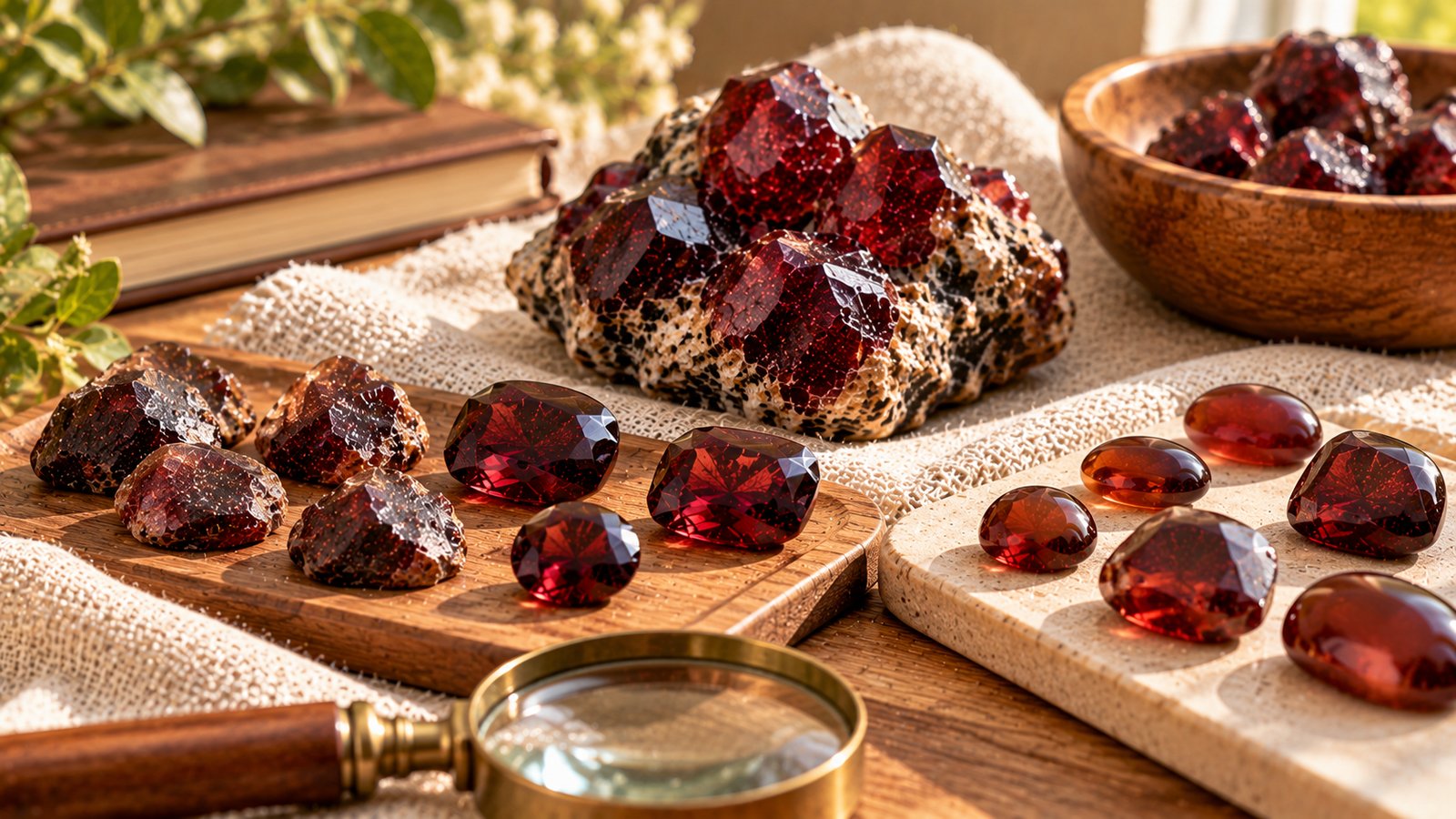
How to Spot Fake or Misrepresented Garnet
Because garnet is so common in jewelry, fakes range from cheap beads to well-made lab stones.
- Red glass. Glass is the classic imitation. Look for round gas bubbles, swirl marks and a too-perfect color. A loupe usually reveals these.
- Plastic. Warm to the touch, light for its size and easy to scratch.
- Doublets. A thin slice of real garnet is sometimes glued to glass. Jewelers check the side of the stone for a seam, and a flash of different colors from the top and edge is a clue.
- Synthetic or lab-grown stones. Some garnet-type materials, such as yttrium aluminum garnet, are manufactured for industrial and jewelry use. They are not natural garnet, though they have a garnet-type structure.
- Misnamed stones. Names like “Cape ruby” and “Arizona ruby” are old trade names for pyrope garnet. They are real garnet, but they are not ruby, and buyers should know the difference.
For a home check, look at the stone through a clear window or against a white card. Because garnet is singly refractive, you should see one set of facets and not a doubled image. Doubling suggests a different mineral. Color also tells a story: natural almandine often looks very dark in a thick stone, and a bright, light red may be glass or a different garnet species such as pyrope.
Trade rules treat most garnets as untreated. When a stone claims to be a rare color such as blue or demantoid green, ask for a lab report, because high-value types are worth testing.
Buying Tips
Ask for the species and not only the word garnet, since a deep red almandine and a rare demantoid are very different purchases. Compare prices by color and clarity, and avoid listings that use phrases such as “natural ruby-like garnet” without a name. For jewelry, check the setting and the claim of carat weight, and keep your receipt. A good garnet ring can last for generations. If you inherit older garnet jewelry, have a jeweler check the prongs and any foil backing before wearing it every day, since the metal often wears out long before the stone does.
Frequently Asked Questions
What is garnet the birthstone for?
GIA lists garnet as the birthstone for January and the gem for the second anniversary.
Is garnet always red?
No. Garnets come in almost every color. Green tsavorite and demantoid, orange spessartine and pink to purple rhodolite are all garnets.
How hard is garnet?
GIA gives the group a Mohs hardness of 6.5 to 7.5, depending on the species, so it is durable for most jewelry.
Can garnet go in water?
Yes. Rinse and dry it, and avoid long soaks in strong chemicals.
How can I tell garnet from ruby?
Ruby is a variety of corundum, which is harder and shows double refraction, while garnet is singly refractive. The mineral is also much more common and costs far less than ruby of similar size.
Is garnet a good stone for beginners?
Affordable, durable and easy to find, garnet gives beginners a good start, and each species has a different look, so beginners can start with one and explore more over time.