| ✨Hey there! This post may contain affiliate links, meaning we earn a commission if you make a purchase through our links, at no cost to you. Please read our disclosures for more info. |
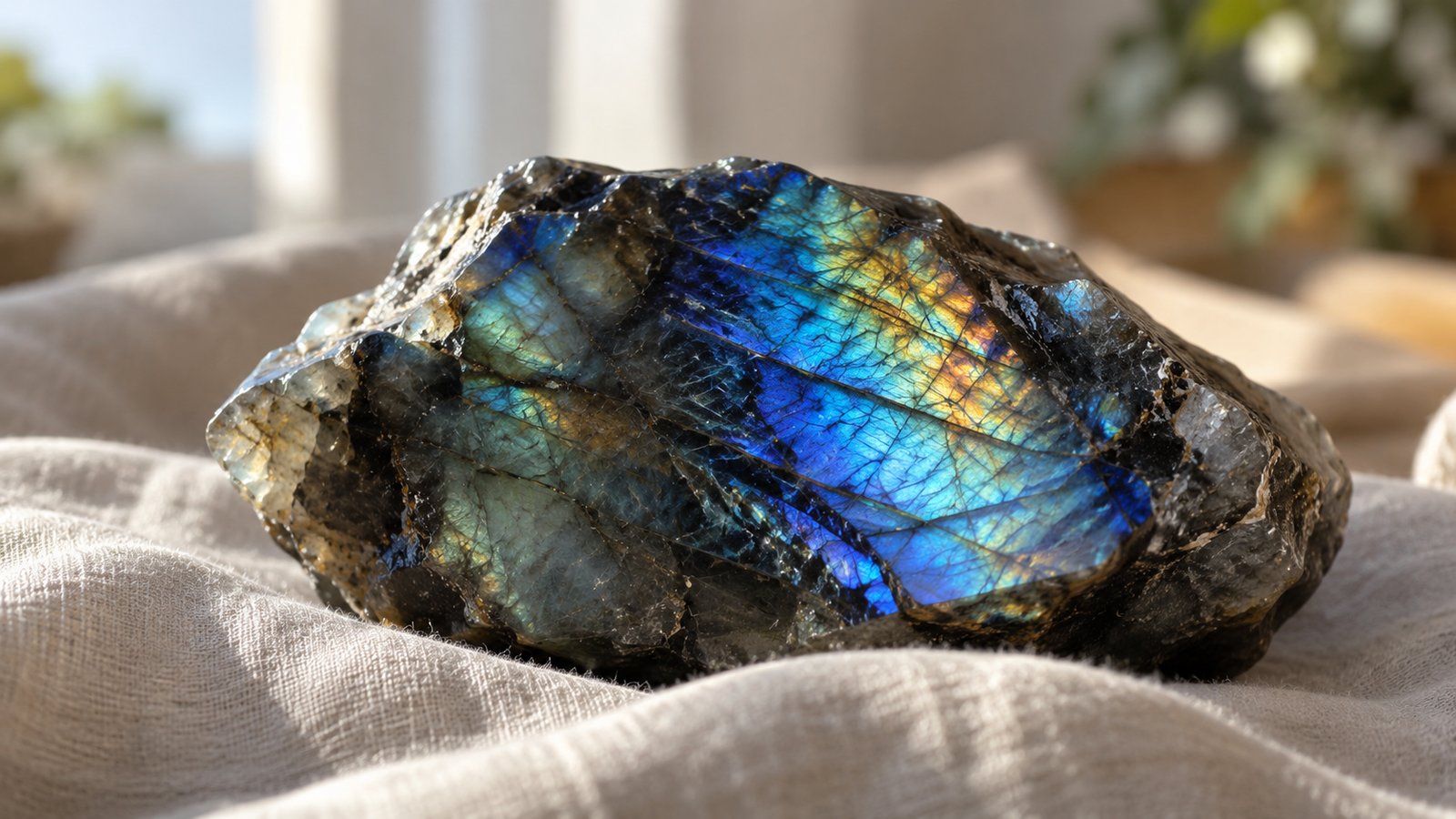
Turn a piece of labradorite in your hand and the stone seems to wake up. A dull gray surface suddenly flashes electric blue, then gold, then green as the angle shifts. Photographs rarely capture it, and shop lights make it look even more theatrical.
The effect has a precise scientific explanation, and the stone has a history tied to a specific place on the map. The mineral comes first below, drawn from Mindat, the Handbook of Mineralogy and GIA, followed by the traditions attached to it and the practical steps for care. Meanings are shared as traditional beliefs.
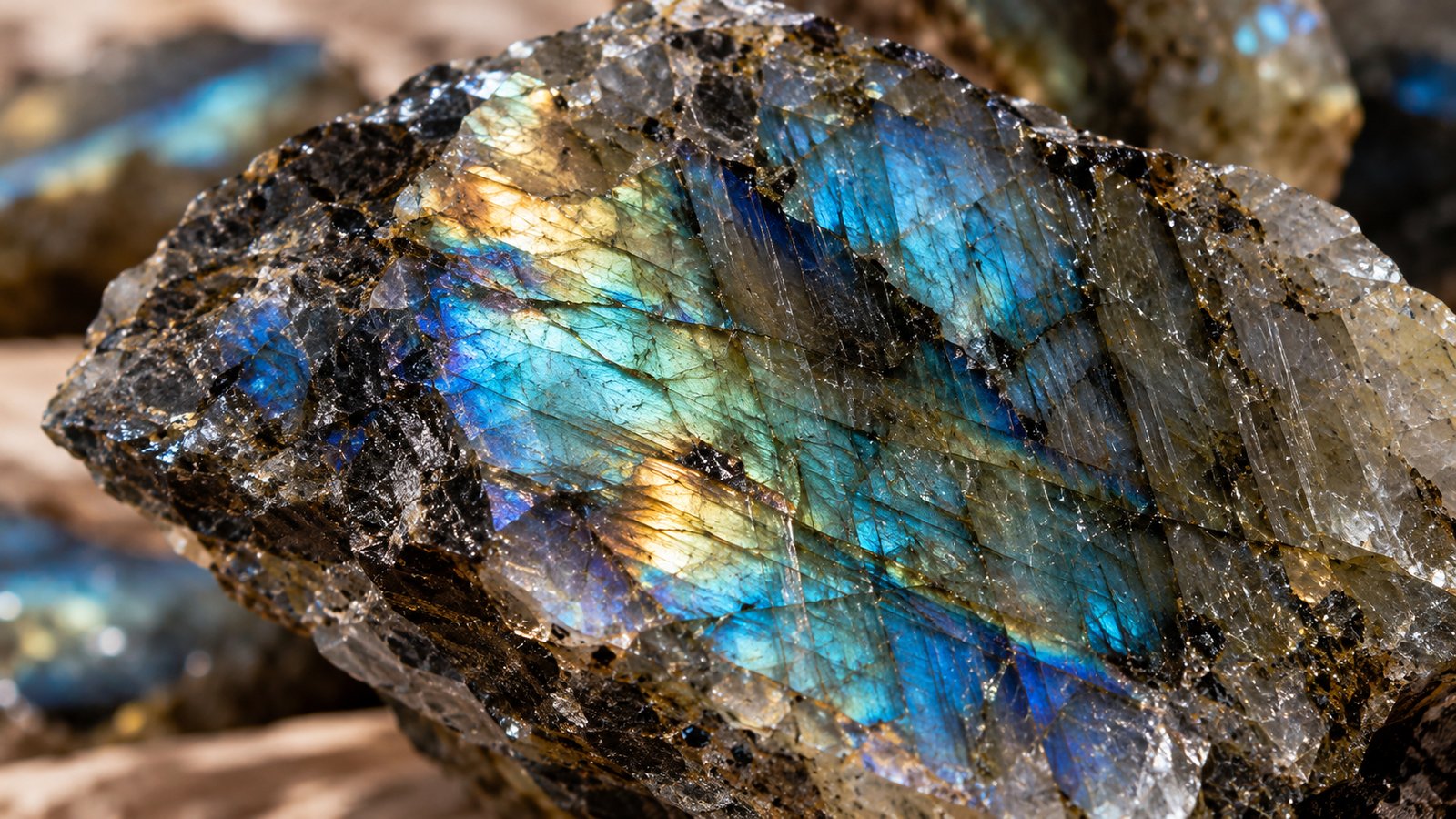
What Labradorite Is
Labradorite is a plagioclase feldspar, one member of a family that makes up a large share of the Earth’s crust. Mindat defines it as plagioclase with an albite to anorthite ratio between 30 to 70 and 50 to 50, which in plain terms means a sodium-and-calcium aluminum silicate where calcium is a major component. The Handbook of Mineralogy gives its crystal system as triclinic.
Hardness runs from 6 to 6.5 on the Mohs scale. Labradorite is harder than a steel knife blade but softer than quartz, so labradorite can be scratched by quartz-rich dust over the years. The stone also has two directions of cleavage that meet at nearly right angles, which means a sharp impact can split it.
Body color is usually gray to dark gray or blackish, sometimes with white patches or a brown tint. The color play happens on top of that dark base, and stones without the effect look like plain gray rock.
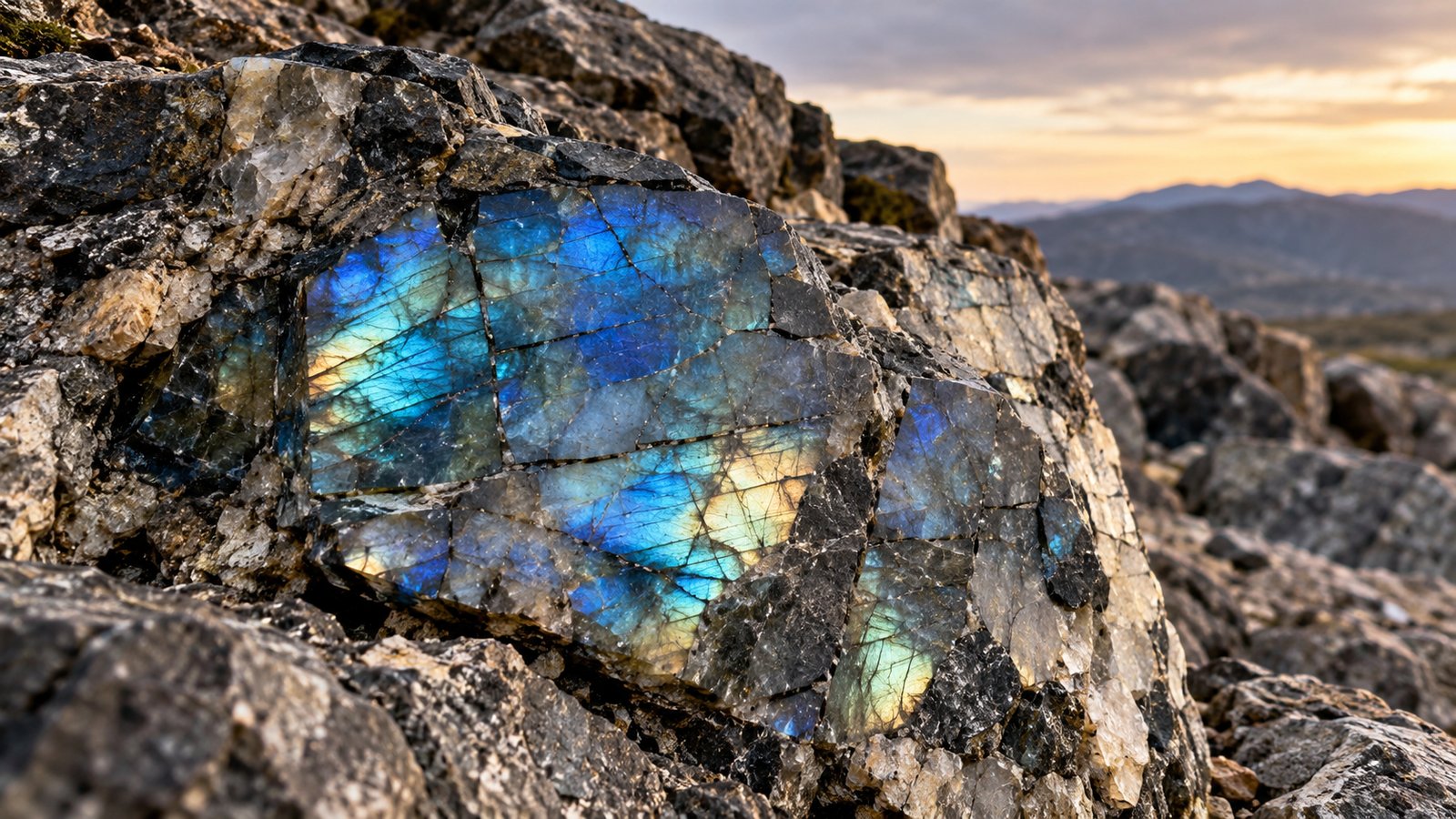
What Causes the Flash
The optical effect is called labradorescence. According to Mindat, it comes from a lamellar structure created by exsolution: as the feldspar cooled very slowly, its sodium-rich and calcium-rich parts separated into extremely thin alternating layers. When the spacing of those layers falls within a certain range, roughly 128 to 252 nanometers, they interfere with light and send back a bright color that changes with viewing angle.
Two requirements follow from this, and they explain why many labradorite pieces show no flash. The rock needs the right chemical composition, and it needs to have cooled slowly enough for the layers to form. Mindat points out that not all labradorites show labradorescence, and not every feldspar that does is labradorite. A plain gray piece may be perfectly good labradorite that simply never developed the effect.
The flash also runs in one direction. Turn the stone until it lights up, and the color disappears when you rotate it away. Cutters orient cabochons so that the flash faces the top. Directional behavior like this is a helpful clue when you want to tell the real stone from an imitation.
Spectrolite and Other Names
Spectrolite is a trade name for the most colorful labradorite from Finland. The geology site Geology.com notes that it was named by the director of the Geological Survey of Finland, and the Finnish material is known for a wider spectrum of colors than blue-green Canadian stones. Today, the name sometimes gets applied to other material, so ask a seller where a so-called spectrolite came from. Other names, such as lynx eye for green-flashing labradorite, describe a look.
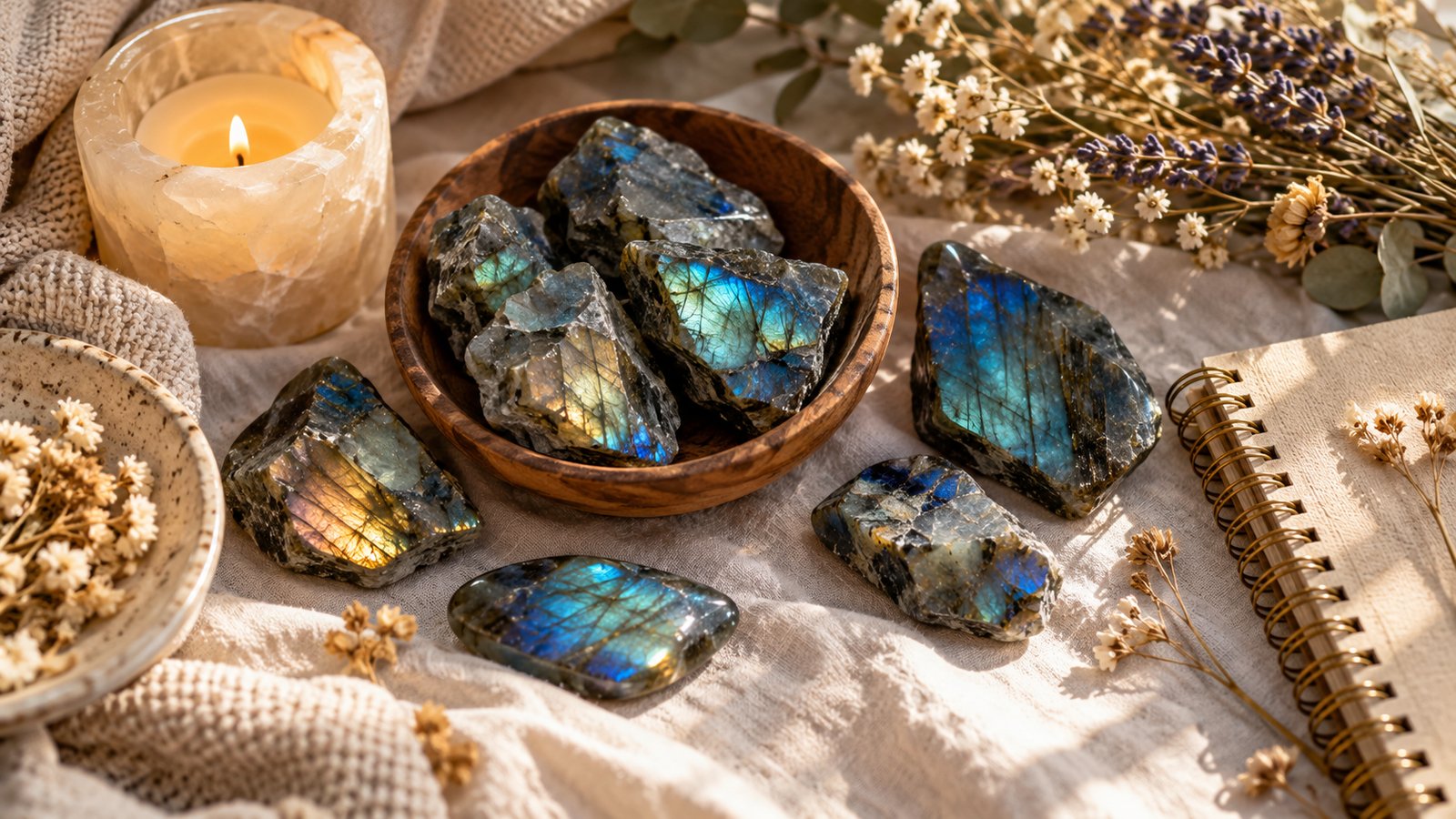
Where Labradorite Comes From
Labradorite takes its name from Labrador, Canada. The type locality is Paul’s Island, near the town of Nain, where Moravian missionaries collected it in the late eighteenth century, in the late eighteenth century. The Handbook of Mineralogy lists the classic site as Ford Harbour on Paul’s Island, and also mentions finds in Quebec and New York State, where labradorite-rich anorthosite forms parts of the Adirondack Mountains.
Today, much of the labradorite on the market comes from Madagascar, which supplies large quantities in a range of qualities. Finland provides the spectrolite. Other sources include Norway, Russia, Ukraine, India and parts of the United States, including Oregon and California. A stone’s origin does not decide its beauty, so choose by flash and by what you like.
An old story from Labrador says the Northern Lights were once frozen inside the rocks of the coast and released by a warrior who struck the stone. The legend is attributed to the Labrador Inuit and is told in several versions. Treat it as folklore that shows why the stone’s colors remind people of the aurora.
What Labradorite Means in Crystal Traditions
In crystal practice, labradorite has a reputation as a stone of transformation and intuition. Those meanings are cultural, and they differ from teacher to teacher.
- Transformation. Because the stone looks gray until the light catches it, it has become a symbol of hidden potential and change.
- Intuition and imagination. Practitioners keep it near a journal or creative workspace, hoping to think more freely.
- Protection. Some traditions treat labradorite as a shield for the aura, similar to what is said of black tourmaline.
- Throat and third eye chakras. Blue flash links the stone to communication and insight in chakra systems.
- Calm during change. People going through a move, a job change or a new chapter sometimes carry a piece as a reminder to adapt.
Astrology lists vary. Many pair labradorite with Leo, Sagittarius and Scorpio, and you can compare with other stones in our zodiac crystals guide. Taken as ritual, a stone like this gives you a focus when life is changing. Many people carry one through a move or a new chapter.

The History of Labradorite
The documented history of labradorite starts on the coast of Labrador. The Canadian Encyclopedia explains that Moravian missionaries established the mission at Nain in 1771, and that labradorite was collected from the Paul’s Island area from about 1773 and named by the mineralogist Abraham Werner in 1780. Mindat lists Ford Harbour on Paul’s Island as the type locality.
Labrador Inuit tradition tells of the Northern Lights frozen in the rocks of the coast. In the version recorded on the Orkney stone-tools site and elsewhere, a warrior strikes the rock and frees some of the lights, leaving the rest to shimmer in the stone. It is a folk story, and it offers a poetic explanation for the flash that science attributes to layered feldspar.
Labradorite and Light: A Closer Look at the Science
Thin-film interference is the same family of effect that colors soap bubbles and oil slicks, though the mechanism inside the stone is different. In a soap bubble, light reflects from the front and back of a film of water, and the two reflections combine to boost certain colors. In labradorite, reflections from the boundaries between neighboring lamellae do the combining, so blue appears when spacing is smaller and gold or red when the spacing is larger. Mindat gives the working range for the lamellae as 128 to 252 nanometers.
This also explains why polishing orientation matters. The lamellae sit in particular planes inside the crystal, and the flash is visible from a narrow range of directions. A cutter studies the rough, finds the direction of the flash, and cuts the surface parallel to it. A cabochon cut in the wrong direction looks dull from the top and flashes only from the side.
Researchers continue to study the lamellar structure with electron microscopy, and Mindat cites a modern electron diffraction study by Götz and colleagues published in 2022. The work is aimed at understanding how the layers form and why they lack long-range order, which affects the colors the stone shows.
A Quick Home Check for Flash
Hold the stone under a single bright light, such as a lamp or a phone flashlight, and rotate it slowly. A genuine flash starts at one angle, peaks and disappears as you continue. Repeat in a second room with different lighting. Glass imitations tend to keep the same color at all angles, and coated stones may show a metallic, mirror-like look.
Choosing and Wearing Labradorite
Look at a piece in several kinds of light. Daylight by a window shows the broad color range, and a bright lamp shows the intensity. A small amount of flash across a large surface can look more striking than a lot of flash on a small spot. Large, flat cabochons and palm stones show the effect best. Smooth tumbled stones tend to show strong flash on one face and a plain gray back.
Jewelry settings work best when they protect the stone. A bezel setting surrounds the edge and shields the cleavage planes, which helps in rings. Pendants and earrings suffer far less wear and suit the stone well. Silver settings highlight blue flash, and yellow gold brings out warm flashes.
Prices rise with the intensity, the range of colors and the size of the flashing area. A gem labeled spectrolite from Finland costs more than ordinary material, and the premium is justified only when the origin is documented. For everyday pieces, ordinary Madagascar labradorite is a pleasing and affordable choice.
Labradorite in Rock Form
Geologists know labradorite as the main mineral in anorthosite, a pale rock made almost entirely of plagioclase feldspar. The Adirondack Mountains in New York are built largely of anorthosite, and Geology.com notes that labradorite is the dominant mineral in some anorthosite bodies. The same rock covers large parts of the Moon’s bright highlands, although lunar anorthosite is richer in calcium than most labradorite and is usually described as anorthite-rich. Seen this way, a labradorite palm stone is a small relative of a rock that makes up mountains.
That context also shows why the stone is easy to find. Slow cooling in large magma bodies is common, and labradorite crystals can grow big. What is rare is the right combination of composition and structure to produce vivid flash, and that is where the art of selecting good rough lies.
A short note on sustainability and sourcing: labradorite is mined in several countries under varying conditions, and buyers who care about ethical sourcing can ask a seller what they know about the supply chain. Honest sellers say plainly when they do not know. Openness like that is a better sign than a confident story with no detail.
Finally, remember that a stone is only a stone. The flash is real and beautiful, and it comes from layers of feldspar that formed over a long cooling of ancient rock. The geology alone is enough to make a piece worth keeping, without any added promises.

How to Care for Labradorite
- Cleaning: a soft damp cloth and a drop of mild soap, then dry thoroughly.
- Impact: perfect cleavage means a drop can split the stone. Pad jewelry and avoid wearing labradorite rings during rough work.
- Ultrasonic and steam cleaners: avoid them because fractures can widen.
- Heat and chemicals: skip prolonged heat and harsh cleaners, which can dull the polish.
- Scratches: store apart from quartz, topaz, sapphire and diamond.
- Light: sunlight does not fade the flash, so labradorite can sit in a bright room.
- Energy cleansing: sound, moonlight and smoke are popular, and the how to cleanse crystals guide lists others.
How to Spot Fake Labradorite
Genuine labradorite is inexpensive, but imitations and treated stones do exist.
- Glass. Glass imitations may flash in every direction at once, and often show round bubbles. Real labradorescence appears in one orientation and vanishes when the stone is rotated.
- Opalite. Man-made glass sold under many names, with a milky blue glow. Labradorite is a different mineral.
- Coated stones. Some cheap stones are coated to produce flash. A coating may wear at the edges, and the color may look uniform and metallic.
- Dyed or foiled stones. Look for color pooling in cracks and for suspicious uniformity.
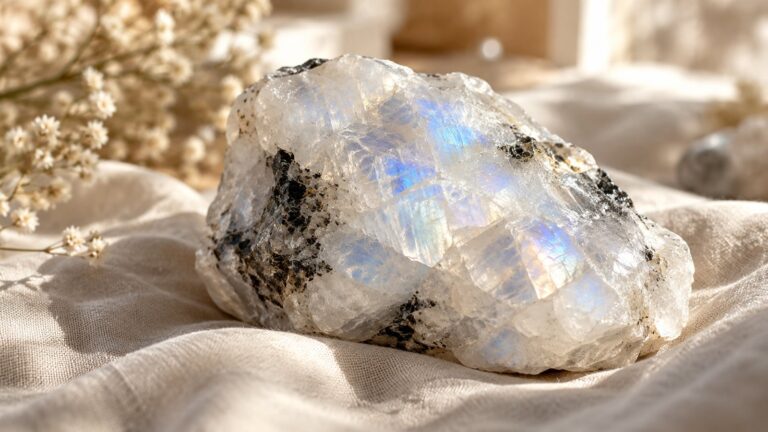
- Moonstone mix-ups. GIA explains that stones sold as rainbow moonstone are actually labradorite, so that is a naming issue and not fraud.
- Doublets and assemblages. A thin slice of stone glued to a base or a colored backing can mimic flash. Look at the side of a cabochon for a visible join.
Check where the stone flashes and where it does not. A genuine piece usually has some dark or dull areas, and the flash lies along specific planes. Be skeptical of a stone that flashes uniformly from every angle and costs little. For a ring or a high-priced stone, a gemological lab report settles the question.
The buying advice is simple. Pick the piece that flashes best when you hold it in different light, and avoid sellers who promise results from owning it. A flat gray stone is not a bad stone, but it is not what most buyers want.

Frequently Asked Questions
Why does labradorite flash different colors?
Thin alternating layers in the feldspar interfere with light. The color you see depends on the angle, which is why it appears to shift.
Is labradorite the same as moonstone?
No. Moonstone is orthoclase feldspar with a milky glow. Some labradorite with a multicolored glow is called rainbow moonstone in the trade, as GIA notes, but it is labradorite.
How hard is labradorite?
The Mohs hardness is 6 to 6.5, with perfect cleavage that makes it prone to splitting under impact.
Does every piece of labradorite show flash?
No. The stone needs the correct composition and slow cooling. Many pieces look plain gray.
What is spectrolite?
It is a trade name for particularly colorful labradorite, originally from Finland. The name is now applied loosely.
Can labradorite go in water?
Yes, a brief rinse is fine. Dry it, and avoid long soaks or ultrasonic cleaners.
Where was labradorite first found?
Mineral references place the first finds on Paul’s Island near Nain, Labrador, Canada, in the late 1700s.
Is labradorite a birthstone?
Labradorite is not on standard birthstone lists. Some alternative lists include it, so check the tradition a source follows.