| ✨Hey there! This post may contain affiliate links, meaning we earn a commission if you make a purchase through our links, at no cost to you. Please read our disclosures for more info. |
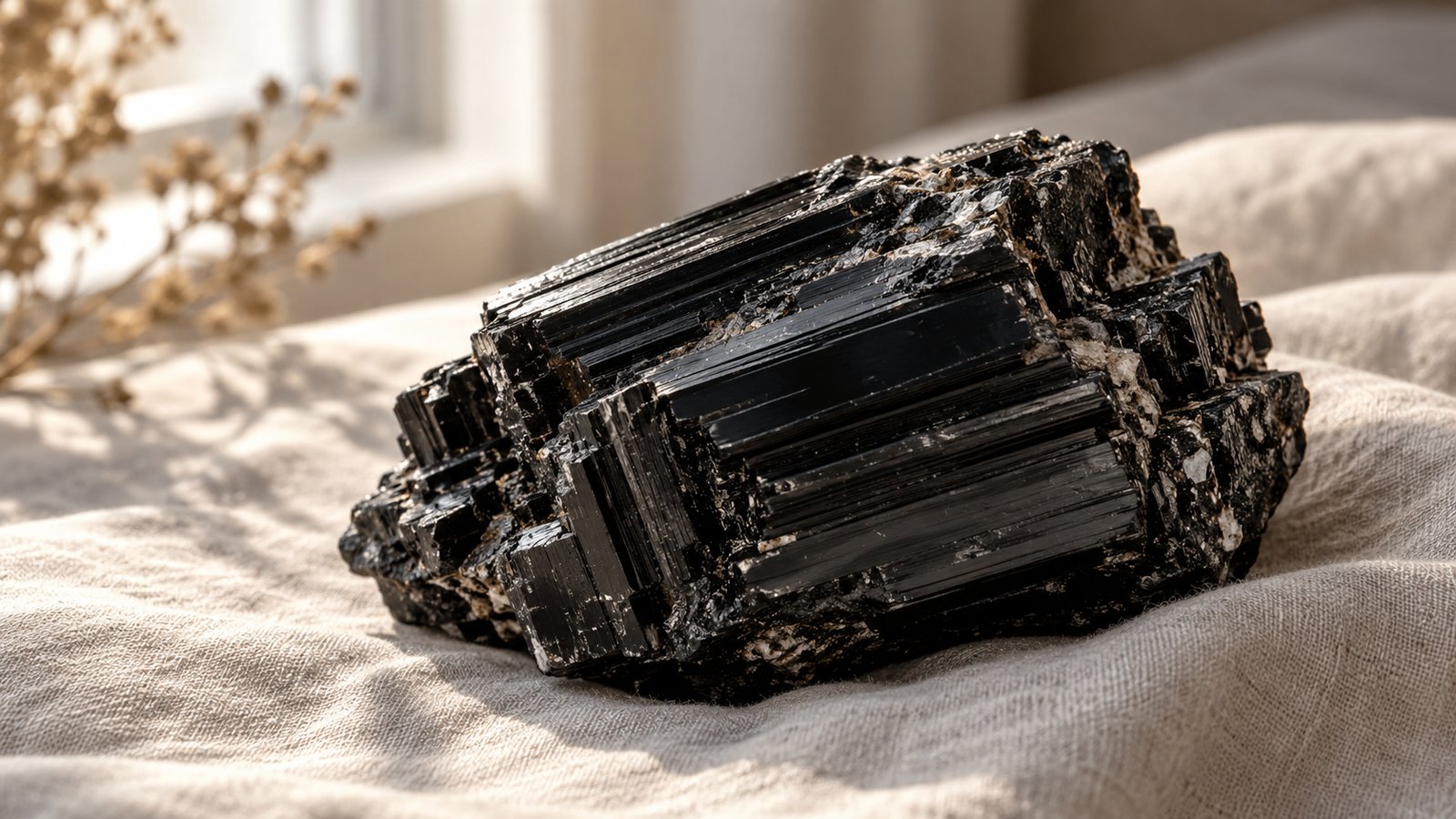
Black tourmaline is the stone that shows up at front doors, on altars and in the pockets of people who like a grounding object. Opaque, glossy and deeply black, it has a no-nonsense look that matches its reputation in crystal lore as a protector.
It also has a more surprising scientific story. This is a boron-bearing silicate that can generate electric charge when it is heated or squeezed, which has made tourmaline a subject of curiosity for centuries. This guide covers the mineral first, with details from Mindat, GIA and the Handbook of Mineralogy, then the traditional meanings and practical care. Beliefs are labeled as beliefs.
Contents
hide
What Black Tourmaline Is
Black tourmaline is the mineral schorl. Schorl is an iron-rich member of the tourmaline group, with an ideal formula of NaFe3Al6(Si6O18)(BO3)3(OH)3(OH), a long string of symbols that translates to a sodium, iron and aluminum silicate with boron in its structure. The black color comes from the iron.
Hardness is listed as 7 on the Mohs scale, and some references give 7 to 7.5, so it resists scratches from dust and most household objects. Tourmaline is nonetheless brittle and can chip or fracture along cracks. Specific gravity runs around 3.1, so a piece feels noticeably heavy for its size.
Schorl is the most common member of the tourmaline family. Other members include the pink and green gem varieties that jewelers cut, such as elbaite, but the black form is rarely used in faceted gems and is sold mostly as rough crystals, rods and tumbled stones.
The Name and Its History
The name schorl is old. Mineral references trace it to a village in Saxony, in what is now Germany, called Zschorlau, where black tourmaline was found with tin ore. The broader word tourmaline comes from a Sinhalese term, turamali, used in Sri Lanka for colorful stones that were hard to identify. Early gem traders mixed tourmaline up with other minerals, and the group was not clearly separated until later chemical studies.
How Schorl Forms and Where It Is Found
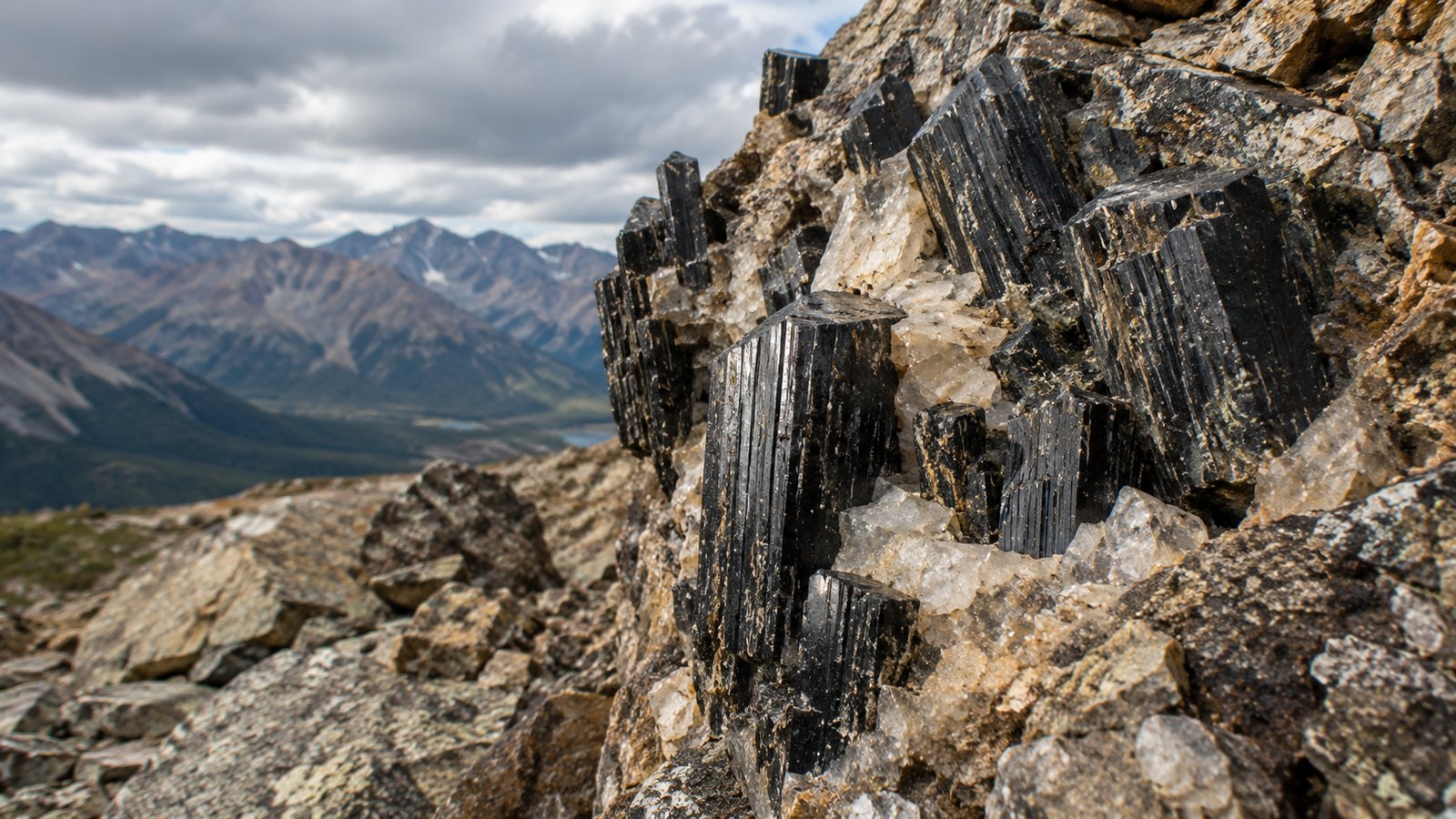
Schorl crystallizes mostly in granites and granite pegmatites, coarse-grained rocks that cool slowly and are rich in boron. Metamorphic rocks such as schist host it too such as schist. Long crystals commonly grow in bundles, and they may be found embedded in white quartz or in feldspar, a pairing that looks striking in specimen form.
Well-known sources include Brazil, Namibia, Pakistan, Afghanistan, Madagascar and the United States. In North America, crystals have come from several states, with Maine and California known for tourmaline in general.
What the Crystals Look Like
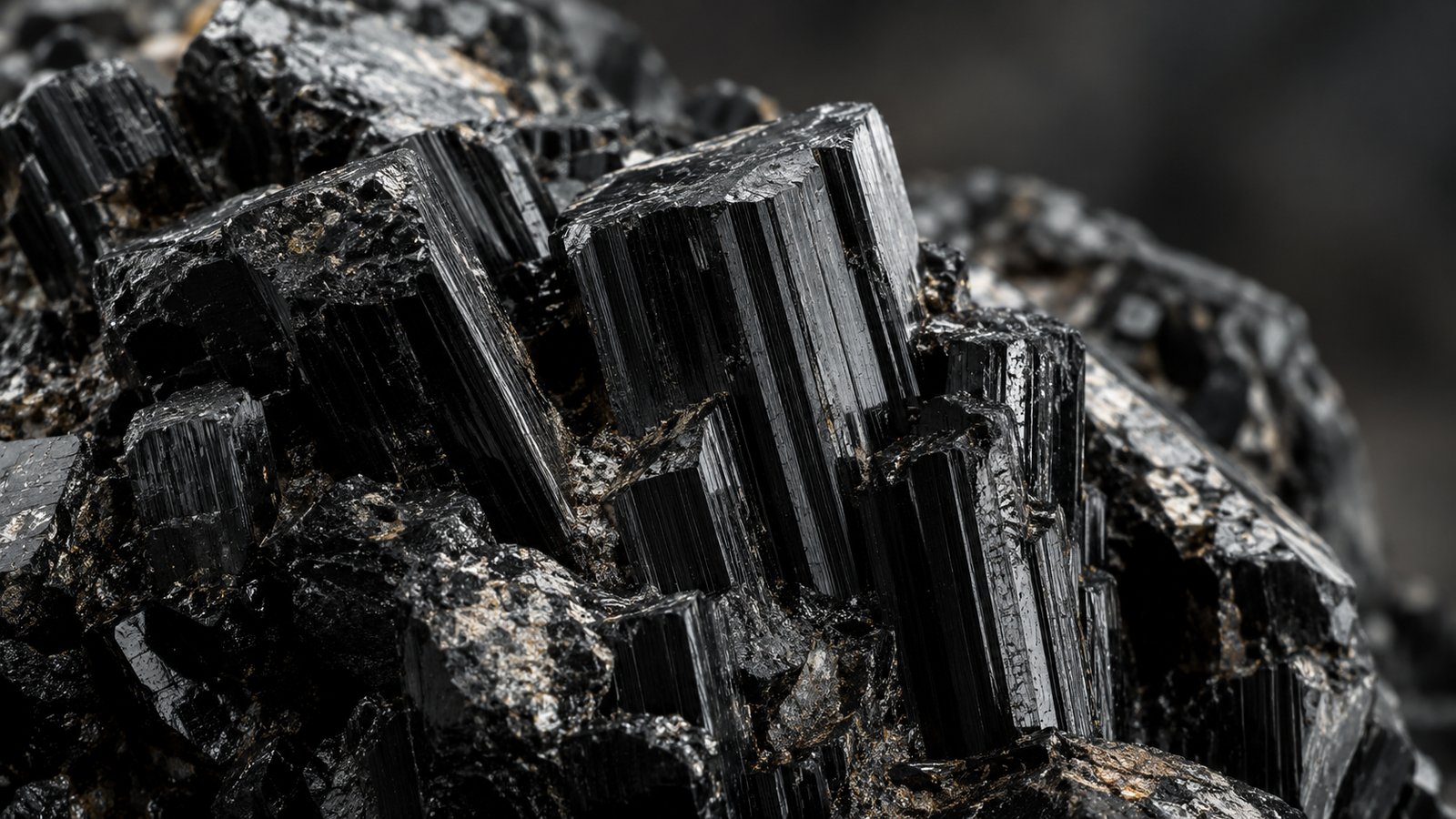
A natural black tourmaline crystal is a long, slender prism with a rounded triangular cross-section. Deep lengthwise grooves, called striations, run along its sides. The ends may be flat, uneven or capped with a pyramid. A tumbled stone loses these features, but a raw piece is easy to recognize once you have seen the pattern.
Collectors also enjoy tourmaline in quartz, where black needles or bundles of schorl run through clear quartz. Dealers call the combination tourmalinated quartz. The black needles are real schorl crystals trapped as the quartz grew around them, and specimens vary from a few thin threads to dense forests of needles. The look is dramatic, and it demonstrates how common schorl is as a companion mineral.
Scientists continue to study the tourmaline group because its chemistry is complex. Boron, a light element that is hard to measure, gives tourmaline its distinctive structure, and trace elements shift color across the group. Schorl carries more iron than most relatives, which is why it is so dark.
Size ranges from pencil-thin crystals to heavy columns. Large raw crystals can weigh a kilogram or more and make dramatic shelf pieces, though pricing depends on how clean the crystal looks and whether the ends are intact. A damaged termination lowers the value for collectors but not the usefulness for ritual.
Electricity and Tourmaline
Tourmaline has two electrical properties. Pyroelectric behavior means the crystal develops opposite electrical charges at its ends when its temperature changes. Piezoelectric behavior means pressure produces a charge. Both behaviors have been known for centuries. Eighteenth-century scientists noticed that heated tourmaline attracted ash, and for a time it was used to clean pipes, which earned it a nickname connected to ash.
These electrical effects are real, documented and tiny. They also feed a popular modern belief that black tourmaline helps neutralize electromagnetic fields from phones and routers. That idea is a belief, while the physics describes how the crystal behaves when heated or squeezed.

Meaning in Crystal Traditions
In crystal practice, black tourmaline is one of the main protection stones. The following associations are traditional.
- Protection. Practitioners place pieces by doors, in corners of a home or in a bag as a symbolic shield from negativity.
- Grounding. Dark stones are linked to the root chakra at the base of the spine and to a feeling of being steady and present.
- Releasing stress. Holding a dark, heavy stone can feel calming in the same way that a worry stone does, and the weight of the schorl adds to that effect.
- Boundaries. Some people use it as a reminder to say no, protect their time and keep a clear separation between work and rest.
- Home and travel. Small pieces end up in glove compartments, suitcases and desk drawers.
For a wider look at dark stones and how they are used, see the post on black crystals. Other protective-minded stones, such as obsidian and onyx, also appear there. Zodiac lists often pair black tourmaline with Capricorn and Scorpio, and you can compare lists in our zodiac crystals guide.
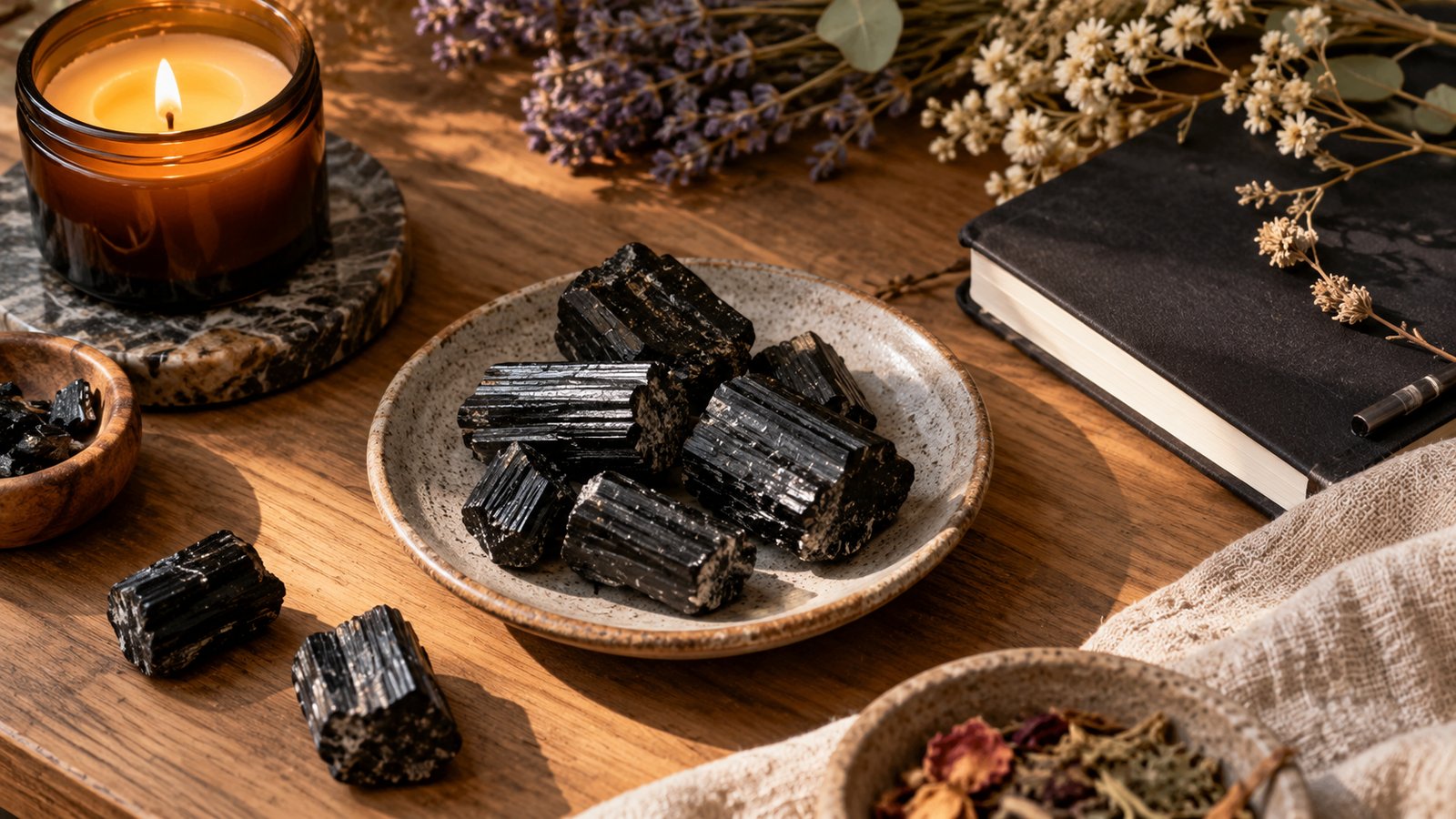
Many people place a stone by the door alongside everyday habits, such as locking up and checking the smoke alarm, as a ritual reminder that home is a safe place.

The History Behind the Name
The documented history of tourmaline is a story of trade and curiosity. According to GIA and the 1911 Encyclopaedia Britannica, the name comes from a Sinhalese word used in Sri Lanka for mixed-color stones, and Dutch traders brought those stones to Europe in the early 1700s, at first confusing them with other gems. Dutch traders also noticed that heated tourmaline attracted ash and nicknamed it the ash puller, a reference to the pyroelectric effect described above. The black variety, schorl, takes its name from the Saxon village of Zschorlau, according to mineral references.
The protective reputation of black tourmaline belongs to modern crystal tradition, and it gives the stone its place beside doors and desks today. The documented record above explains why mineralogists and collectors have been drawn to tourmaline for centuries: it does things, such as building an electrical charge, that few other minerals do.

How Schorl Compares With Other Dark Stones
Black stones are easy to confuse because the color hides detail. A short comparison of hardness and appearance makes a shop visit easier. Obsidian is natural volcanic glass, with a Mohs hardness near 5 and glassy, curved breaks. Jet is fossilized wood, light and warm, and much softer. Onyx is banded chalcedony that is often dyed black. Hematite is heavy and metallic with a red-brown streak. Shungite is a carbon-rich rock that is dull black and soft enough to leave marks on paper.
Black tourmaline stands apart for its crystal habit. If a piece has long lengthwise grooves, it is probably schorl or something molded to look like it. Hardness is the other clue. At 7, schorl will scratch glass and a steel knife blade, but testing a stone you plan to keep is not advisable, because scratch tests damage the surface.
Combining stones is a personal choice. Some practitioners place black tourmaline with clear quartz, as discussed in the clear quartz guide, and with amethyst, covered in the amethyst guide. Such arrangements serve symbolism and appearance and have no proven effect.
Using Black Tourmaline in a Home Ritual
A simple ritual starts with a few quiet minutes. Hold the stone, breathe slowly and name what you want from the space, such as calm evenings or a tidy desk. Place the stone where it will serve as a reminder. Revisit the intention weekly. Nothing mystical needs to happen for the ritual to be useful, because the pause itself is a calming habit.
Families sometimes involve children by letting them choose where a stone sits. That turns a shared space into a small project, and it brings a conversation about what makes a home feel safe: kind words, locked doors, working alarms and trusted adults.

Caring for Your Stone
Schorl is durable enough for display and handling, with a few cautions.
- Cleaning: a soft cloth, warm water and mild soap. Dry fully.
- Brittleness: avoid drops and hard knocks. Long crystals can snap across their length.
- Heat: tourmaline responds to temperature changes by building charge, and sudden heat can crack it. Do not put it near a flame or in a very hot car.
- Ultrasonic and steam cleaners: skip them, especially for stones with fractures.
- Storage: keep raw crystals in a padded box or wrapped in cloth, away from harder gems.
- Energy cleansing: a common idea is that black tourmaline absorbs energy and needs frequent cleansing. Popular methods include sound, smoke and moonlight, listed in the guide on how to cleanse crystals.
Practical shopping advice rounds out the picture. Tumbled stones and small raw pieces cost little, and that is a fair guide for what a typical piece should cost. Pay more only for size, a clean termination, or a pleasing association with quartz or feldspar. Choose sellers who describe the stone plainly and present protection as a tradition.
Pets and children deserve a mention. Long, pointed crystals can hurt if they fall or are thrown, and small tumbled stones are a choking hazard for young children and animals. Keep stones out of reach of toddlers, and teach older kids to handle crystals gently, because the brittle nature of tourmaline means a dropped crystal often breaks.
If a stone cracks, there is no need for alarm. Brittleness is part of its nature, and broken pieces keep their mineral character. Some people glue a clean break with a clear adhesive, while others keep the pieces together in a bowl. Collectors treat a broken termination as a normal sign of age.

How to Spot a Fake
Real black tourmaline is inexpensive, so counterfeits are mostly about substitution. The materials below are often passed off as it.
- Glass. Glass dyed black can mimic the look of tumbled schorl. A loupe may reveal swirl marks or round bubbles, and a glass piece lacks the lengthwise grooves of a raw crystal.
- Obsidian. Volcanic glass breaks with curved, shell-like fractures and is much softer, at about 5 on the Mohs scale. A sheen or banding may show.
- Onyx and dyed agate. Layered chalcedony, a quartz relative, can be dyed black, and that is what most onyx sold in shops is. Dye may show in cracks or rub off.
- Hematite or magnetite. Metallic minerals of this type are noticeably heavy and may be magnetic. Hematite leaves a red-brown streak on unglazed porcelain.
- Plastic or resin. Light weight and a warm feel give these away.
For raw crystals, the best check is structure. Look for deep, parallel grooves running the length of the crystal and a triangular-rounded cross-section if the end is broken. Fake raw crystals are rare because they are hard to mold convincingly. A polished or tumbled piece is harder to judge, so rely on a seller who names the mineral and gives an origin.
A gem laboratory can identify the mineral with instruments, but for a cheap tumbled stone the cost is not worthwhile. Reasonable skepticism and a trustworthy seller are enough.

Frequently Asked Questions
Is black tourmaline the same as schorl?
Yes. Schorl is the mineral name, and black tourmaline is the common crystal-shop name for it.
How hard is black tourmaline?
Black tourmaline measures about 7 on the Mohs scale, with some references giving up to 7.5. The stone is hard but brittle.
Does black tourmaline block EMF?
Many practitioners believe so and place it near devices. The documented science is that tourmaline is pyroelectric and piezoelectric, which describes its response to heat and pressure.
Can black tourmaline go in water?
The mineral tolerates water, so rinsing is fine. Dry it, and avoid soaking pieces with cracks or glued bases.
Is black tourmaline the October birthstone?
The October birthstones are opal and tourmaline. Gem-quality pink and green tourmaline is more typical for jewelry than black schorl.
Where should black tourmaline be placed?
Traditions suggest entryways, corners of rooms or a desk. The placement is a matter of ritual and taste.
Does it need cleansing often?
Crystal traditions advise cleansing it frequently because it is said to absorb negativity. Physically, a wipe with a soft cloth is enough.
What is the difference between black tourmaline and obsidian?
Tourmaline is a crystalline mineral with grooves and a Mohs hardness near 7. Obsidian is volcanic glass, softer at about 5, with curved fractures.