| ✨Hey there! This post may contain affiliate links, meaning we earn a commission if you make a purchase through our links, at no cost to you. Please read our disclosures for more info. |
Quick answer: moonstone is a variety of the feldspar orthoclase, made of thin alternating layers of orthoclase and albite that scatter light into a soft glow called adularescence. Its Mohs hardness is 6 to 6.5, and it cleaves easily, so it needs careful handling. Moonstone is the traditional June birthstone, and crystal traditions link it with intuition and new beginnings.
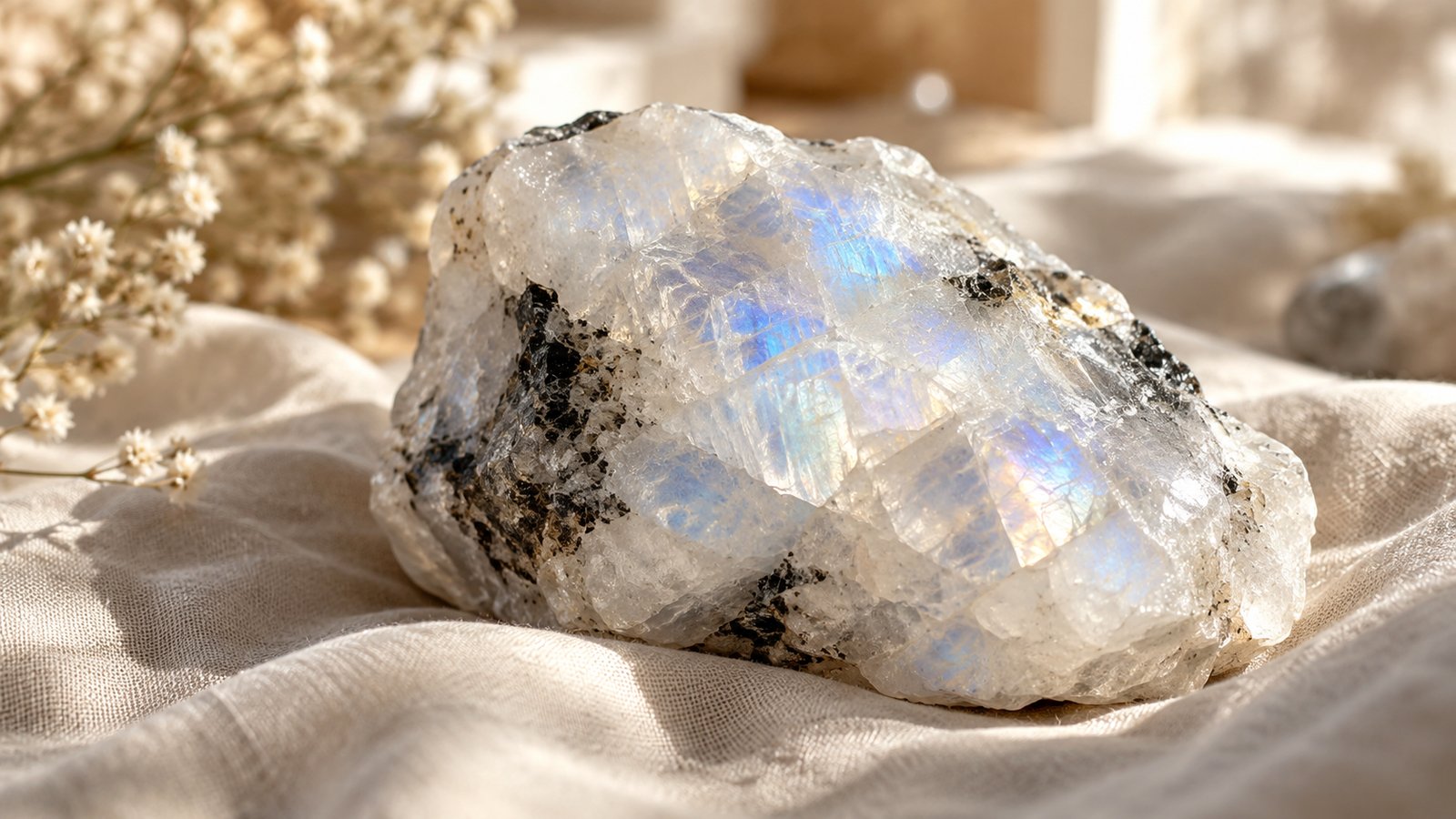
The glow inside a good moonstone looks like light trapped under a thin layer of milk. The glow seems to drift across the surface as the stone moves, like moonlight through cloud. Drifting light like that explains the name, and it explains why moonstone has appeared in jewelry for centuries.
This guide starts with the science, using GIA, Geology.com and mineral references, and moves on to where moonstone is found, the traditions attached to it, care, and how to avoid imitations. Meaning and ritual are shared as traditional beliefs.
Contents
hide
What Moonstone Is
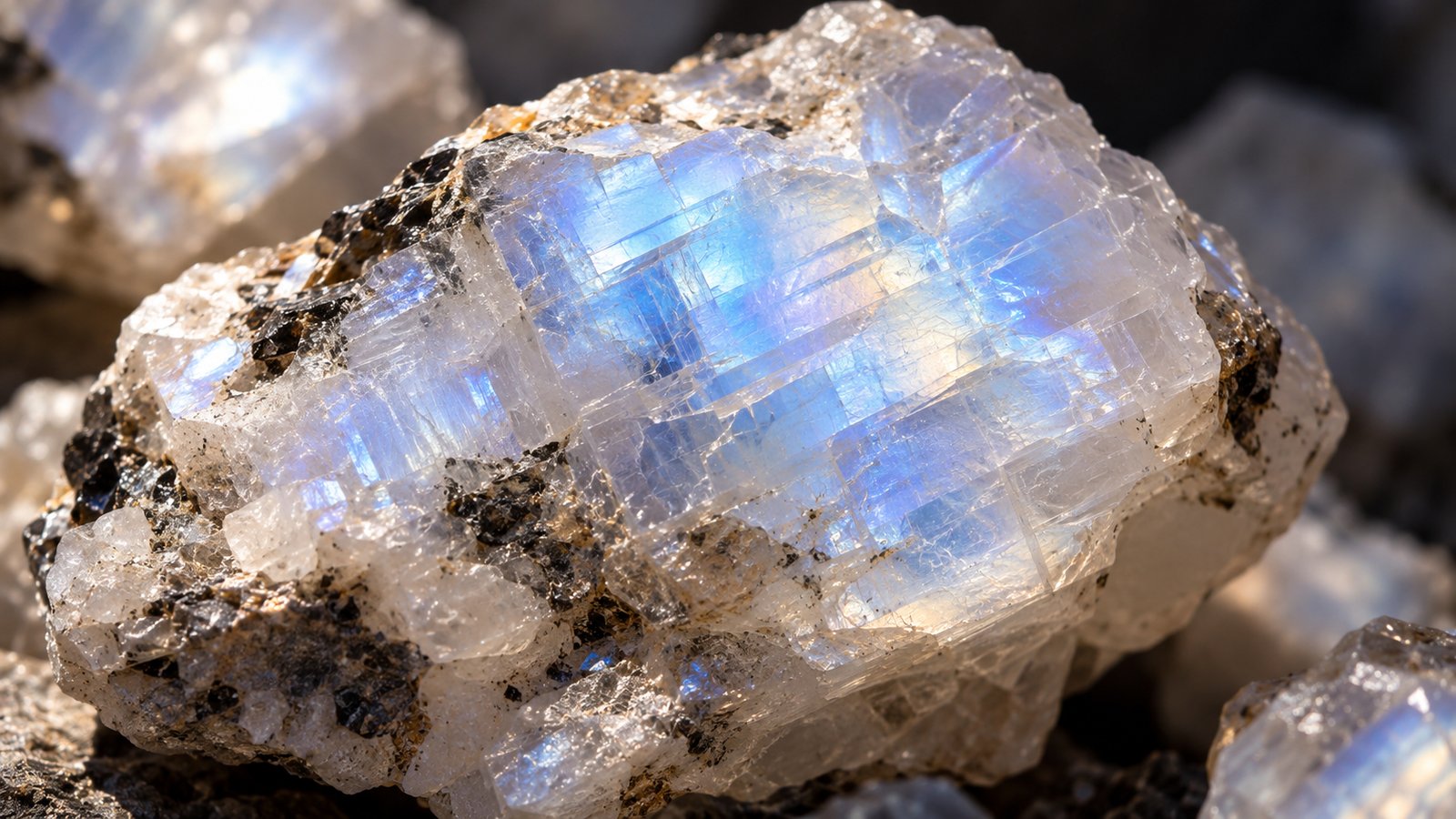
GIA describes moonstone as a variety of the feldspar-group mineral orthoclase, with the chemistry KAlSi3O8 for the orthoclase portion. During formation, orthoclase and albite, a sodium feldspar, separate into alternating layers as the rock cools. When light falls between these thin layers it scatters, and the scattering produces adularescence, the soft, billowing glow that appears to float beneath the surface.
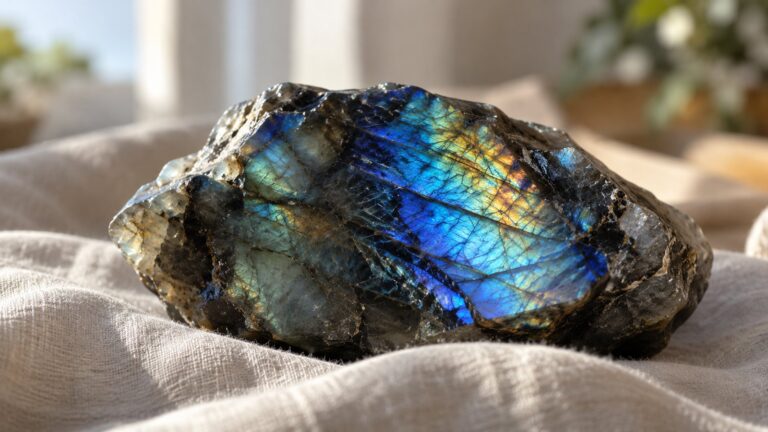
The same feldspar layers that make the glow are close in size to the wavelength of visible light, which is why the effect works. Moonstone is not the only stone to show it. GIA lists labradorite and sanidine among other feldspars that can produce adularescence.
Hardness is 6 to 6.5 on the Mohs scale. As Geology.com points out, moonstone has two directions of perfect cleavage, so a sharp impact can break it. That puts it among stones that look sturdy but need care in rings and bracelets.
Adularescence Is Not Labradorescence
Moonstone glows with a soft, diffuse sheen in blue or white. Labradorite flashes with saturated, shifting colors. The two effects have similar physical roots in layered feldspar but look quite different. Cutters shape moonstone into smooth domes, called cabochons, so that the glow sits at the center. The highest-quality moonstone is nearly transparent with a blue glow that moves.
Where Moonstone Comes From
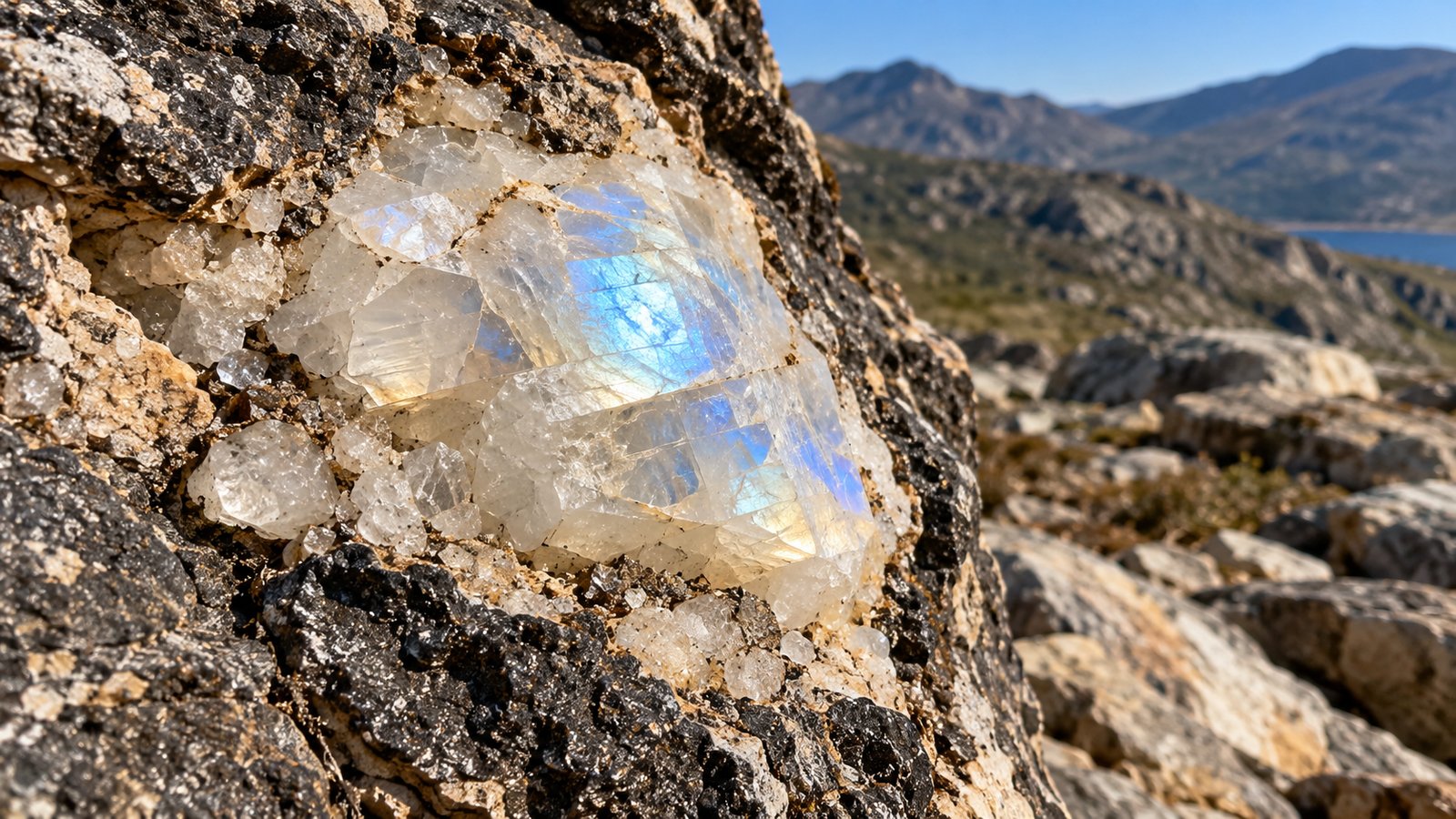
Sri Lanka is the world’s most important source of fine moonstone, according to Geology.com. Other producers include India, Myanmar, Brazil and Madagascar, with smaller amounts from other countries. Color ranges from colorless and white to gray, peach, green and brown, and the most prized stones are nearly clear with a vivid blue sheen.
Moonstone was among the original modern birthstones listed in 1912, and GIA lists it as a June birthstone alongside pearl and alexandrite. Jewelry designers from the Art Nouveau period used it widely, and it still appears in modern designs, often set in silver.
Rainbow Moonstone
Rainbow moonstone is a trade name for a pale, milky stone that flashes several colors. GIA explains that this material, found in Madagascar, is actually labradorite and not orthoclase. The name is common in shops and not wrong as a trade term, but it is useful to know the mineral. Readers of our labradorite guide will recognize the name.
What Moonstone Means in Crystal Traditions
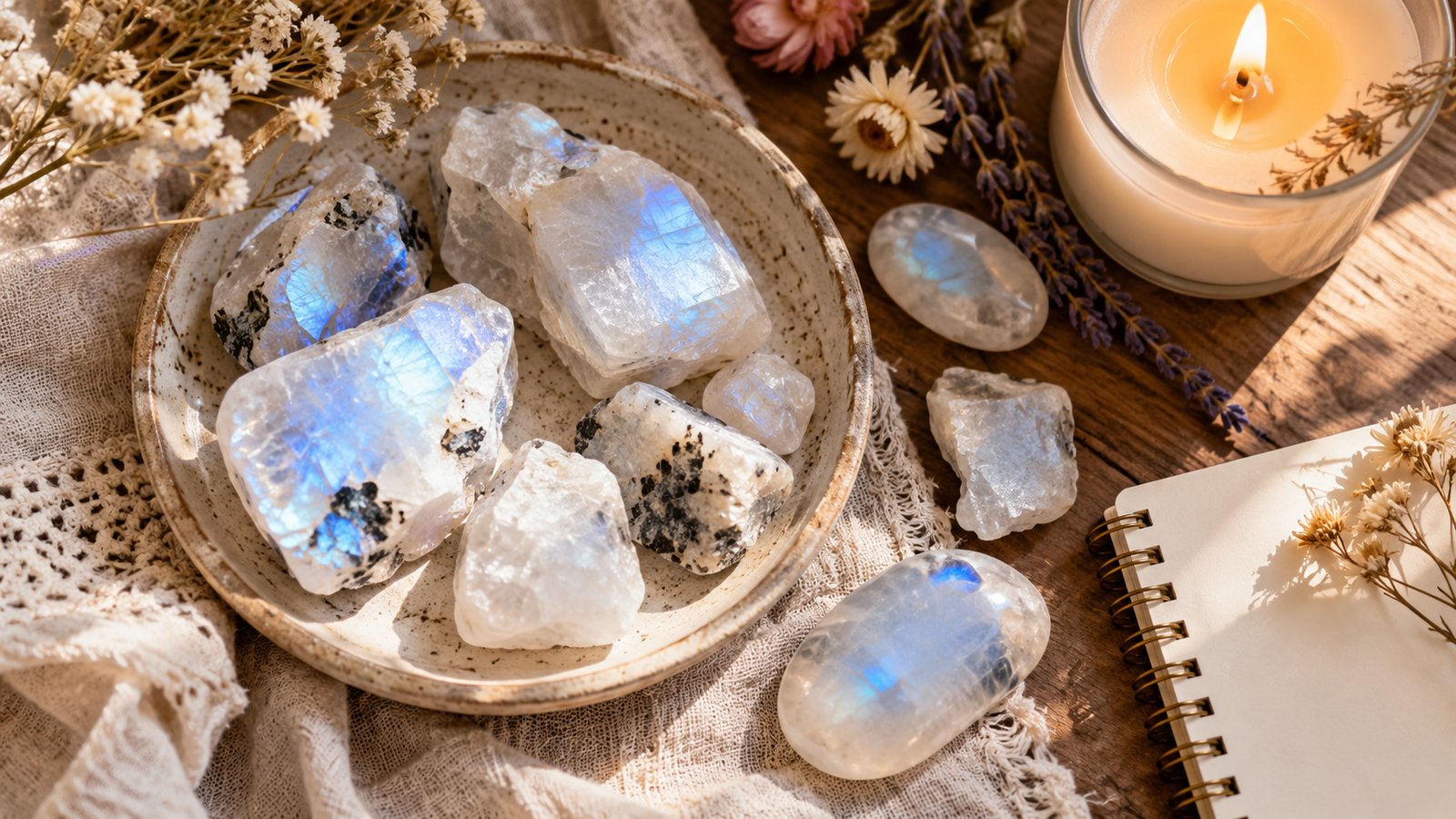
Crystal traditions tie moonstone closely to the moon and its cycles. Meanings here are cultural and spiritual, and nobody has measured them in a laboratory.
- New beginnings. The moon starts each month anew, so moonstone is a favorite for new projects and fresh starts.
- Intuition. The soft glow encourages many practitioners to treat it as a stone for listening to their inner voice.
- Cycles and rhythm. Moonstone is used in rituals tied to the lunar calendar, such as setting intentions at the new moon.
- Emotional balance. People who journal at night sometimes keep a piece nearby as a calming object.
- Feminine energy. Traditional language links moonstone to the divine feminine, a symbolic idea in many spiritual practices.
An old tradition holds that moonstone was a lover’s stone that helped couples reconcile, and others say travelers carried it for safe passage at night. Such stories vary by source and are impossible to verify, so they are better enjoyed as folklore than as fact.
Astrology lists commonly pair moonstone with Cancer, the sign ruled by the moon, along with Libra and Scorpio. Compare more pairings in our zodiac crystals guide. The moon ties moonstone to water for some people, and the aquamarine guide covers another water-associated stone.
People often keep a moonstone on a desk or around the neck as a gentle reminder to pause, and that is a pleasant, honest use.

Moonstone Across Cultures
The International Colored Gemstone Association describes moonstone as holy and magical in India, where it has been called a dream stone, and a study of Sanskrit mineral literature mentions a gem called candrakanta, “moonlight.” The American Gem Society’s history records that the ancient Romans and Greeks linked the stone to lunar deities, and that Pliny wrote about its changing shimmer in relation to the phases of the moon. Those are traditions and reports of belief, and they show how consistently people tied the glow to the moon.
GIA’s history of moonstone notes that Art Nouveau designers, René Lalique among them, made the stone a signature gem of their jewelry, and the stone is still treasured as the June birthstone. The pattern across cultures is steady: a glow that seems to move beneath the surface invites a lunar story.

Moonstone in Jewelry
Moonstone has been a jewelry stone for generations. Designers working in the Art Nouveau period favored it for its soft glow, and today it appears in engagement rings, pendants and stacking bands. Because the cleavage can split the stone, setting choices matter. A bezel setting that wraps the edge gives better protection than a prong setting, and a pendant or earring faces less risk than a ring worn through daily chores.
Cabochon shape is the norm. A tall dome shows the glow best, and a thin or flat dome loses it. Cutters orient the stone so the sheen appears in the center of the dome when viewed from the top. A glow at the edge suggests the stone was cut without much care, and the price should reflect that.
Fine blue moonstone is the most valuable type. Colorless stones with a strong blue sheen top the market, while peach, gray and brown stones with a white sheen cost less. Larger stones with clean interiors and a floating glow cost more than small, cloudy ones. Compare similar sizes and colors, and ask where the stone was mined.
Birthstones and Anniversaries
June is one of the few months with three stones: pearl, alexandrite and moonstone, per GIA. A moonstone for a June birthday carries a personal touch and is more affordable than alexandrite. Since moonstone links to the moon, it also makes an easy gift for a new baby or a new chapter. Include a note that the stone is a gift of symbolism and not a promise.

Simple Ways to Work With Moonstone
- Set an intention at the new moon. Write one goal on a card and keep the stone beside it for a lunar month.
- Evening reflection. Hold the stone and note three things that went well, then set it down and finish the day.
- Journaling. Keep a piece on the notebook cover when writing about change.
- Meditation. Watch the glow shift as you tilt the stone, and use the movement to focus your attention.
- Full moon ritual. Rest the stone on a windowsill and cleanse it in moonlight.
Each of these is a ritual, and a ritual works through attention, not through any property of the stone. That attention is useful. A few minutes of quiet each evening has value whether or not a crystal sits in your hand.
Moonstone also pairs well with other pale stones in jewelry, such as clear quartz and pearls, and with deeper stones such as amethyst for contrast. Designers set it in silver more often than gold, since white metals echo the cool glow, though yellow gold gives the peach and gray stones a warm look.
Lunar timing is a popular but optional layer. Some people cleanse and set intentions at the new moon and release or reflect at the full moon. The moon does follow a predictable cycle of about 29.5 days from one new moon to the next, so the habit gives a monthly rhythm for planning. Whether you use a calendar app or a crystal, the benefit comes from returning to your goals regularly.
Finally, treat moonstone with the same curiosity you would give any natural object. Look closely, tilt it in the light and notice how the sheen changes. The physics of layered feldspar and the folklore of moonlight are two ways of appreciating the same stone, and neither needs exaggeration.
A practical way to explore moonstone is to compare two pieces side by side. Hold a blue-sheen cabochon and a plain white one under the same lamp, and tilt each slowly. The difference in how the glow floats and fades shows what the layered structure is doing and helps you decide what appeals to you. Many collectors find that a modest stone with a clearly moving sheen gives more pleasure than a large stone with a flat look.
Action steps help turn curiosity into a habit. Pick one stone, note its Mohs hardness, name the feldspar it belongs to, and write down one tradition associated with it. Keep the notes with the stone. After a month, revisit them and see what you remember, which tradition still appeals and which fact surprised you most. That small routine builds real knowledge about the stones you own.

How to Care for Moonstone
- Clean with a soft cloth, lukewarm water and a drop of mild soap. Rinse and dry.
- Avoid ultrasonic and steam cleaners. Cleavage planes and any fractures can widen.
- Protect from knocks. Wear moonstone rings with a protective setting, and remove them for heavy work.
- Keep away from harder stones. Quartz, topaz, sapphire and diamond can scratch it.
- Avoid chemicals such as bleach, acids and strong cleaners.
- Avoid heat. Sudden temperature changes can crack a stone.
- Store wrapped in a soft pouch.
For energy cleansing, moonlight is a natural fit, and that tradition suits the stone. Setting a piece on a windowsill overnight at a full moon is common. Other methods are in the guide to how to cleanse crystals.

How to Spot Fake Moonstone
Moonstone is mid-priced, with fine blue stones commanding high prices, so imitations are common.
- Opalite. Opalite is a man-made glass with a blue-white glow, sold in many shops as synthetic moonstone or sea opal. The glow looks too uniform and often shows a milky look in any direction. Real adularescence shifts as the stone moves.
- Glass cabochons. Glass often has round bubbles and looks too clear. A real moonstone typically has fine internal texture, including tiny cracks called centipedes.
- Labradorite sold as moonstone. Such a label may be a legitimate trade name for rainbow moonstone, so ask what the mineral is.
- Doublets. A thin slice of moonstone glued to a base can show up in cheap jewelry. Check the side of the cabochon for a join line.
- Dyed stones. Colorful moonstone in bright colors is often dyed or coated.
Look for the sheen to float beneath the surface and shift as you move the stone, rather than sit flat on top. A real moonstone often has small internal features such as cracks. Gem labs identify material with instruments, which makes sense for a ring or any purchase of real value.
Buy from sellers who say what the stone is and where it came from, and who allow returns. A very low price for a large, clean, blue-sheen cabochon is a warning sign, since top-quality stones carry high prices.

Frequently Asked Questions
What makes moonstone glow?
Alternating thin layers of orthoclase and albite scatter light. GIA calls the effect adularescence.
What is the Mohs hardness of moonstone?
It is 6 to 6.5, and the stone has perfect cleavage, so it can break on impact.
Is rainbow moonstone real moonstone?
GIA notes that rainbow moonstone is a trade name for a labradorite variety, so it is a real mineral but not orthoclase moonstone.
Which month is moonstone the birthstone for?
June, alongside pearl and alexandrite, per GIA.
Can moonstone go in water?
A brief rinse is fine, but avoid long soaks and ultrasonic cleaners.
Where does the best moonstone come from?
Geology.com lists Sri Lanka as the most important source of fine moonstone.
Is opalite moonstone?
No. Opalite is a glass. It is sold under several names and has no connection to feldspar.
Does moonstone help with sleep or emotions?
Crystal traditions say so: moonstone is the classic stone of intuition and quiet evenings. Use it as a symbol and a ritual.