| ✨Hey there! This post may contain affiliate links, meaning we earn a commission if you make a purchase through our links, at no cost to you. Please read our disclosures for more info. |
Quick answer: carnelian is the orange-to-red variety of chalcedony, a microcrystalline quartz (SiO2) with a Mohs hardness of about 6.5 to 7. Iron oxide gives it color, and heating has been used to deepen that color for thousands of years. Crystal traditions link it with motivation, warmth and creativity. Most fakes are dyed agate or glass, so look for natural color variation and a waxy glow.
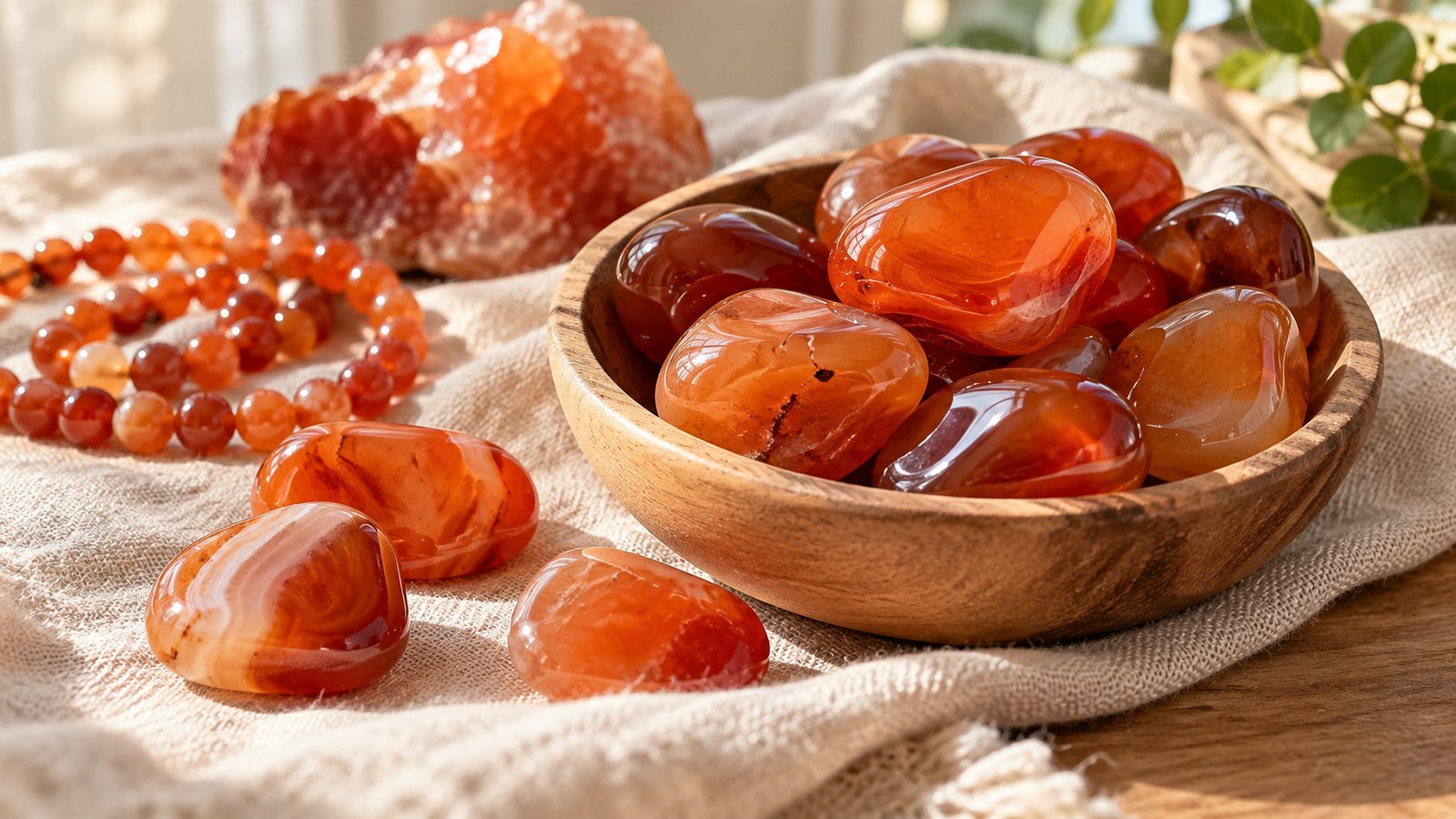
Some stones feel like a small piece of sunset, and carnelian is one of them. Hold a good piece up to the window and the light passes through in shades of tangerine, rust and deep red, almost like looking at a lit ember. People have been drawn to that color for a very long time, which is why carnelian shows up in some of the oldest jewelry ever dug out of the ground.
This guide covers what the stone actually is, where it comes from, the surprisingly rich archaeology behind it, what crystal traditions say it means, and how to care for it and tell a real piece from a dyed one. The science comes from mineral and museum sources, and the meanings are labeled as tradition. If you are new to stones, the crystal meanings guide gives the big picture first.
Contents
hide
What Carnelian Is
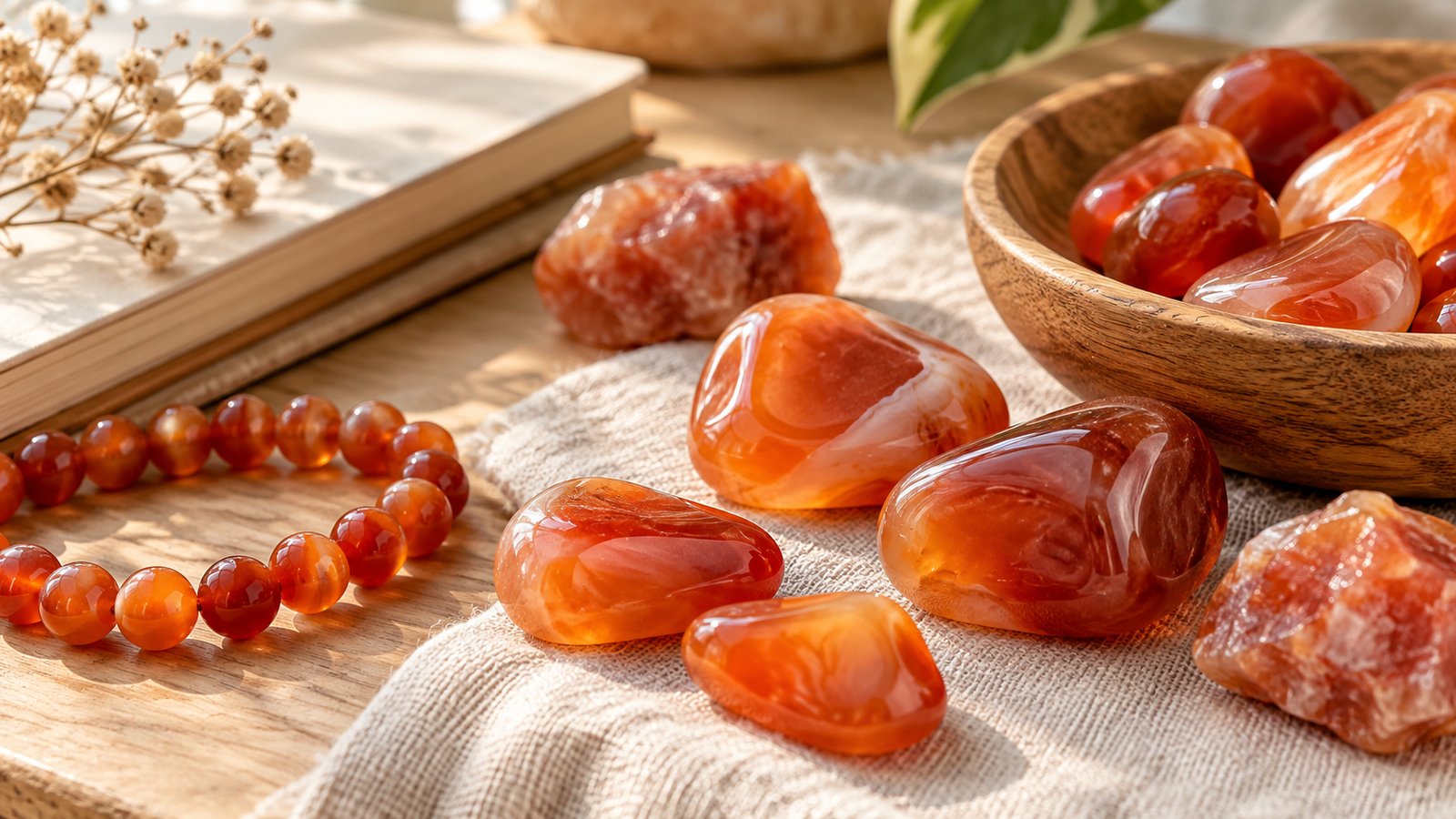
Carnelian is a variety of chalcedony. Chalcedony is quartz made of crystals so tiny that you cannot see them without a microscope, which is why the stone looks smooth and waxy instead of glassy like a quartz point. Britannica describes carnelian as a translucent variety of chalcedony whose red to reddish-brown color comes from finely dispersed hematite, a form of iron oxide.
Its chemical formula is SiO2, the same as amethyst and citrine, and its Mohs hardness is about 6.5 to 7. That is tough enough for rings and bracelets, with a fracture that breaks in smooth, curved surfaces called conchoidal fracture and no cleavage planes. Those features are why carvers have favored it for fine detail.
Sard is a close relative. Britannica notes that sard differs from carnelian mainly in having a browner shade of red. Agate is also chalcedony, though it forms in bands, and onyx has straight black and white bands. The names describe color and pattern, and the mineral underneath is largely the same.
Color ranges from pale orange to a dark brownish red. A uniform, glowing orange-red is more prized than a muddy brown, but the most intense colors often come from treatment, which brings us to heat.
Heat and Color
Archaeological writers on the carnelian trade, including a feature in the magazine The Past, explain that yellow or brown chalcedony colored by hydrated iron oxides such as goethite turns orange to red when heated to roughly 250 to 350 degrees Celsius, because those compounds convert to hematite. Heat treatment is therefore an old, accepted practice, and many stones sold as carnelian today began as paler chalcedony. Good sellers say so.
Where Carnelian Comes From
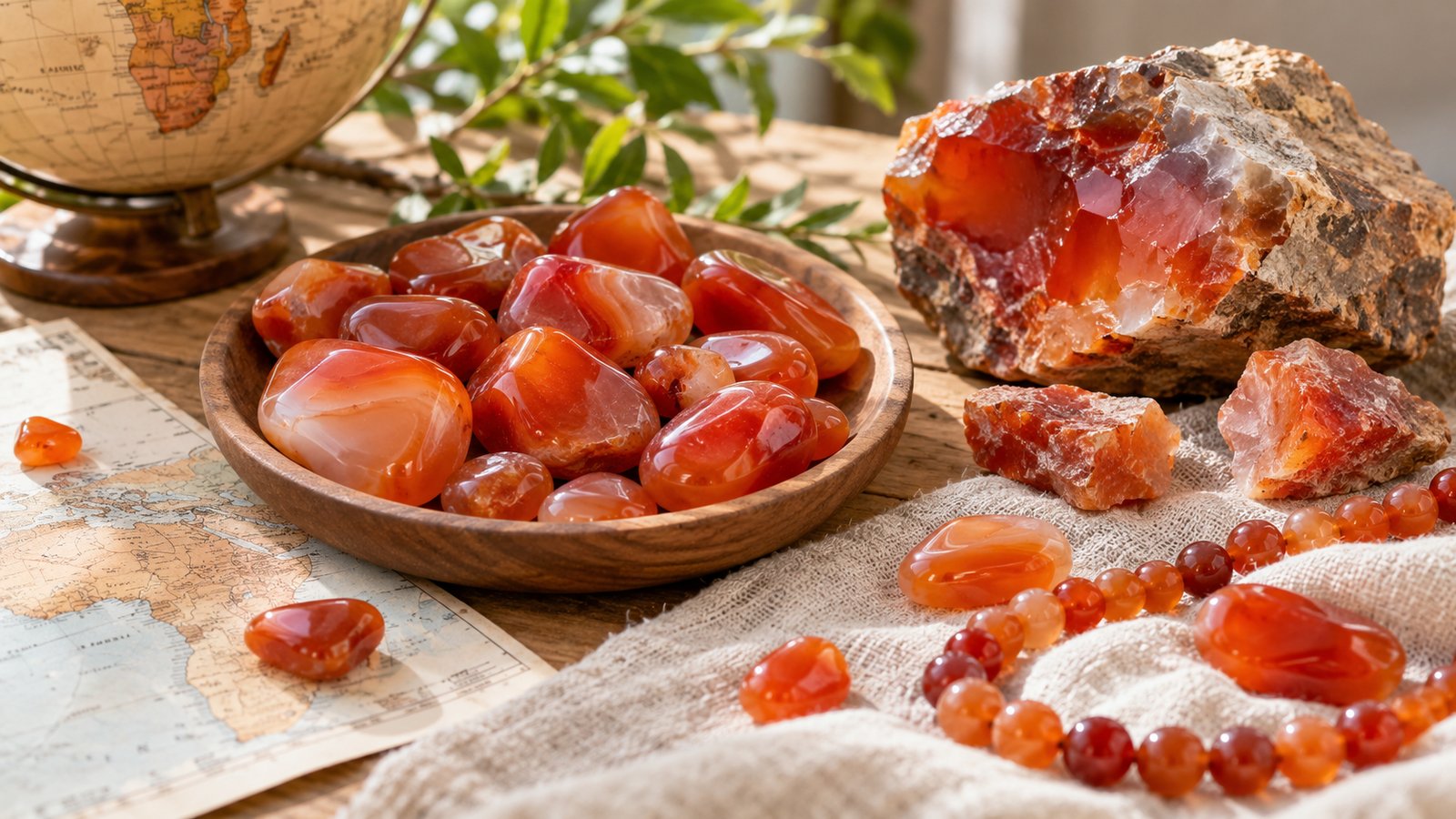
India has been a major source and a processing center for carnelian for millennia, and the gem trade still points to Indian workshops, especially in Gujarat, as centers for heating and finishing. Other sources include Brazil, Uruguay and Madagascar.
Chalcedony forms where silica-rich water moves through cavities and cracks in volcanic rock, then slowly deposits layers of microscopic quartz. Carnelian often occurs as nodules or pebbles that river action has rounded, which is why some of the best-known ancient beads are made from small, water-worn pieces.
Cutters usually shape the stone into cabochons, beads and flat engraving blanks, and they sort rough by how evenly the color runs through it. Pieces with a clear, warm orange and a smooth polish rise to the top of the price list, while cloudy brown pieces become tumbled stones and cheap beads.
Because large, clean pieces are plentiful, carnelian stays affordable. A tumbled stone costs very little, and fine cabochons and carvings cost more because of workmanship rather than rarity.
Carnelian in Ancient and Historical Records
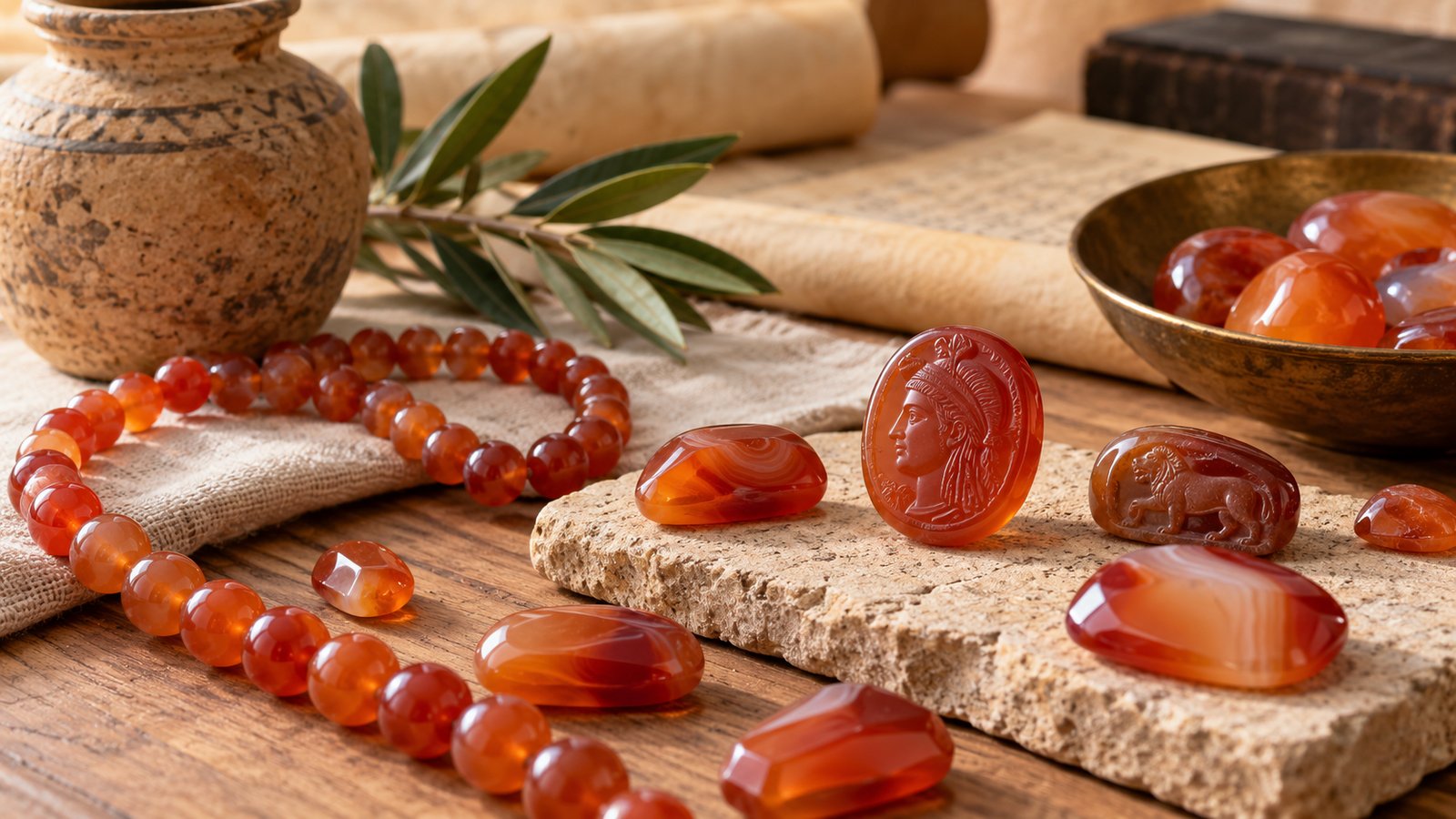
Few stones have a clearer archaeological trail. The British Museum describes etched carnelian beads that first appeared in the Indus Valley around the middle of the third millennium BCE. Craftspeople painted a paste of washing soda and plant juice onto the stone, then fired it so a permanent white design remained, and the museum’s experiments reproduced that technique. Similar beads have been found from Iran and Iraq to Syria, Ukraine and Russia.
Etched carnelian beads found in the Royal Cemetery of Ur, dated to roughly 2600 to 2450 BCE, are described by the museum as probably imported from the Indus Valley. Cuneiform texts from the time of Gudea of Lagash, around 2125 BCE, list bright carnelian from a land called Meluhha among goods brought to Sumer. Most scholars link Meluhha with the Indus region.
Greeks and Romans carved carnelian into intaglios, engraved gems pressed into wax as signatures. Britannica notes that some of these ancient intaglios have kept a high polish better than harder stones, and many writers add that wax does not stick to smooth chalcedony, which made it practical for sealing letters.
Egyptian jewelers used the stone widely as well. Carnelian beads and inlays appear in burial goods, including pieces linked with Tutankhamun, according to jewelry historians.
Craft knowledge traveled along with the stone. The same technology that etched white designs onto beads also spread eastward and westward over many centuries, which is why a bead from Ukraine and a bead from Mesopotamia can look so similar. For a modern reader that is a useful reminder: the orange stone in your jewelry box belongs to a very old chain of human skill, and the oldest chapters are written in museum catalogs rather than in crystal books.
Some traditions also tie carnelian to religious customs, such as stories about signet rings in early Islamic history. Those accounts come from devotional literature, and this guide treats them as tradition rather than archaeology.
What Carnelian Means in Crystal Traditions
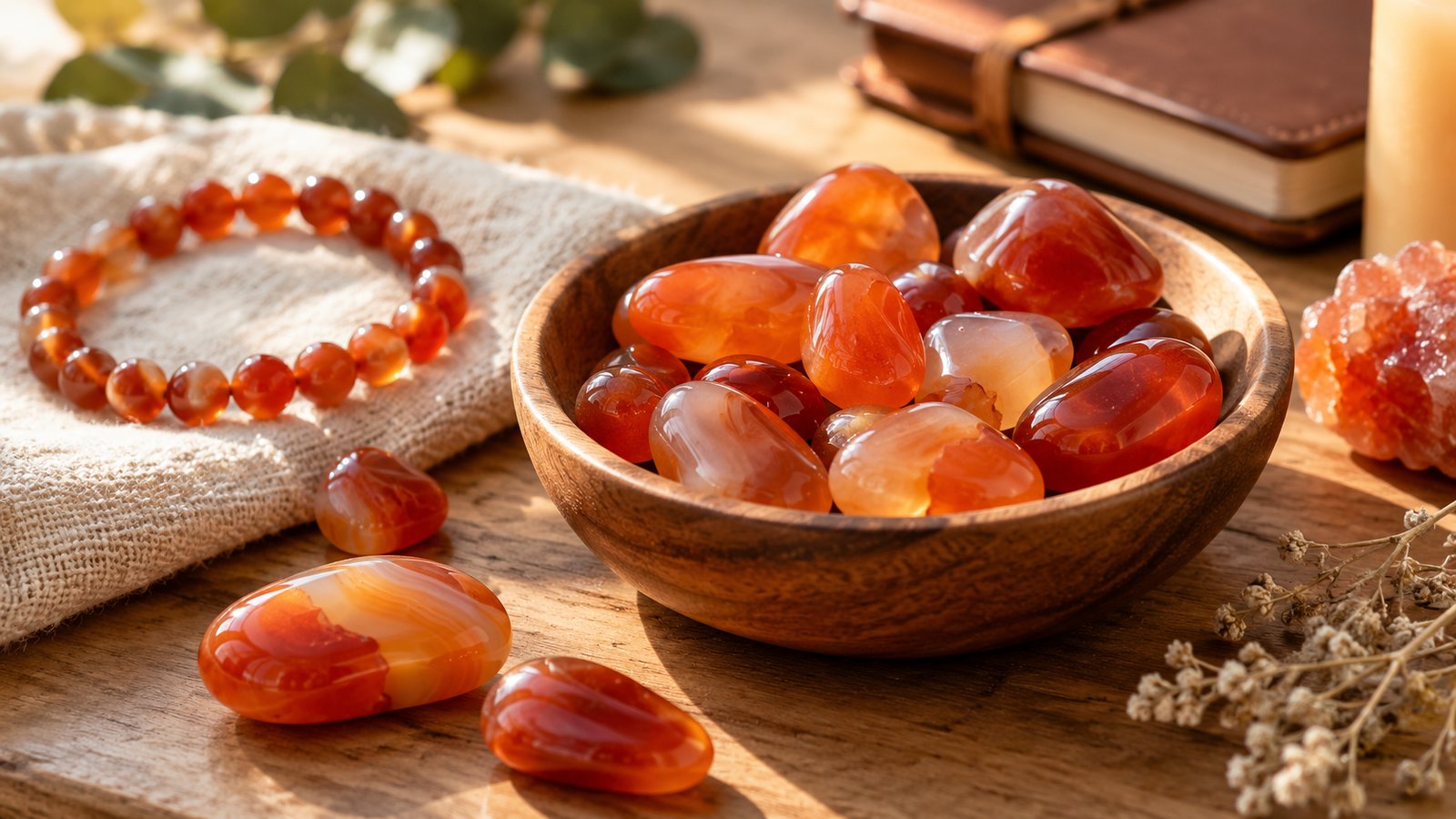
The next list reflects modern crystal practice and older folklore. None of it is scientific, and none of it treats or cures any condition.
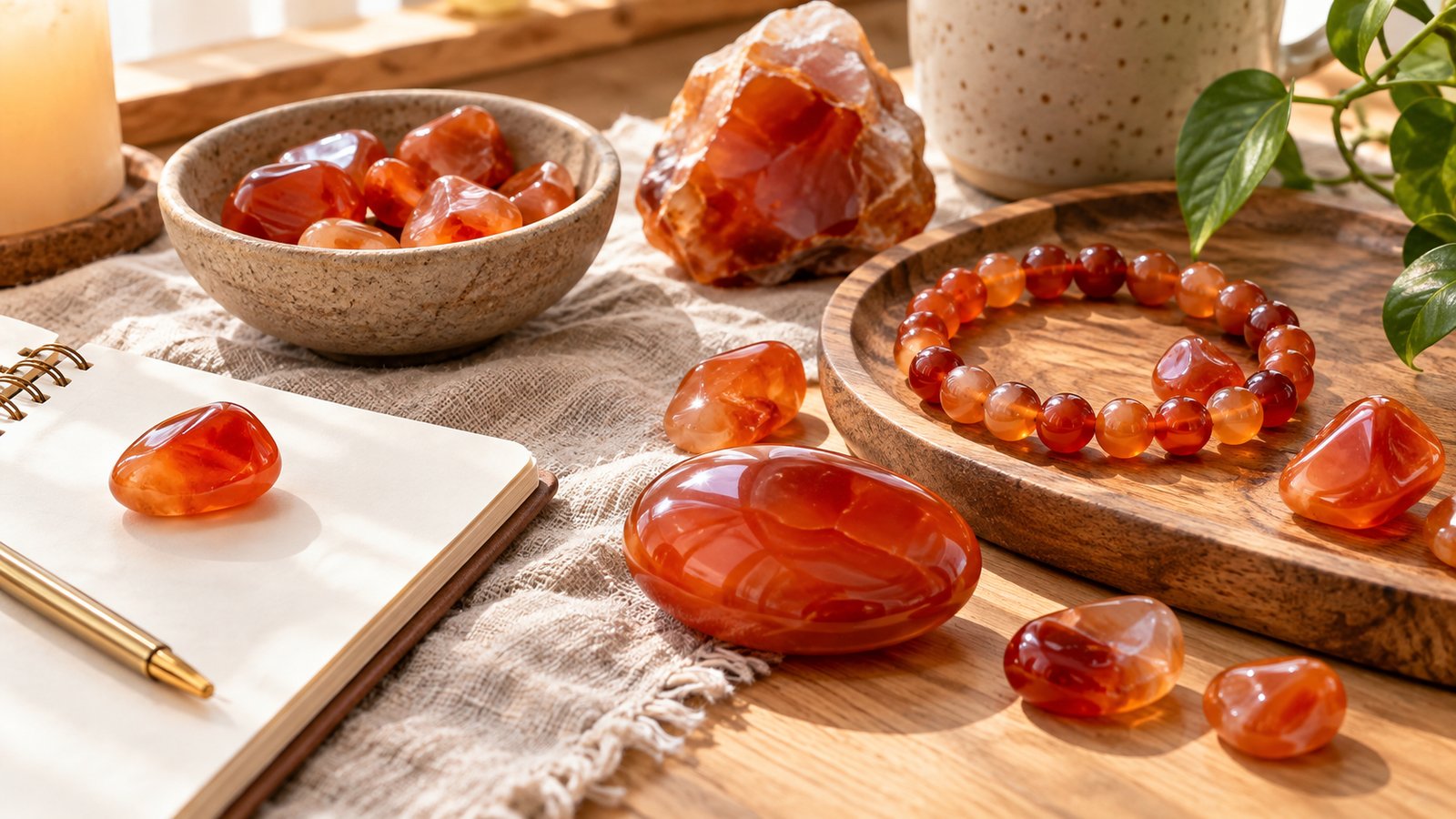
- Motivation and drive. The fiery color leads many practitioners to link carnelian with getting started and following through.
- Creativity. Artists and makers sometimes keep it nearby as a prompt for new projects.
- Courage and presence. Some people carry it before speaking in public.
- Warmth and vitality. The orange tone connects it with the sacral chakra in modern chakra systems, a framework popularized in the twentieth century and not an ancient rule.
- Protection. Older European folklore described carnelian as a guard against envy and misfortune.
Traditions also differ about where to put it. Some people keep carnelian near a workspace, some wear it at the waist or wrist, and others place it in a kitchen or studio where creative work happens. Nothing here is a rule, and you can choose the spot that makes sense for your day. Notice that carnelian traditions emphasize action and warmth, while stones such as amethyst emphasize calm. People who like the contrast sometimes pair them, and the amethyst guide shows how the two stones differ in both science and symbolism.
Simple Ways to Work With Carnelian
A practical routine beats vague wishes. Here is a five-step approach that takes a few minutes in the morning.
- Choose one small task you have been putting off, such as an email, a phone call or a ten-minute tidy.
- Hold the carnelian in your palm and notice its color against the light. Take three slow breaths.
- Say what the first action will be, in plain words and with a time attached.
- Put the stone beside you while you do the task, on your desk or in a pocket.
- When you finish, put it down and note the result in a journal. Tracking wins builds momentum better than any stone could on its own.
Carnelian also suits jewelry, since the hardness handles daily wear. Pair a bracelet with clear quartz for a classic combination, using the clear quartz guide to choose a good piece.
Caring for Carnelian
With a Mohs hardness of 6.5 to 7, carnelian handles normal wear, though harder gems can scratch it. Keep it in a soft pouch and away from loose diamonds, sapphires and rubies.
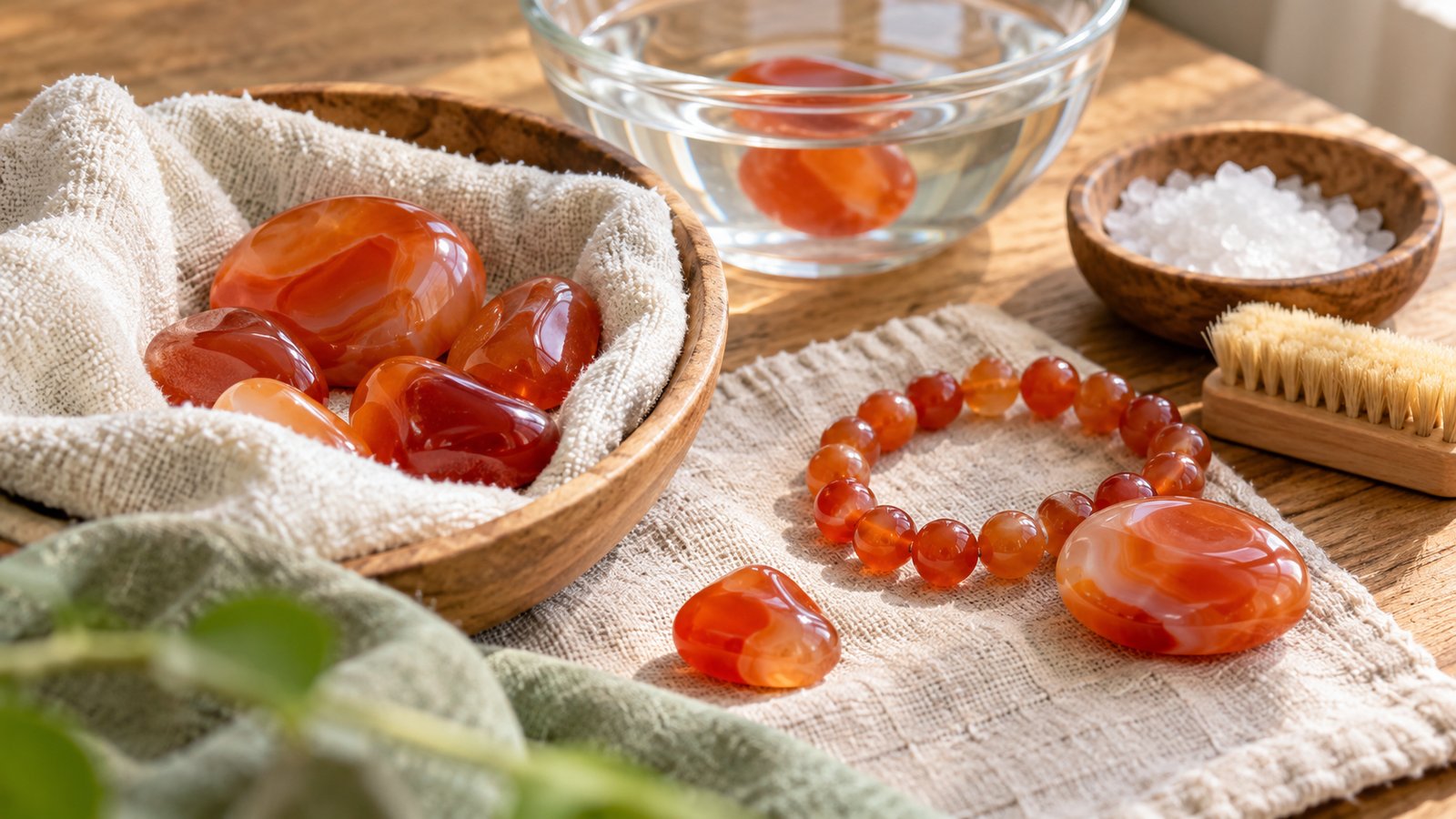
Clean it with lukewarm water, a few drops of mild soap and a soft brush, then rinse and dry. Retailers who specialize in chalcedony usually advise against ultrasonic cleaners, since small internal cracks are common and vibration can stress them.
Avoid long exposure to strong chemicals, hot water and sudden temperature changes. Heat-treated stones have already been through fire, but a quick shock can still crack a thin bead.
Water is generally fine for carnelian. For a longer list of stones that should stay dry, see which crystals cannot go in water.
Storage matters for strands too. Bead necklaces strung on thread can stretch or fray, and knotted silk or nylon cord should be checked every year or so. Beads that knock together can chip at the drill holes, so lay a strand flat in a box instead of hanging it from a hook for years.
Fading is a common question. Natural carnelian can pale slightly with long, strong sun exposure, so rotate display pieces rather than leaving them on a hot windowsill.
For cleansing, people use moonlight, sound, smoke or a selenite plate. These are customs, and the mineral itself needs only soap and water.
How to Spot Fake or Misrepresented Carnelian
The label “carnelian” is applied loosely, so use a checklist.
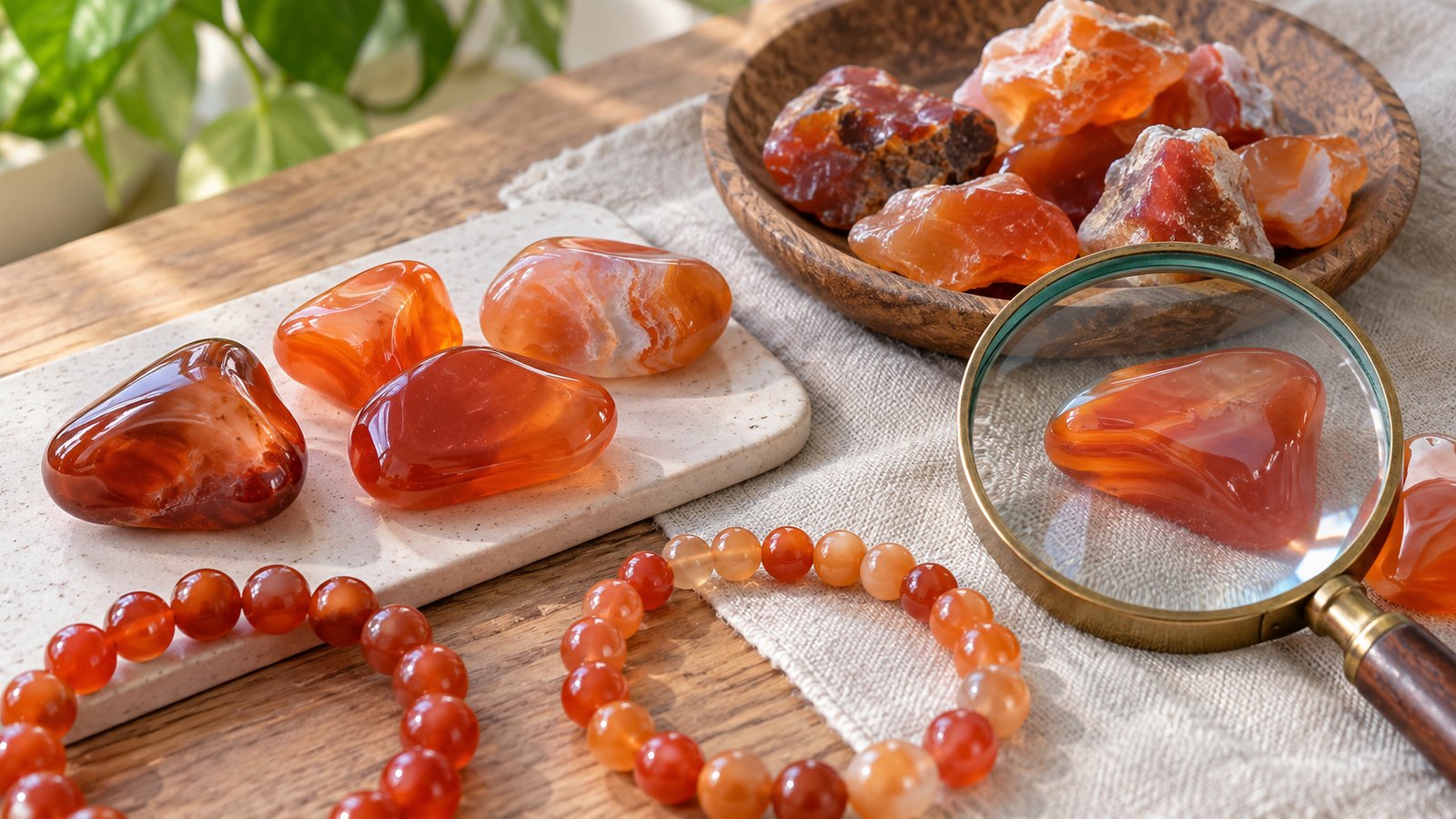
- Dyed agate. Plain gray or white agate can be dyed orange or red. Look for color pooling in cracks and the drill holes of beads, or uniform neon color with no natural variation. Real carnelian shows cloudy patches, small color shifts and sometimes faint banding.
- Glass. Glass beads often feel colder and smoother, may contain round bubbles and can look too perfect. Real chalcedony has a waxy, slightly greasy luster.
- Plastic or resin. These feel light and warm, scratch easily and sound dull when tapped against a tooth or another bead.
- Overheated stones. Some very bright “carnelian” is heat-treated yellow or brown chalcedony. That is accepted in the trade, though the seller should disclose it.
Hold the stone against a strong light. Genuine carnelian is translucent in thin edges and shows uneven glow. A uniform, opaque, flat red is a warning sign.
Buying Tips
Ask whether the stone is natural color, heated or dyed. Check the return policy and buy small first. Compare the price with typical tumbled stones, and be careful with unusual claims such as “rare” or “healing grade,” which have no meaning in mineralogy. Carnelian is a plentiful stone, so a fair price is modest, and you pay extra for skilled carving or fine jewelry work rather than for a mystery.
Frequently Asked Questions
Is carnelian a real crystal?
Carnelian is a natural variety of quartz, but its crystals are microscopic, so you will not see points or facets. It is a real stone with a fine-grained structure.
Is carnelian the same as sard?
They are very close. Britannica says sard differs only in having a browner shade of red, and the trade uses both names, often interchangeably.
Can carnelian go in the sun?
Short exposure is fine, but strong, long sunlight can fade some pieces, so avoid leaving it on a sunny sill all summer.
Is heat-treated carnelian fake?
No. Heating has been used for thousands of years and remains an accepted enhancement. Dyed stones are different, and honest sellers separate the two.
What zodiac sign goes with carnelian?
Lists vary. Some link it with Virgo or Taurus and others with Leo, which shows these are modern associations. The zodiac crystals guide compares several systems.
How hard is carnelian?
Its Mohs hardness is around 6.5 to 7, so it resists everyday wear but can be scratched by harder gems.
Can I wear carnelian every day?
Yes, for most people. The stone is hard enough for daily jewelry, but rings take the most knocks, so bracelets and pendants last longer. Remove it before heavy cleaning, gardening or workouts, and check the setting occasionally to make sure the prongs or glue are still holding the stone firmly in place.