| ✨Hey there! This post may contain affiliate links, meaning we earn a commission if you make a purchase through our links, at no cost to you. Please read our disclosures for more info. |
Quick answer: lapis lazuli is a deep blue rock, not a single mineral, made mainly of lazurite with white calcite and gold-colored flecks of pyrite. It is soft for a gemstone (Mohs hardness about 5 to 5.5), so it needs gentle care. Crystal traditions link it with truth, wisdom and clear expression. The most common fakes are dyed jasper or howlite, glass and the man-made imitation sold as “Gilson” lapis.
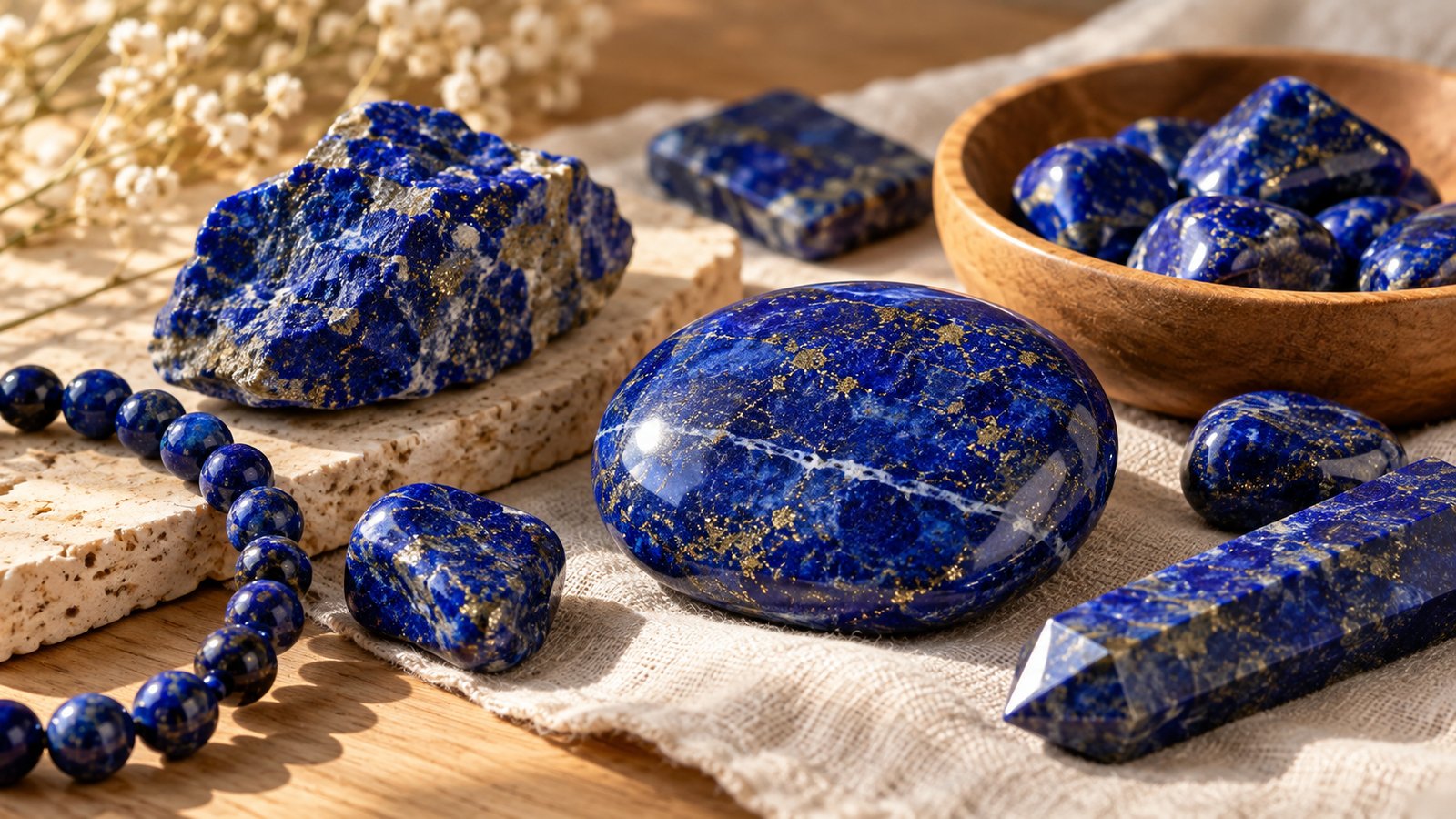
Few colors stop people in their tracks like the blue of fine lapis lazuli. The color is a deep, saturated, slightly violet blue, scattered with tiny sparkles that look like stars on a night sky. People have been carving, grinding and trading this stone for thousands of years, and some of the oldest jewelry in the world is made of it.
That long record makes lapis an unusually good stone to learn about. The science is surprising, the history is documented in museums and the facts behind the fakes are practical. This guide follows the usual pattern of this series: mineral facts from gemological and museum sources first, then tradition clearly labeled as tradition. The crystal meanings guide shows how lapis fits among the other stones.
Contents
hide
What Lapis Lazuli Is Made Of
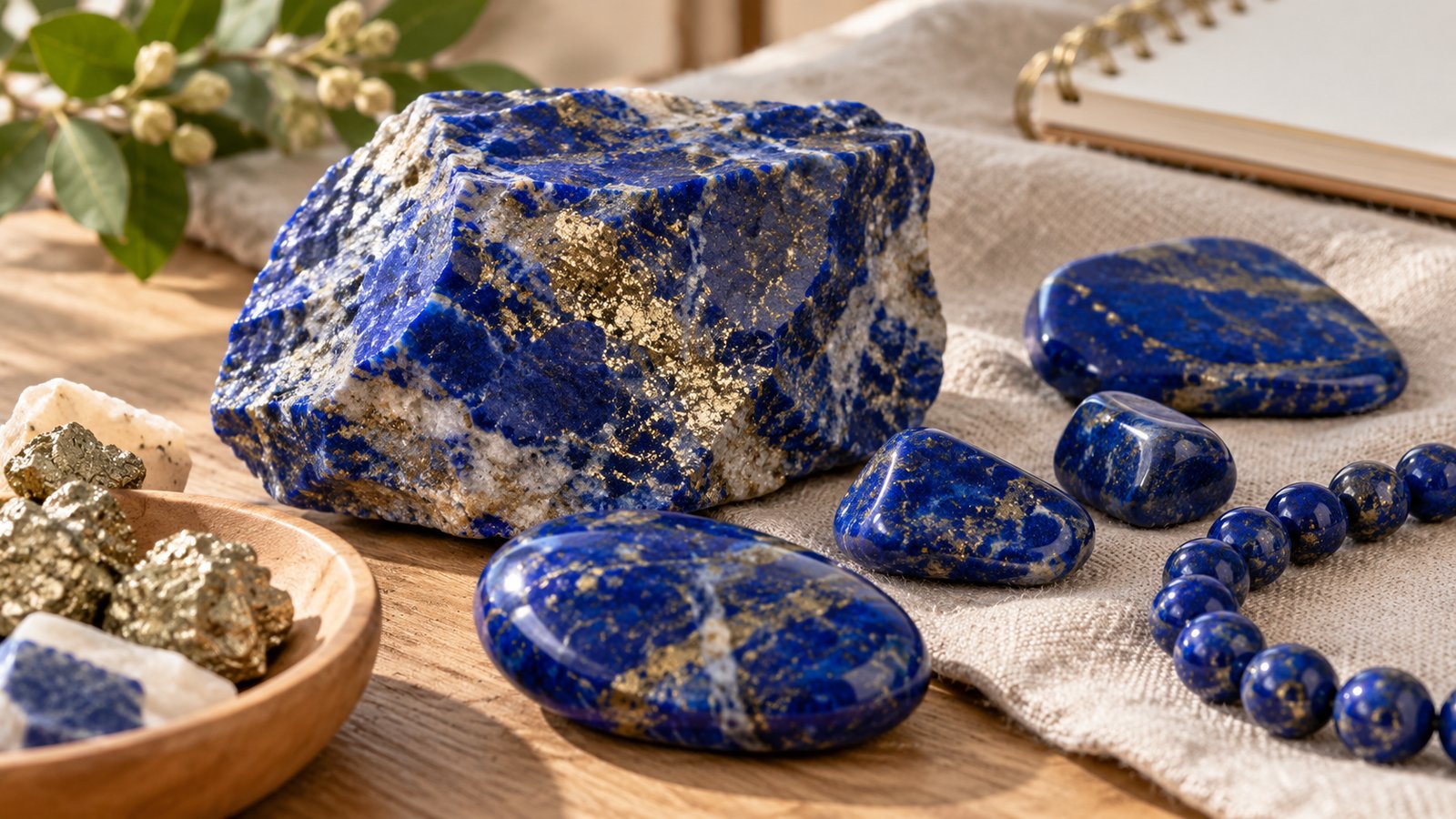
Lapis lazuli is a rock, which means it is a mixture of minerals. The Gemological Institute of America (GIA) describes it as an aggregate of several minerals, mainly lazurite, calcite and pyrite. Lazurite is the ingredient responsible for the royal blue. Calcite shows up as white streaks and patches, and pyrite appears as the golden flecks. Lesser amounts of diopside, amphibole, feldspar or mica can also be present.
GIA lists the color as greenish blue to violetish blue and the specific gravity as about 2.75, give or take. The stone is opaque and usually cut as cabochons, beads, inlays or flat tablets rather than faceted gems.
Because lapis is a mix, its properties vary from piece to piece. Mineral references usually give a Mohs hardness of about 5 to 5.5, which is softer than quartz and close to a steel knife blade. Calcite is softer still and reacts with acids, a fact that matters for cleaning.
Quality depends on color first. The most valued material is an even, dark blue to violet-blue with little visible white calcite and a small scatter of fine pyrite. A lot of white calcite lowers the value, and heavy, brassy pyrite can look coarse. The goal is a balance of blue, shimmer and polish.
Lazurite Versus Sodalite
Sodalite is a similar blue mineral often confused with lapis. It is usually a bit more purple-blue with white veins and has no gold flecks, because it generally lacks pyrite. A quick test is to look for the gold: sodalite rarely has it, and lapis usually does.
Where Lapis Lazuli Comes From
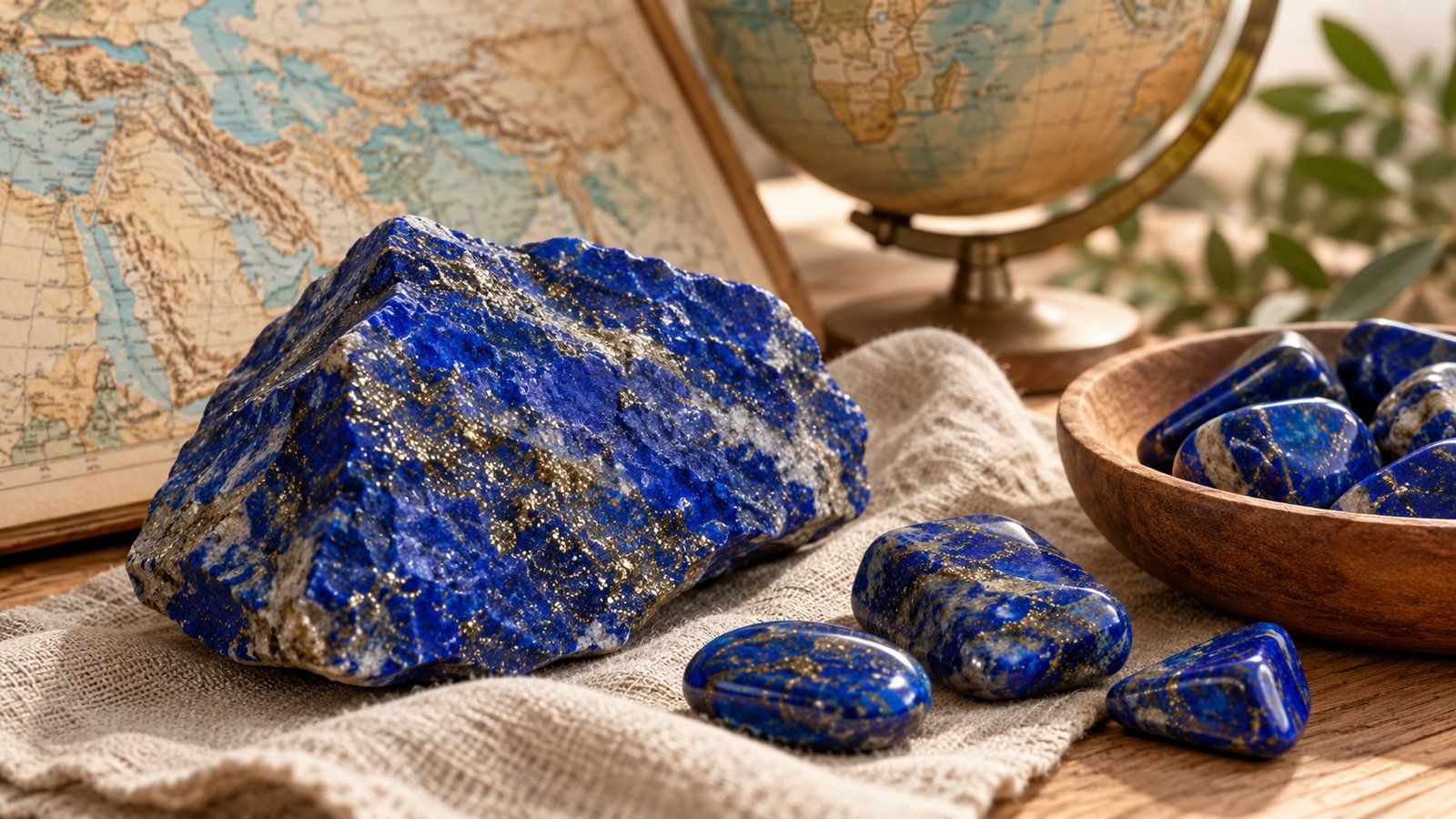
Afghanistan is the classic source. The Sar-e-Sang mines in the mountains of Badakhshan have produced lapis for thousands of years, and GIA notes that in 1271 Marco Polo described the lapis mines of ancient Bactria, the same region. Scholars believe the link between people and lapis there reaches back beyond 6,500 years.
Other sources include Chile, Russia near Lake Baikal, Tajikistan, Myanmar and the United States. Chilean lapis is often paler and more mixed with calcite, while Afghan material is famous for its deep color.
This blue rock forms when limestone is changed by heat and pressure in a process called contact metamorphism, which creates lazurite alongside calcite and pyrite. Because that combination is geologically unusual, good deposits are few, which helps explain why the stone traveled so far in ancient trade.
Lapis in Ancient and Historical Records
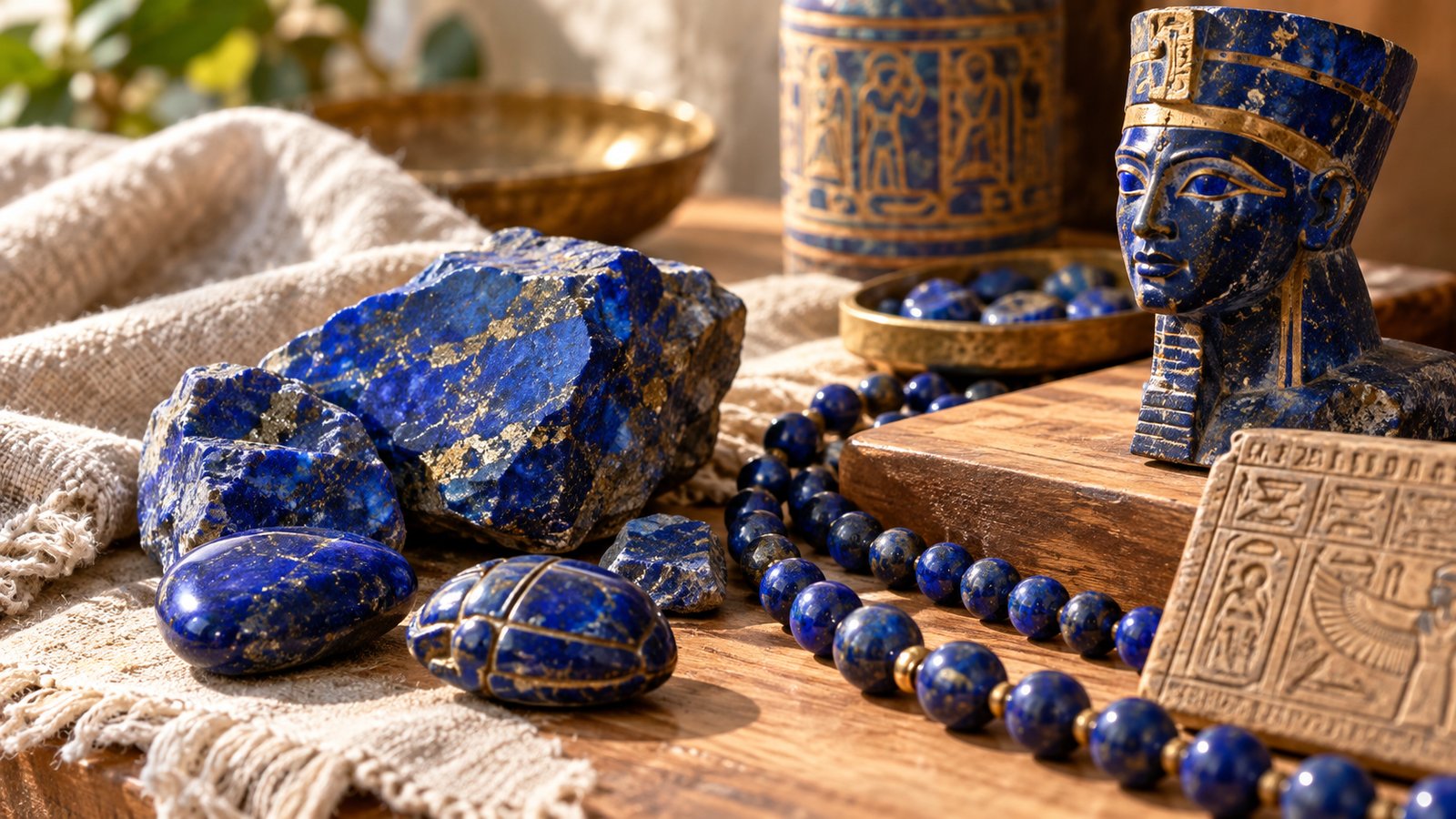
GIA states that lapis was treasured by the ancient civilizations of Mesopotamia, Egypt, China, Greece and Rome. The museum record backs that up. Lapis inlays, beads and cylinder seals were among the grave goods in the Royal Cemetery at Ur in Mesopotamia, which dates to around 2600 to 2450 BCE, and the stone’s source was far away in Afghanistan, which shows how extensive trade routes were even then.
Egyptian craftspeople used lapis in amulets, scarabs and inlays, and the famous gold funerary mask of Tutankhamun uses blue inlay in the striped headdress and brow, a combination that museum catalogs describe as lapis lazuli and glass.
The most famous use may be pigment. For centuries, painters crushed lapis and purified it into ultramarine, whose name means “beyond the sea” because the stone came from across it. GIA notes that Renaissance painters used lapis to make this expensive pigment of unrivaled brightness and stability. Because ultramarine cost as much as gold in many periods, patrons sometimes specified in contracts exactly how much real ultramarine an artist had to use, usually for the robes of the Virgin Mary. Johannes Vermeer’s use of natural ultramarine in the turban of his well-known painting is widely documented by conservators.
Natural supply shaped art history, because a painter who could not afford ultramarine had to use cheaper blues that were less stable and less brilliant. Many museum conservators say this is why certain blues in old paintings look different from the original intent. The pigment story also shows how lapis moved from the mine to the studio by long trade routes, passing through merchants in Venice that gave the color its European name. In the 1820s chemists succeeded in making synthetic ultramarine, a much cheaper pigment, and that discovery changed both painting and the dye trade. Today the synthetic version is still sold in paint tubes, and the natural stone is used mainly as a gem material.
Why the Pyrite Matters
The golden flecks are more than decoration. Pyrite helps with identification, because dyed look-alikes rarely contain real pyrite crystals, and it also records how the rock formed. Under a loupe, real pyrite looks like tiny angular metallic patches that catch light from only one angle, while glitter in glass looks round and sparkles from every direction. If you can look at a stone under a bright lamp and a 10x loupe, spend a minute on this check before buying.
What Lapis Lazuli Means in Crystal Traditions
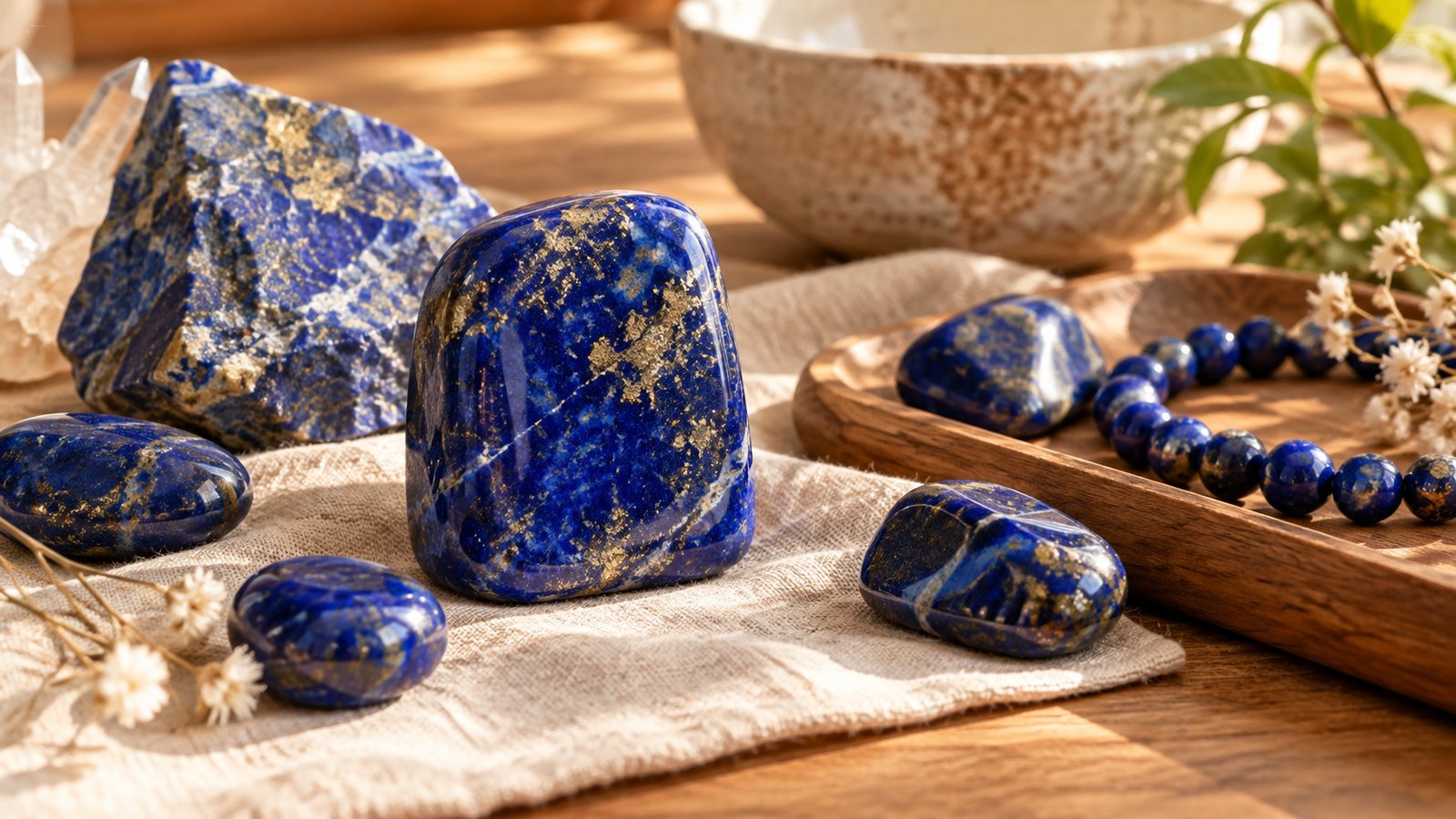
Tradition gives lapis a reputation for wisdom and honest speech. The associations below are beliefs and customs, and nothing here is medical.
- Truth and honesty. The deep blue links lapis with the idea of speaking clearly, a theme tied to the throat chakra in modern systems.
- Wisdom and inner vision. Writers and students sometimes keep it nearby as a reminder to think carefully and ask questions.
- Royalty and status. Because rulers prized it, lapis became a symbol of authority, and Egyptian traditions linked it with the heavens.
- Protection. Ancient amulets made from lapis were meant to protect wearers, according to museum descriptions of the objects.
- Calm contemplation. Many people simply find the dark blue restful to look at.
Some modern websites claim that lapis treats headaches, depression or other medical problems. There is no scientific support for those claims, and this guide does not make them. Use the stone as a visual reminder and keep working with a doctor for any health concern.
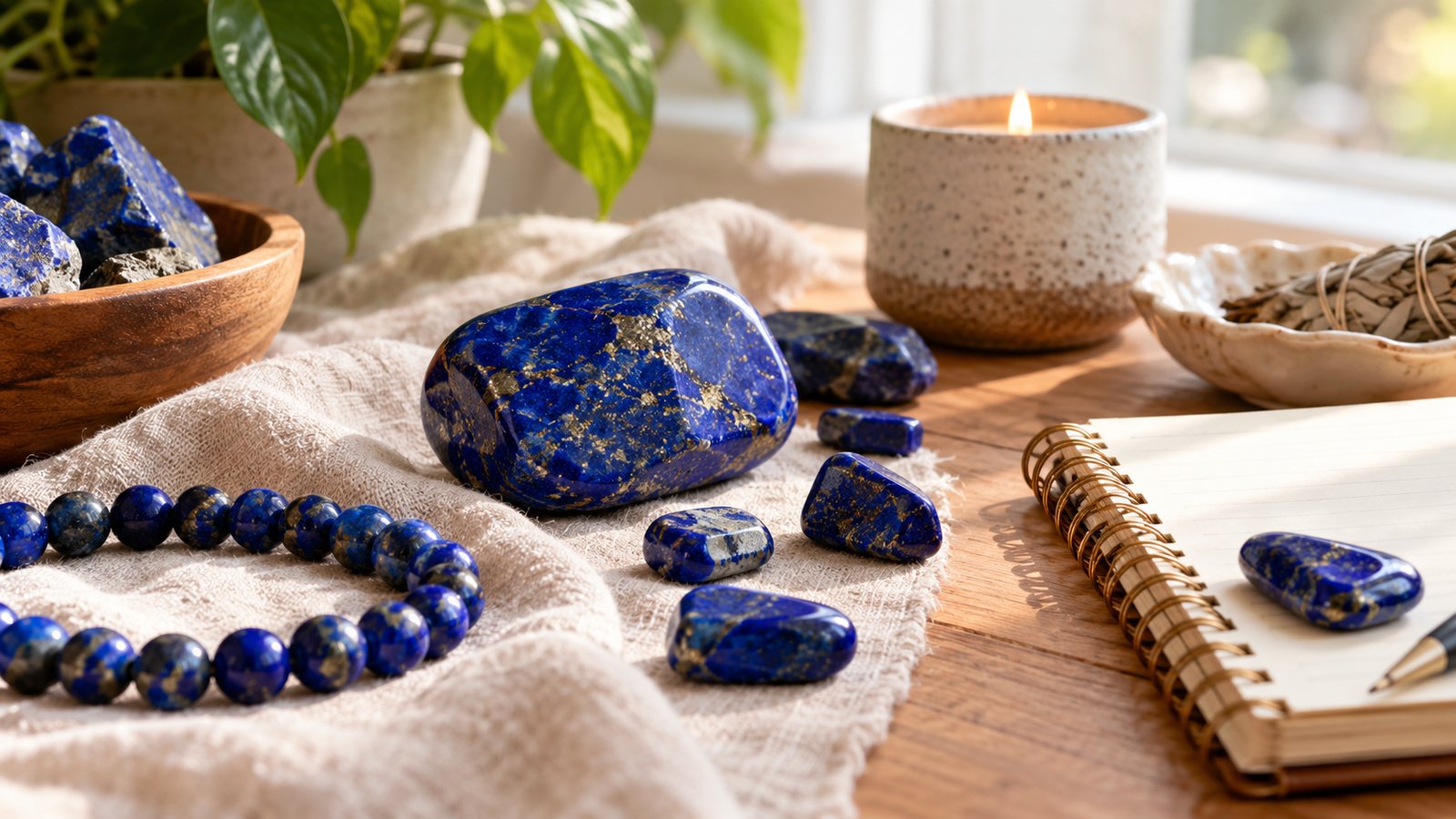
Simple Ways to Work With Lapis Lazuli
Lapis suits quiet, reflective habits, and the dark color makes it easy to rest your eyes on while you think. Try this routine, and adjust the timing to your own schedule so it feels like a pause rather than a chore.
- Choose a topic you want to think about clearly, such as a decision, a conversation you are preparing for or a piece of writing.
- Hold a lapis stone in your hand and study the pattern of blue, white and gold for a minute without trying to analyze it.
- Write down three honest sentences about the topic. No editing, just the plain truth as you see it.
- Keep the stone beside your notebook or on your desk while you work.
- At the end of the week, read the sentences again and decide on one next step.
Small pieces such as pendants, earrings and bead bracelets. Lapis pairs nicely with moonstone, and the moonstone guide explains why the soft glow of one stone works with the deep color of the other.
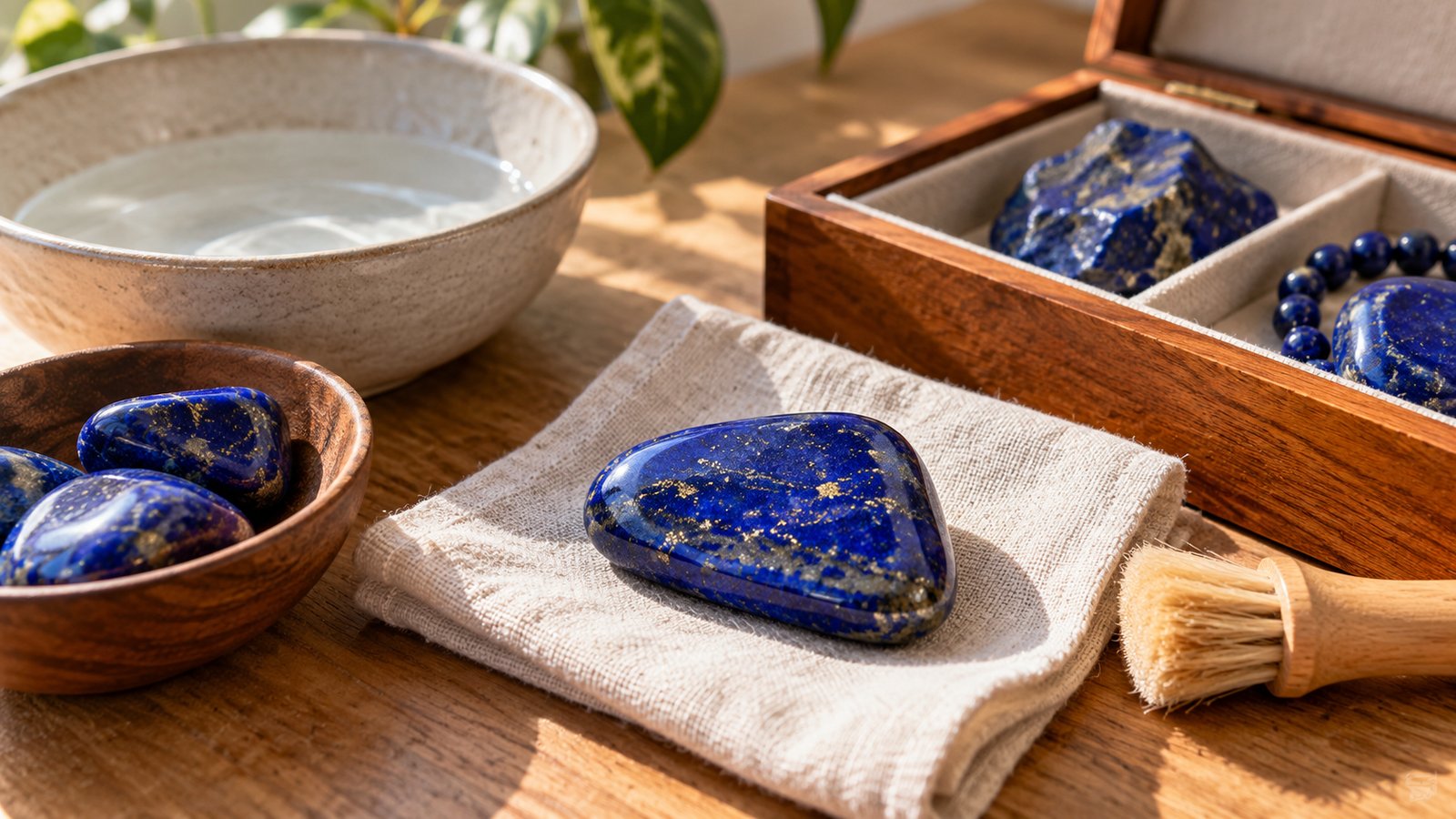
Caring for Lapis Lazuli
This rock is softer and more porous than most popular stones, so it deserves gentler habits.
- Wipe it with a soft, damp cloth and dry it right away. Avoid soaking.
- Keep it away from acids, including vinegar, lemon juice and many household cleaners, because the calcite in the rock can react.
- Do not use ultrasonic or steam cleaners.
- Remove lapis jewelry before swimming, bathing, applying perfume or cleaning, because chemicals and long contact with moisture can dull the polish.
- Store pieces separately in a soft pouch so harder stones do not scratch them.
Treatments are worth understanding before you buy. Stabilization with wax, oil or polymer improves polish and reduces water absorption, and dye is sometimes used to deepen pale material. Reputable sellers describe treatments plainly, and a stone sold with no information at a low price deserves extra questions. GIA lists lapis treatments, synthetics and imitations on its gem encyclopedia page, which is a good starting point for a skeptical shopper.
Some lapis is stabilized with wax or resin, or lightly oiled, to improve the polish. That is common and acceptable if disclosed, but it means heat and solvents can damage the finish. Keep it out of hot cars and avoid direct strong sunlight for long periods.
Keep this one dry. The guide to crystals that cannot go in water explains why porous and soft stones suffer from soaking, and the instructions for cleansing crystals suggest gentle methods such as moonlight, sound or smoke rather than water for stones like this.
How to Spot Fake or Misrepresented Lapis
Prices run high at the top end, so imitations are common. Here is what to check.
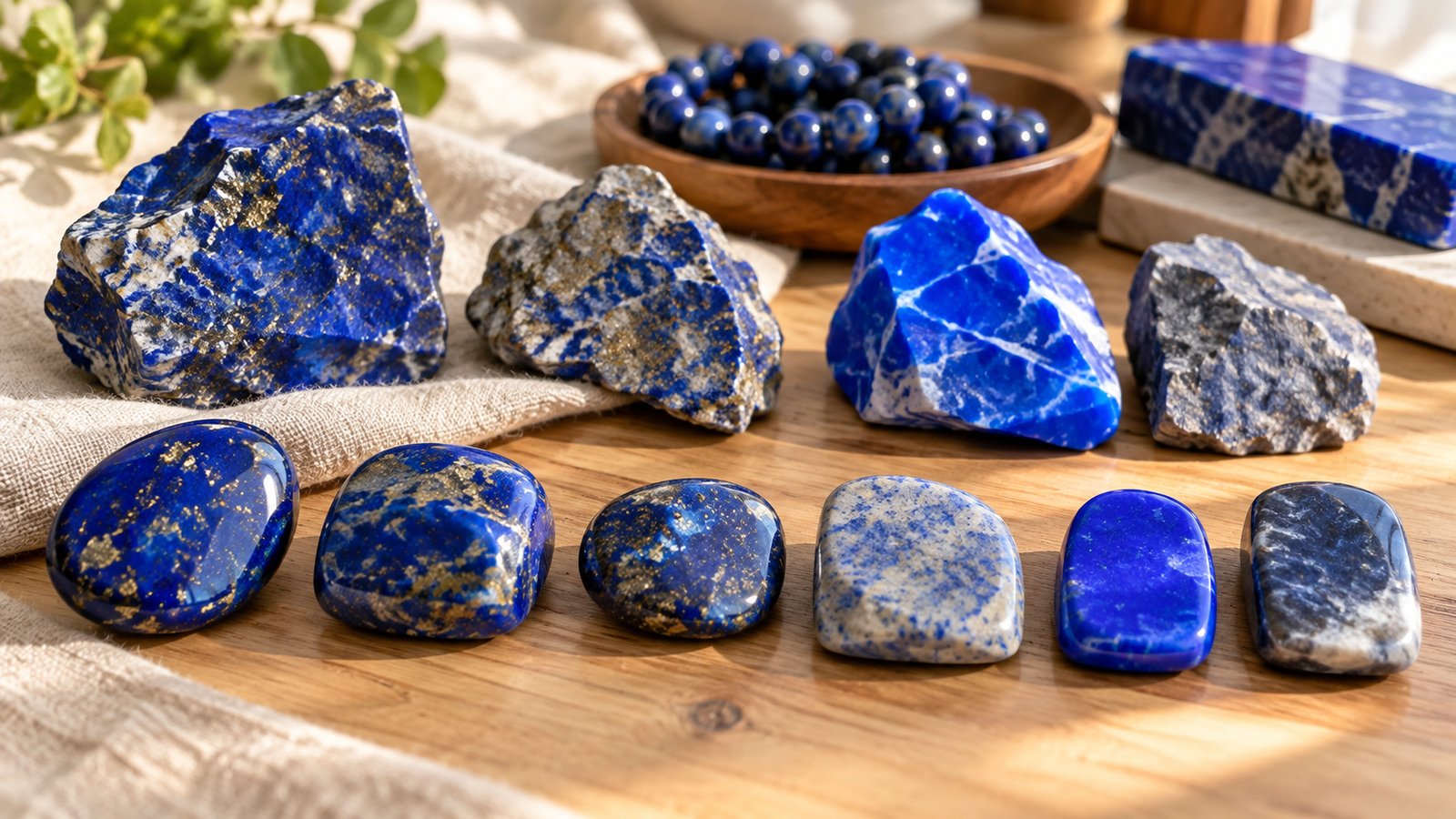
- Dyed jasper or quartzite. A dull stone dyed blue can look convincing, though the color usually pools in cracks and is flat, with no natural contrast between lazurite, calcite and pyrite.
- Dyed howlite. White howlite takes dye very easily and is sold as imitation turquoise and sometimes as imitation lapis. Gemological databases note that an acetone swab can reveal the dye, and a very soft stone with a cauliflower-like texture may be howlite.
- Glass. Blue glass with gold glitter, often called goldstone or “blue sandstone,” has uniform sparkle and sometimes visible bubbles. Pyrite flecks in real lapis are irregular, angular and metallic like brass, not round and glittery.
- Gilson lapis and other lab-made imitations. These can look very good and are usually sold openly as man-made.
- Plastic or reconstituted material made from lapis powder and resin. This is sometimes sold as lapis, and the seller should say so.
A real piece often has white calcite streaks, so a perfectly smooth, uniform blue with scattered round gold dots should raise questions. A very cheap price for a large, deep blue piece is another warning. Do not scratch a piece you plan to return, and instead ask the seller about treatments and for clear photographs in daylight.
Frequently Asked Questions
Is lapis lazuli a crystal or a mineral?
Neither, strictly. It is a rock made of several minerals, mainly lazurite, calcite and pyrite. Many people still call it a crystal in everyday crystal talk.
Why does lapis have gold flecks?
The gold flecks are pyrite, an iron sulfide often called fool’s gold. Pyrite forms together with lazurite when the rock is created.
Can lapis lazuli go in water?
Avoid soaking it. The rock is porous and contains calcite, so wipe it with a damp cloth and dry it quickly instead.
What is the difference between lapis and sodalite?
The gold flecks usually show up in lapis pyrite flecks and a deeper violet-blue, while sodalite tends toward a more purple-blue and shows white veins instead of gold sparkle.
What zodiac sign goes with lapis lazuli?
Lists differ. Some name Sagittarius and others Libra, which shows that these are modern conventions rather than rules. The zodiac crystals guide compares several systems side by side.
Is real lapis expensive?
Fine Afghan material can be costly, while lower grades with a lot of calcite are modestly priced. A large, flawless piece at a bargain price is unlikely to be what the label says.