| ✨Hey there! This post may contain affiliate links, meaning we earn a commission if you make a purchase through our links, at no cost to you. Please read our disclosures for more info. |
Quick answer: amazonite is the blue-green variety of microcline feldspar (KAlSi3O8) with a Mohs hardness of about 6 to 6.5. Its color is believed to come from traces of lead and water in the crystal structure. Crystal traditions link it with calm communication and hope. It cleaves easily, so avoid knocks, and watch for dyed howlite, dyed quartz and glass sold under its name.
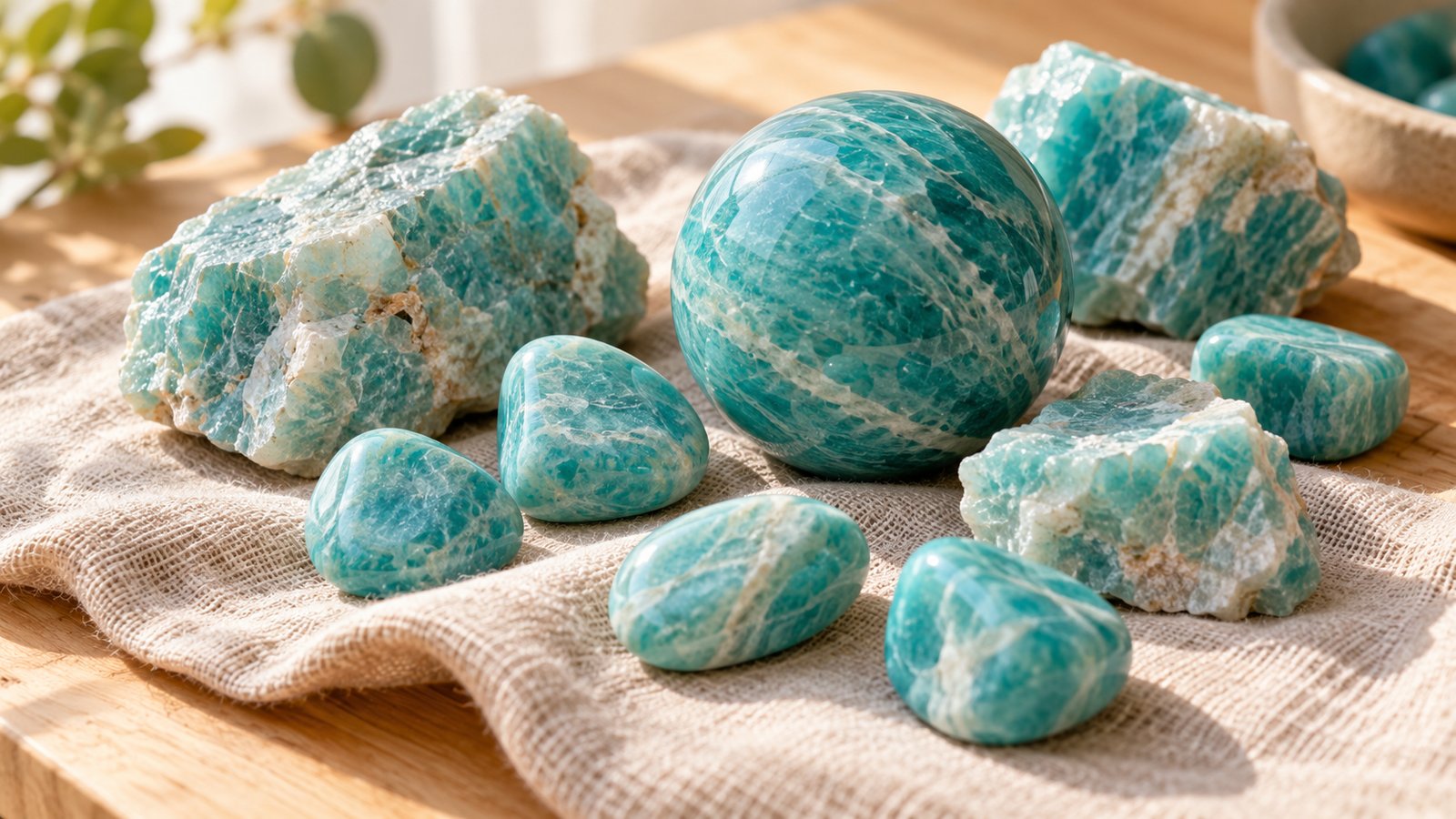
Amazonite is the stone people reach for when they want the color of shallow tropical water in something small enough to hold. The color sits between green and blue, often with pale white streaks that look like ripples, and it brightens a collection of darker stones the way a window brightens a room.
This stone also has a surprising amount of real science and history behind it. Researchers have argued about its color for generations, and ancient Egyptians counted it among their most precious stones. This guide separates mineral facts from tradition, as the other stone guides here do, so you know exactly which statements are measured and which are beliefs. Start with the crystal meanings guide if you want the full overview of how these posts are organized.
What Amazonite Is
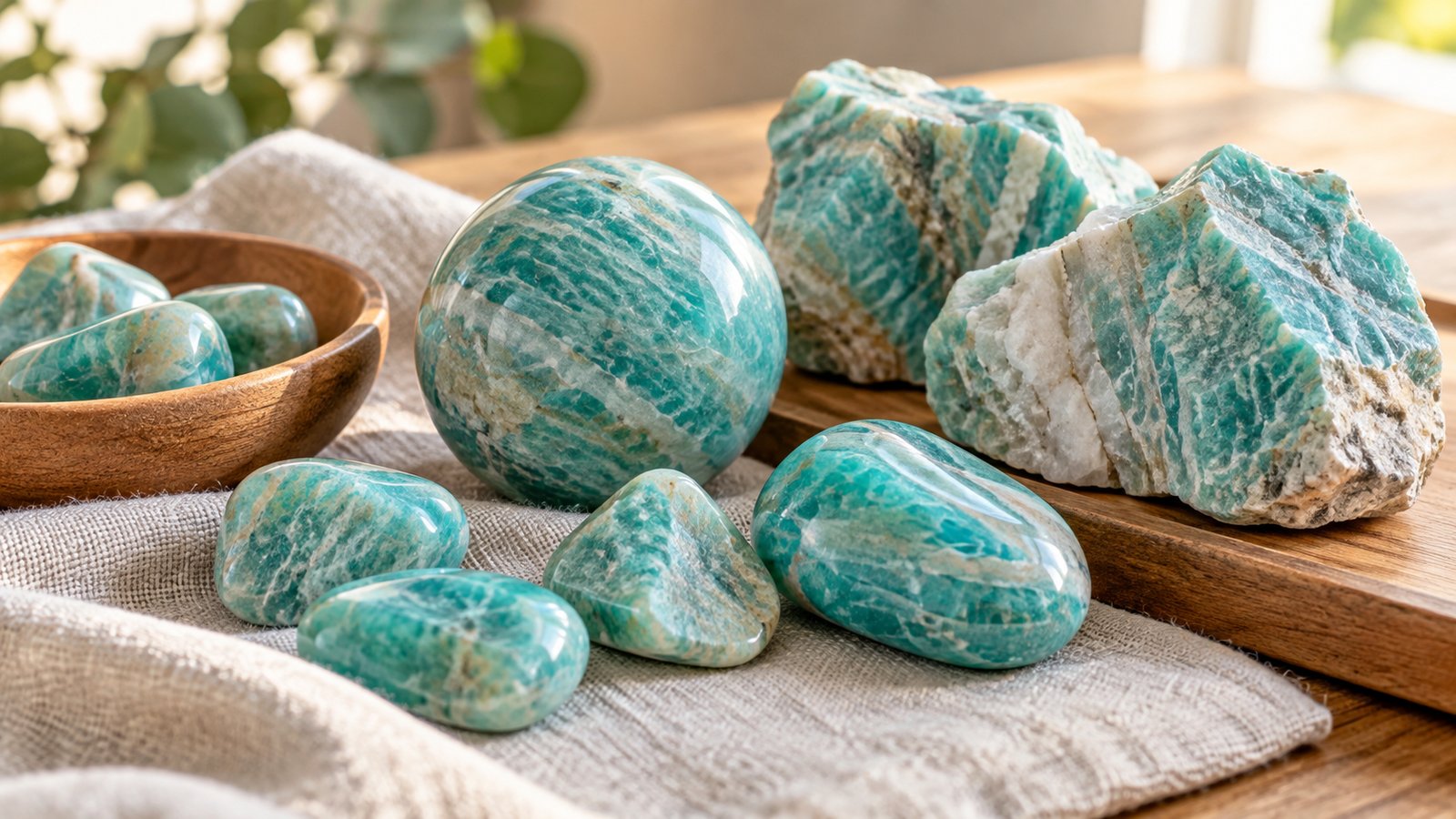
Mindat classifies amazonite as a green to blue-green variety of potassium feldspar, usually microcline, with the chemical formula KAlSi3O8. Feldspars are the most abundant mineral group in the Earth’s crust, so amazonite is a colorful member of a very ordinary family, the same family as moonstone, which is covered in the moonstone guide.
The museum conservation reference CAMEO lists a Mohs hardness of 6 to 6.5 and a density of about 2.56 to 2.58 grams per cubic centimeter. Hardness at that level means it is tougher than glass but softer than quartz, so a quartz point can scratch it. The stone is opaque to slightly translucent, with a vitreous to pearly luster on cleavage surfaces.
The most important property for care is cleavage. Feldspars split cleanly along flat planes, and microcline has two good directions of cleavage. A hard knock can break a piece along one of those planes, which is why amazonite beads sometimes show tiny flat chips near the drill hole.
Many pieces show pale streaks or crosshatch patterns. These come from intergrowths of white albite, another feldspar, with the microcline, and from twinning, a crystal-growth pattern typical of microcline. The patterns are a good sign of natural material.
Why Is Amazonite Blue-Green?
For decades people assumed the color came from copper, as in many blue and green minerals. The Smithsonian’s National Museum of Natural History explains that it is now believed to result from small quantities of lead and water in the feldspar. Mindat adds that the color is usually tied to elevated lead content, while some studies point to iron in certain specimens. A study of amazonite from the Serra Branca pegmatite in Brazil links the blue-green absorption to lead and notes that water plays an important role, too.
Mindat also warns that some slightly gray-green feldspar sold under the name is photosensitive and fades toward smoky gray, while sunlight can sometimes enrich the color of genuine amazonite. In practice, color can change a little with light exposure, so a piece that looked deeper in the shop may look softer at home.
Where Amazonite Comes From
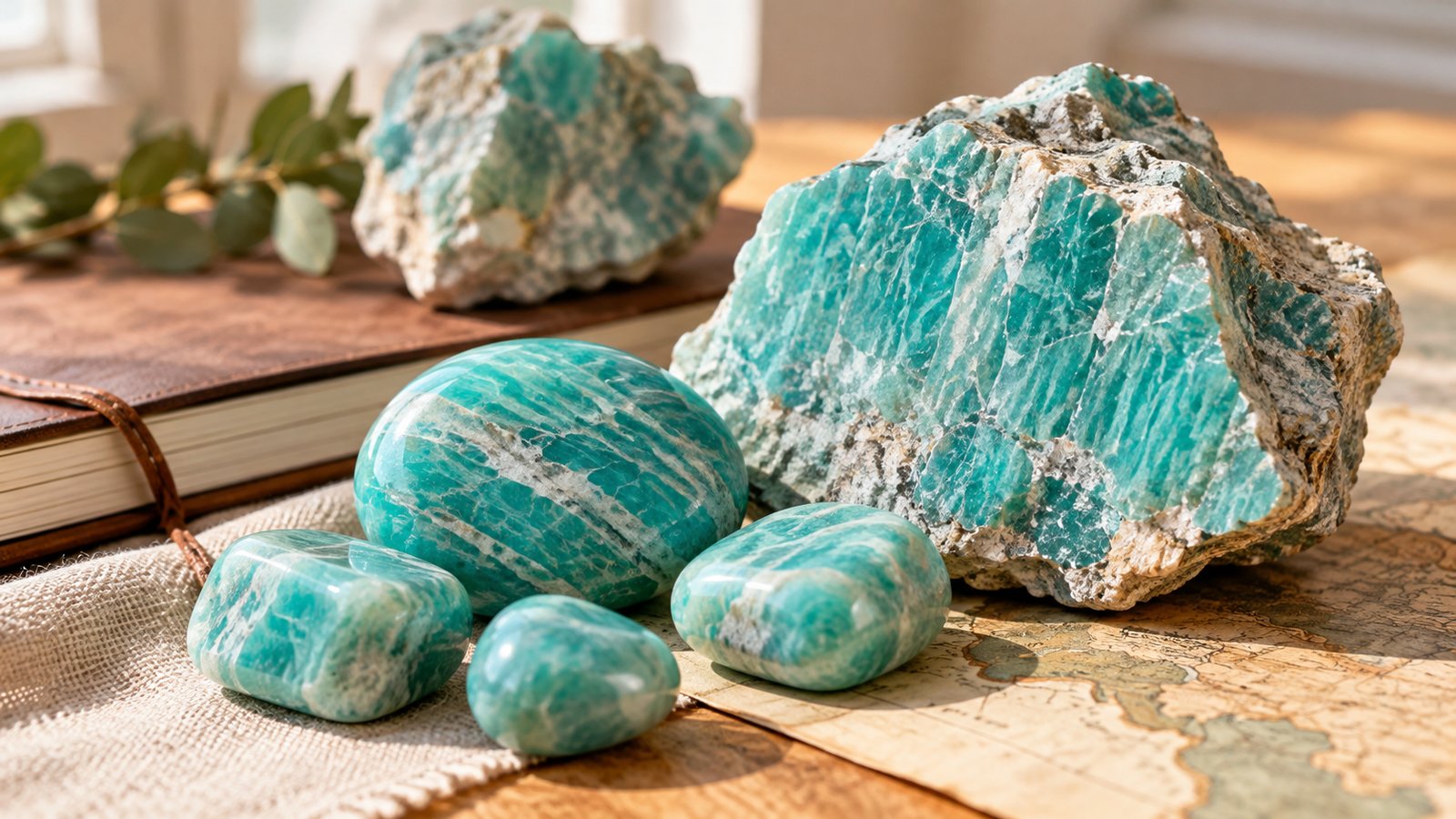
The name has a funny history. Mindat reports that it was named in 1847 by the German mineralogist Johann Friedrich August Breithaupt for a locality said to be near the Amazon River, yet no amazonite deposits have been found in the Amazon basin. The Smithsonian makes the same point. The label stuck anyway.
Real sources include Russia, especially the Ilmen Mountains region, along with Madagascar, Brazil, Namibia and the United States. In Virginia, the Morefield Mine near Amelia Courthouse, discovered in 1929, is described by the Smithsonian as the nation’s best source of amazonite and one of the few places where it is still mined. Colorado’s Pikes Peak region is another famous locality. Brazilian pegmatites such as Serra Branca produce huge crystals of bluish-green amazonite that are cut for ornamental use and gems.
In nature the mineral grows in granitic pegmatites, which are coarse-grained rocks that crystallize slowly from water-rich melt at the late stage of a magma’s cooling. Slow growth in a water-rich setting allows big crystals, and it is also the kind of environment where lead and water can be built into feldspar.
Amazonite in Ancient and Historical Records
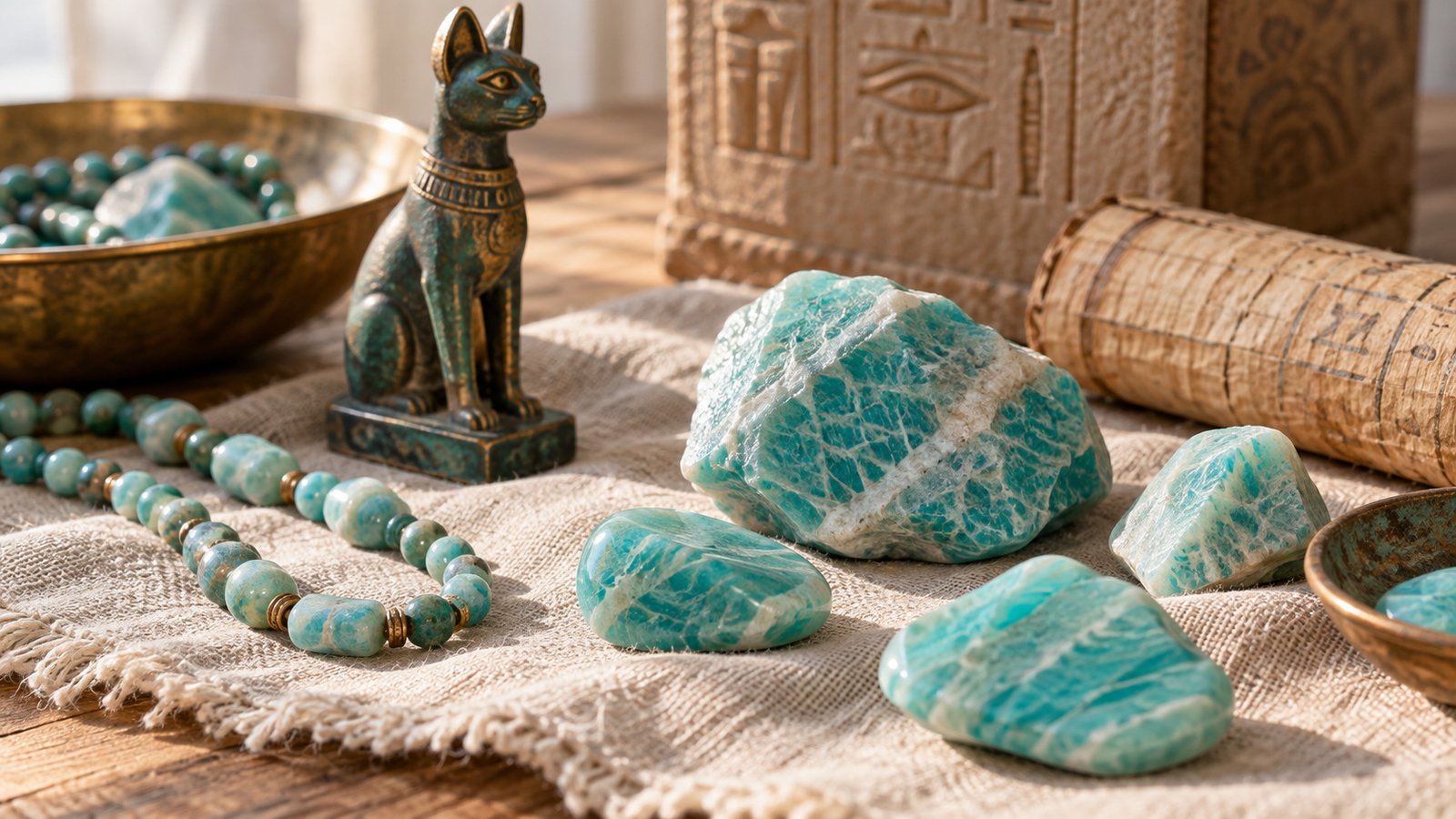
CAMEO reports that amazonite has been used since about 3000 BCE for decorations, amulets, vessels, beads and as a gemstone, with ancient examples found in Egypt, Mesopotamia and northern India. CAMEO adds that amazonite was considered one of the six most precious stones in Pharaonic Egypt.
That is a useful fact to keep in mind when you read modern claims. Ancient jewelers worked with a stone that is relatively soft and easy to shape, so the material was well suited to beads and small carvings long before steel tools.
Online stories claiming that it adorned specific pharaohs or that it was once the “stone of hope” for a named civilization are usually modern embroidery. If a page does not name a museum, a publication or a catalog entry, treat the claim as unverified.
What Amazonite Means in Crystal Traditions
The associations below come from modern crystal practice and folklore, and they are not scientific or medical claims.
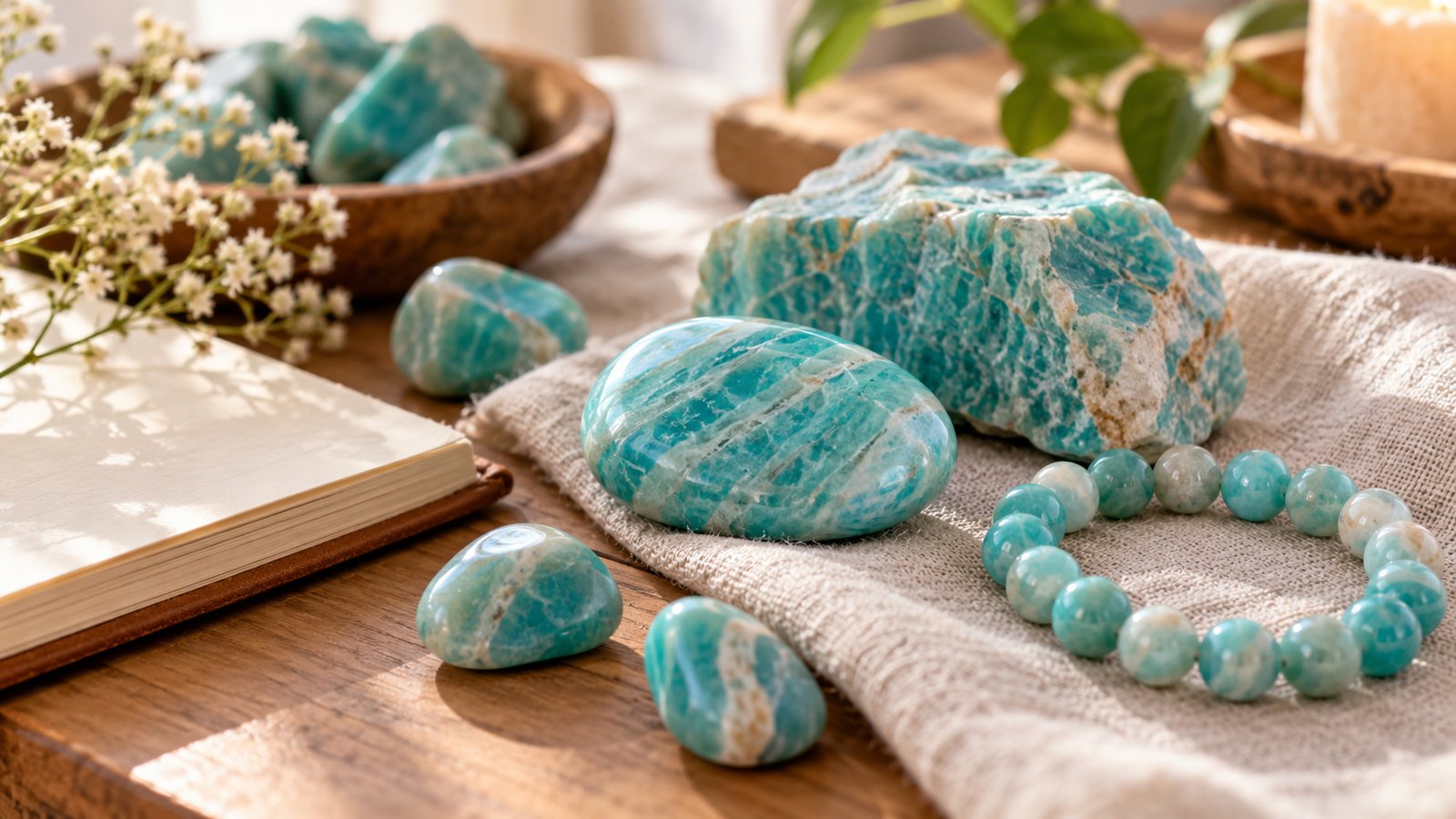
- Calm communication. The soft aqua color links amazonite with the throat and heart chakras in modern chakra systems, which many practitioners connect with speaking gently and honestly.
- Hope and optimism. Its color is often described as hopeful and fresh, like water on a bright day.
- Balance. Some traditions say the stone helps hold two points of view, which people connect with its color between blue and green.
- Boundaries. A few modern writers call it a stone for saying no politely.
- Creative flow. Writers and speakers sometimes keep a piece nearby while drafting.
No stone treats or cures any health problem, and this guide does not suggest otherwise. Some websites claim amazonite protects against radiation from electronics. There is no scientific evidence for that, so you can safely skip those claims.
Because amazonite is a green-blue stone, people often group it with other green stones. The green crystals guide compares several options, and amazonite fits well beside them.
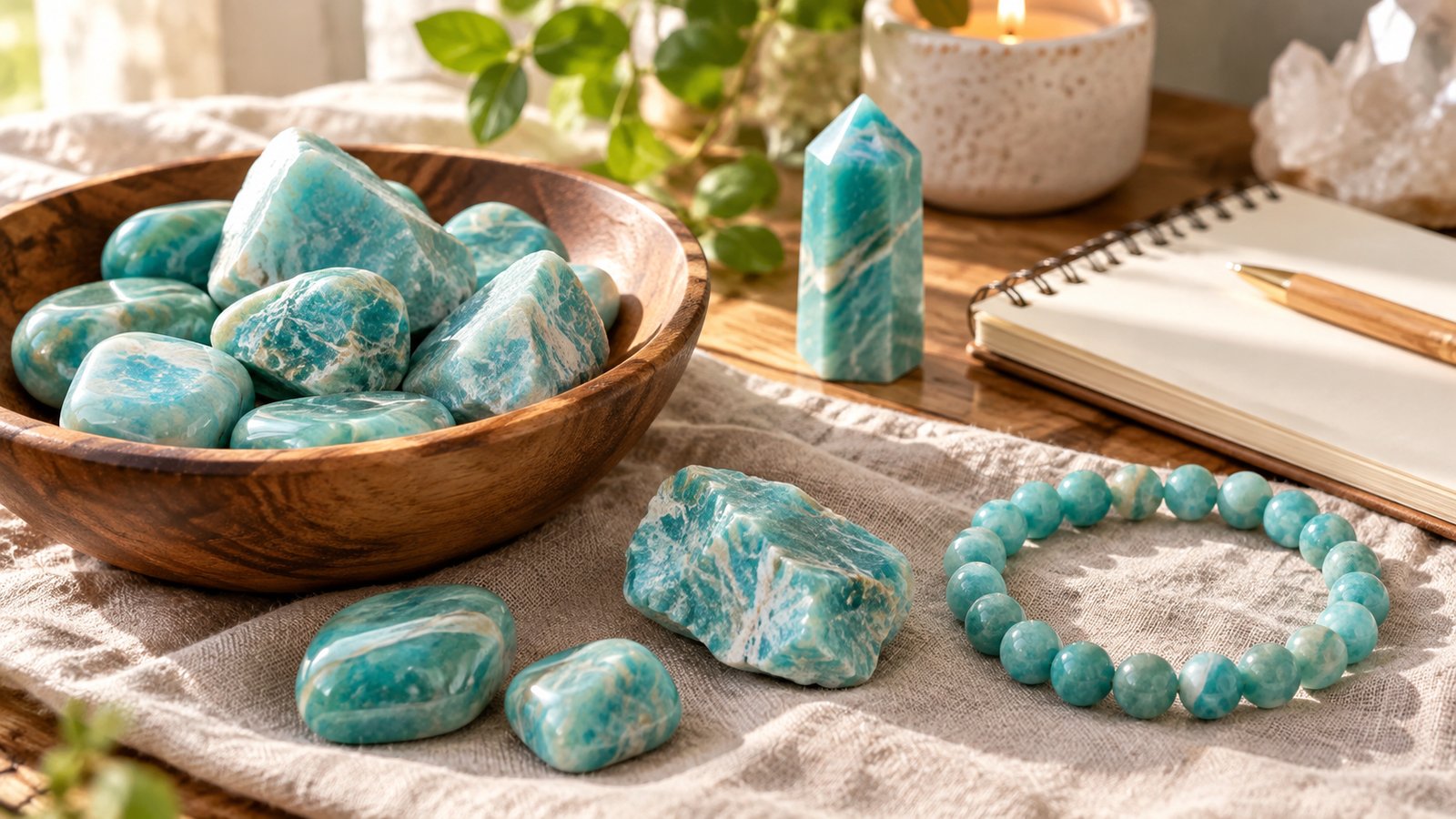
Simple Ways to Work With Amazonite
Try a conversation-prep ritual for a moment when you want to say something clearly and kindly.
- Write down the one thing you most need the other person to understand.
- Reduce it to two sentences, with no blame and no apology.
- Hold the amazonite in your hand and read the sentences aloud once.
- Take three slow breaths while looking at the blue-green color.
- Keep the stone in a pocket or on the table during the conversation as a quiet cue to speak slowly.
That is a communication habit with a stone as the reminder. As jewelry, it works as a bracelet or pendant for daily wear, though its cleavage makes rings a poor choice.
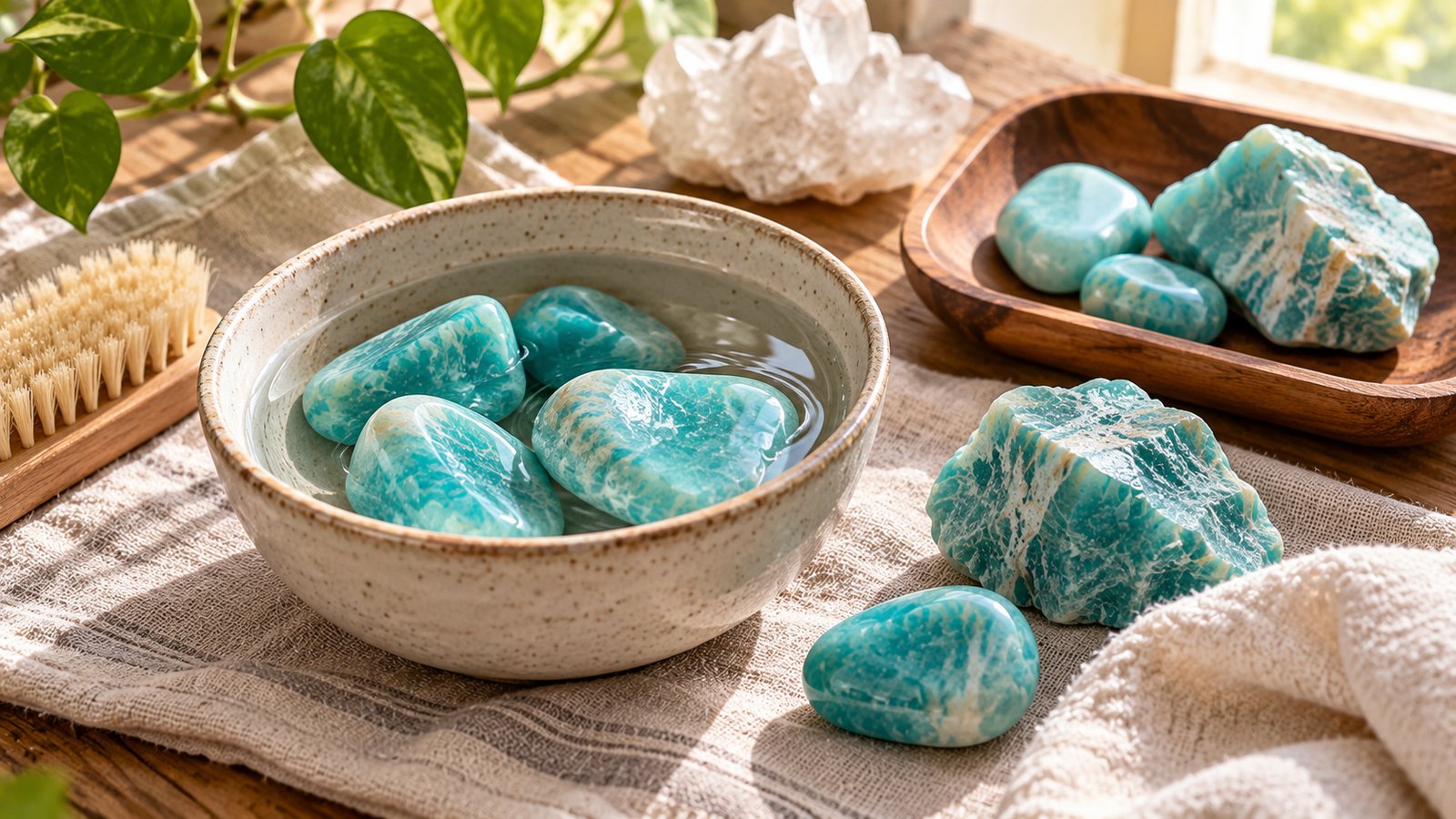
Caring for Amazonite
With a hardness of 6 to 6.5 and cleavage, amazonite is moderately durable but not tough. Treat it gently.
- Wipe with a soft cloth, lukewarm water and a little mild soap, then dry thoroughly.
- Avoid ultrasonic and steam cleaners, which can worsen tiny cracks along cleavage planes.
- Store it separately from harder stones such as quartz, topaz and sapphire.
- Protect it from knocks and falls. A bead dropped on tile can chip.
- Keep it out of hot cars and away from prolonged strong sunlight, since some material may lighten.
For gem water and elixirs, skip amazonite. Analyses show that lead is among the trace elements in amazonite, and while the lead is part of the mineral structure, there is no reason to put the stone in drinking water, and powdering or grinding it is also a bad idea. Wash your hands after working with rough pieces and keep stones away from small children who might put them in their mouths.
Brief contact with water is tolerated with water, but the guide to crystals that cannot go in water is a good place to check the habits for each stone, and the same rule applies to bead strands: dry them completely before putting them away, so that moisture does not sit in the drill holes or weaken the cord over time. For cleansing, moonlight, sound and smoke are popular and safe choices, and how to cleanse crystals lists each method with its pros and cons.
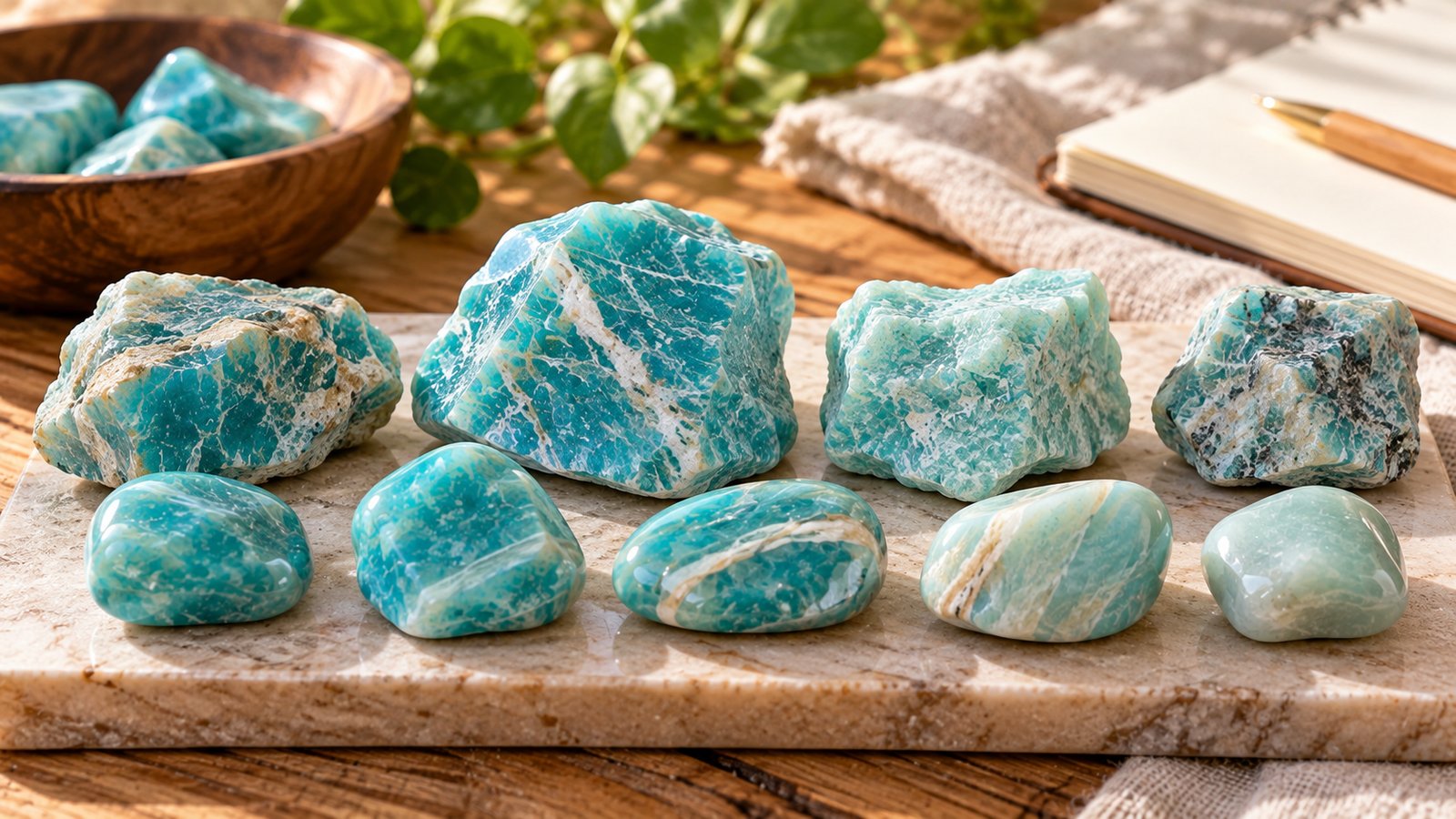
How to Spot Fake or Misrepresented Amazonite
With moderate prices, the problems are mostly dyed stones and mislabeling.
- Dyed howlite. White howlite takes dye very easily and is sold in many colors, including a turquoise or aqua tone that can pass for amazonite beads. Howlite is much softer, with a Mohs hardness around 3.5, and its veins look gray or black instead of the white streaks of feldspar.
- Dyed quartz or jade. Color concentrated in cracks and drill holes, or a flat, neon green-blue with no variation, suggests dye.
- Glass. Glass beads are smooth and glossy, may show bubbles and lack the pale streaks and cleavage flashes of feldspar.
- Other minerals sold as amazonite. Fluorite, aventurine and green calcite are sometimes mislabeled. Fluorite is softer and shows perfect octahedral cleavage, aventurine often sparkles with mica flakes and calcite fizzes in acid.
- Plastic and resin. These are warm, light and easy to scratch.
Look for cleavage flashes, which are small, flat, shiny surfaces that catch light at one angle when you turn the stone. Natural amazonite often shows them, along with white streaks and cracks, while dyed fakes are uniform. A magnifying loupe helps. A scratch test is risky for stones you may return, so ask for photos and a return policy instead.
Amazonite Compared With Other Blue-Green Stones
Side-by-side comparisons help when a listing is vague. Aquamarine, covered in the aquamarine guide, is a beryl with a much higher hardness, and GIA-style references place beryl around 7.5 to 8, so it resists scratching far better. Aquamarine is also usually transparent and glassy, while amazonite is opaque to faintly translucent with pale streaks. Turquoise is an opaque copper aluminum phosphate that is often veined with brown or black matrix, and its color is usually a more saturated sky blue or green. Green fluorite is translucent and often shows sharp color zoning in layers. When you hold the three stones in sequence, amazonite is the one with soft white ripples and a slightly pastel, milky tone.
Buying Tips
Ask where the material was mined and whether it is natural color. Reliable sellers will answer plainly. A string of top-quality blue beads for a few dollars is a red flag, because bright, even color is more valuable. Expect the best stones, which are deep teal with few white streaks, to cost more than pale gray-green ones.
Frequently Asked Questions
Is amazonite a crystal?
Yes. Amazonite is a variety of microcline, a feldspar mineral with a triclinic crystal structure. Most polished pieces are cut from larger crystals and show their structure through cleavage flashes and twinning.
Why is it called amazonite if it is not found in the Amazon?
The name was given in 1847 for material said to come from near the Amazon River. Mindat and the Smithsonian both note that no deposits have been found there.
Does amazonite fade in the sun?
Some pieces can lighten with long exposure, and Mindat warns that gray-green feldspar can fade toward gray, so keep it out of strong sunlight to be safe.
Can amazonite go in water?
Briefly, yes. Dry it afterward, and skip soaking, gem water and elixirs.
What is the difference between amazonite and turquoise?
Turquoise is a copper aluminum phosphate with a different chemistry and typically a deeper blue or green. Amazonite, a feldspar with white streaks, is usually lighter and more translucent.
Which zodiac sign is amazonite linked to?
Lists vary and some name Virgo. Those are modern conventions, and other crystal sources compare several systems.