| ✨Hey there! This post may contain affiliate links, meaning we earn a commission if you make a purchase through our links, at no cost to you. Please read our disclosures for more info. |
Quick answer: obsidian is natural volcanic glass formed when silica-rich lava cools too fast to grow crystals, so it is not technically a crystal or a true mineral. Its Mohs hardness is about 5 to 5.5 and it breaks into extremely sharp edges. Crystal traditions link it with protection and honest self-reflection. The most common fake is ordinary man-made black glass sold as obsidian.
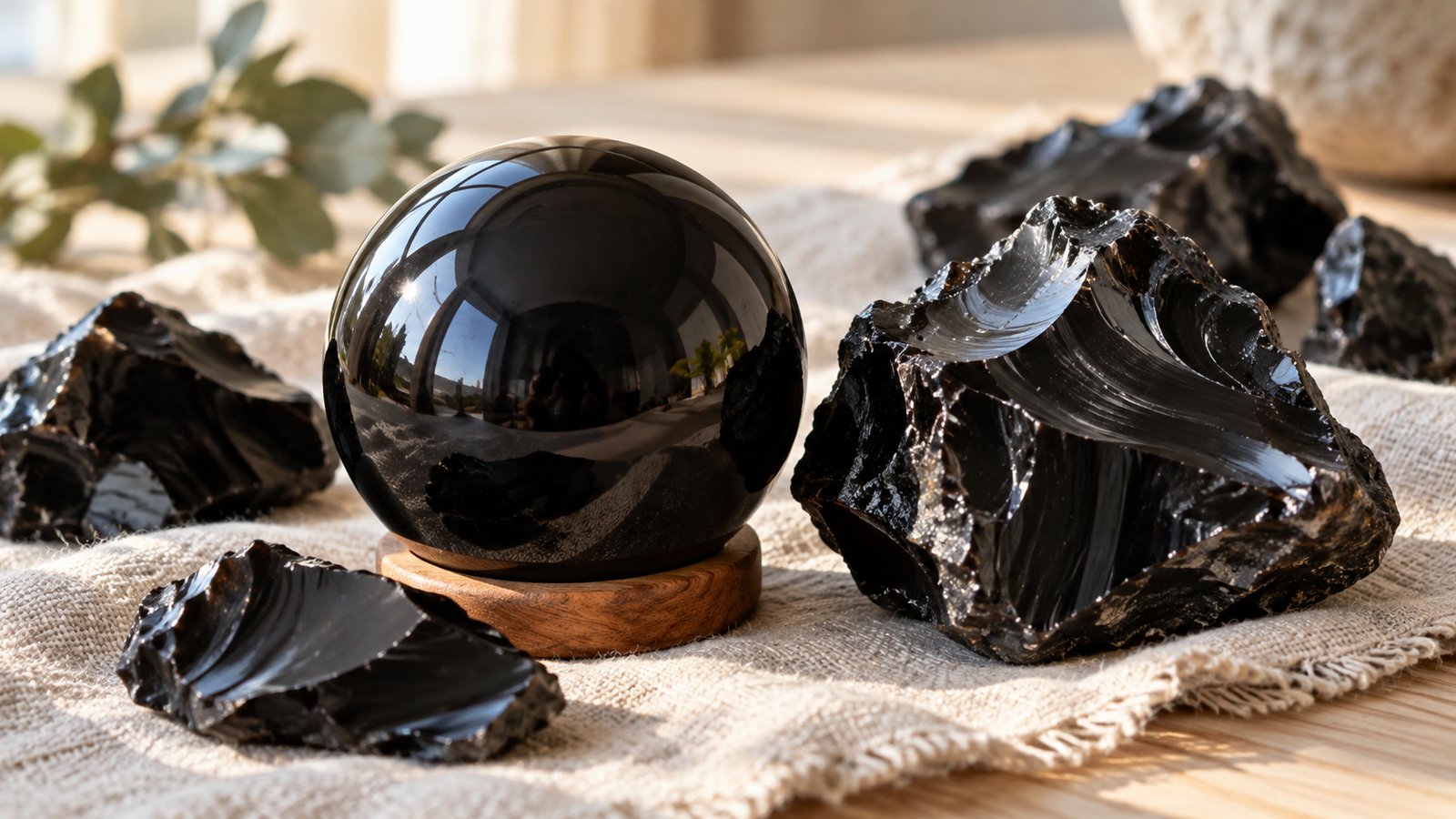
A piece of polished black obsidian looks like a pool of ink that someone froze in place. Look closely and your own reflection appears in it, which is exactly why people across the world have used it as a mirror for thousands of years. This mix of mystery and practicality is what draws people to the stone today, whether they keep a sphere on a shelf or wear a small pendant.
The stone also breaks a rule that most crystal guides skip: it has no crystal structure at all. Below, the science comes first, then the history, then the traditional meanings, with each one kept in its own box. The black crystals guide compares obsidian with other dark stones, and the crystal meanings guide shows where it fits in the wider collection.
Contents
hide
What Obsidian Is
Britannica defines obsidian as an igneous rock that occurs as a natural glass, formed by the rapid cooling of viscous lava from volcanoes. The rock is extremely rich in silica, about 65 to 80 percent, and low in water, with a composition similar to the volcanic rock rhyolite.
Oregon State University’s Volcano World explains the key point: obsidian has almost no sizable mineral crystals within its glassy matrix. Because it is made of non-crystallized silica, the university’s volcano education page notes it is technically not even a true rock but a congealed liquid with small amounts of microscopic crystals and impurities. In other words, it is closer to window glass than to quartz, although the chemistry differs.
Obsidian is relatively soft, with a typical Mohs hardness of 5 to 5.5, compared with 7 for quartz. Gemological databases agree, and add that it has no cleavage and a conchoidal fracture. The fracture is the stone’s most famous feature, because the smooth, curved surfaces it breaks into meet at edges that can be sharper than a razor.
Typical color is jet black, though iron oxide can produce red and brown, and tiny gas bubbles or crystals can produce sheens. Geologically, the glass is young. Volcano World notes that it is rare to find obsidian older than about 20 million years, because over long periods the glass slowly rearranges into crystals in a process called devitrification.
Why does lava sometimes turn into glass instead of rock? Thick, silica-rich lava moves slowly, and its atoms are tangled in long chains that struggle to line up into crystals. If that lava cools quickly at the surface, for example at the edge of a flow or where it meets water or air, the atoms freeze in place before they can organize. The result is glass. A slower cooling inside the same flow would give granite-like rock with visible crystals, so a single volcano can produce both.
Main Varieties
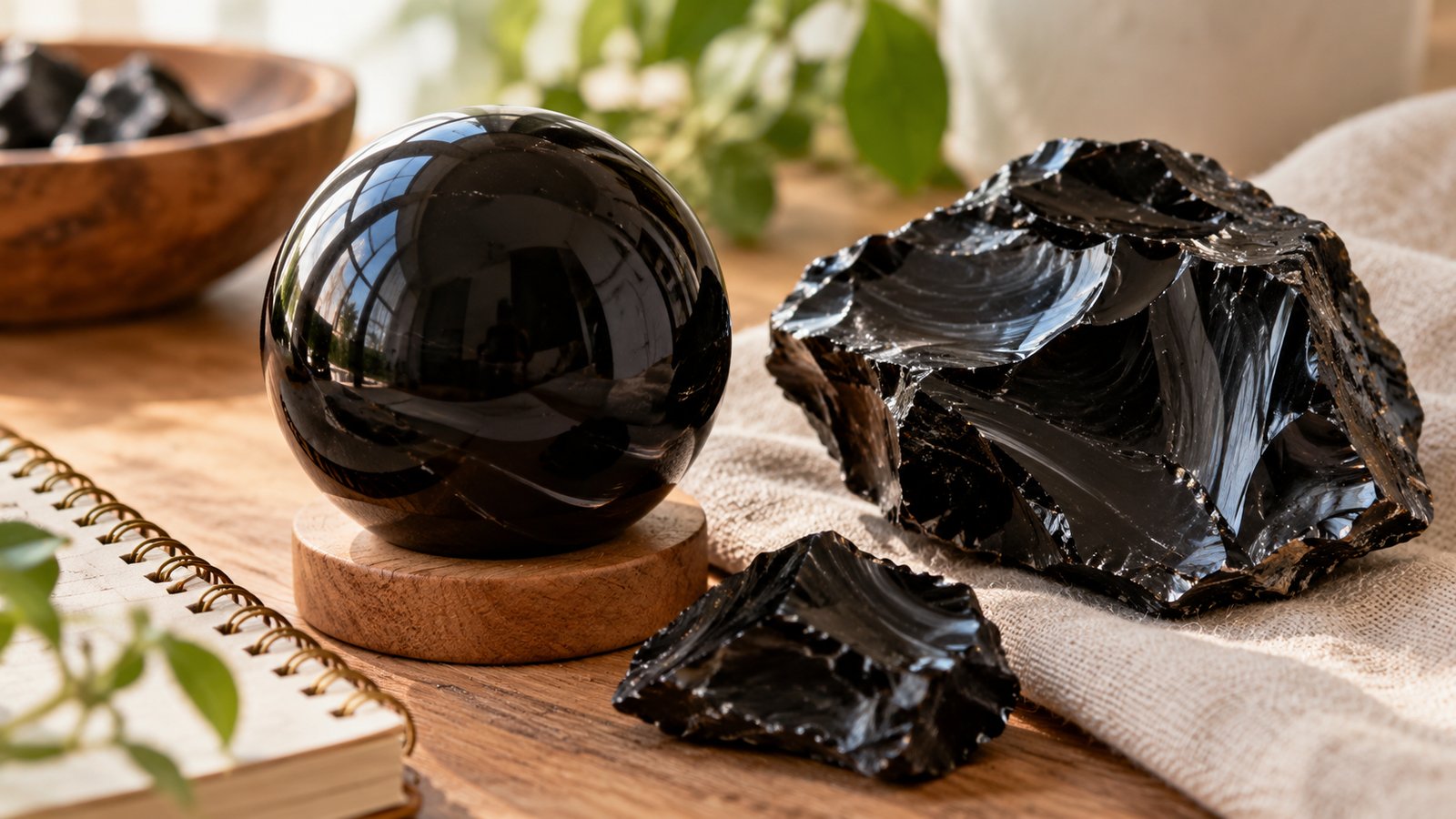
- Black obsidian. The classic jet black stone, often polished into spheres, palm stones and arrowhead-shaped pieces.
- Snowflake obsidian. Mindat describes it as volcanic glass with white snowflake patterns of the mineral cristobalite, created by partial crystallization of the glass.
- Mahogany obsidian. Black and reddish brown swirls colored by iron oxide.
- Rainbow and sheen obsidian. Gemological references describe sheen and rainbow effects caused by inclusions, such as tiny gas bubbles, aligned within the glass.
- Apache tears. Small, rounded pebbles of obsidian found in the American Southwest, which look translucent smoky brown when held to light.
Where Obsidian Comes From
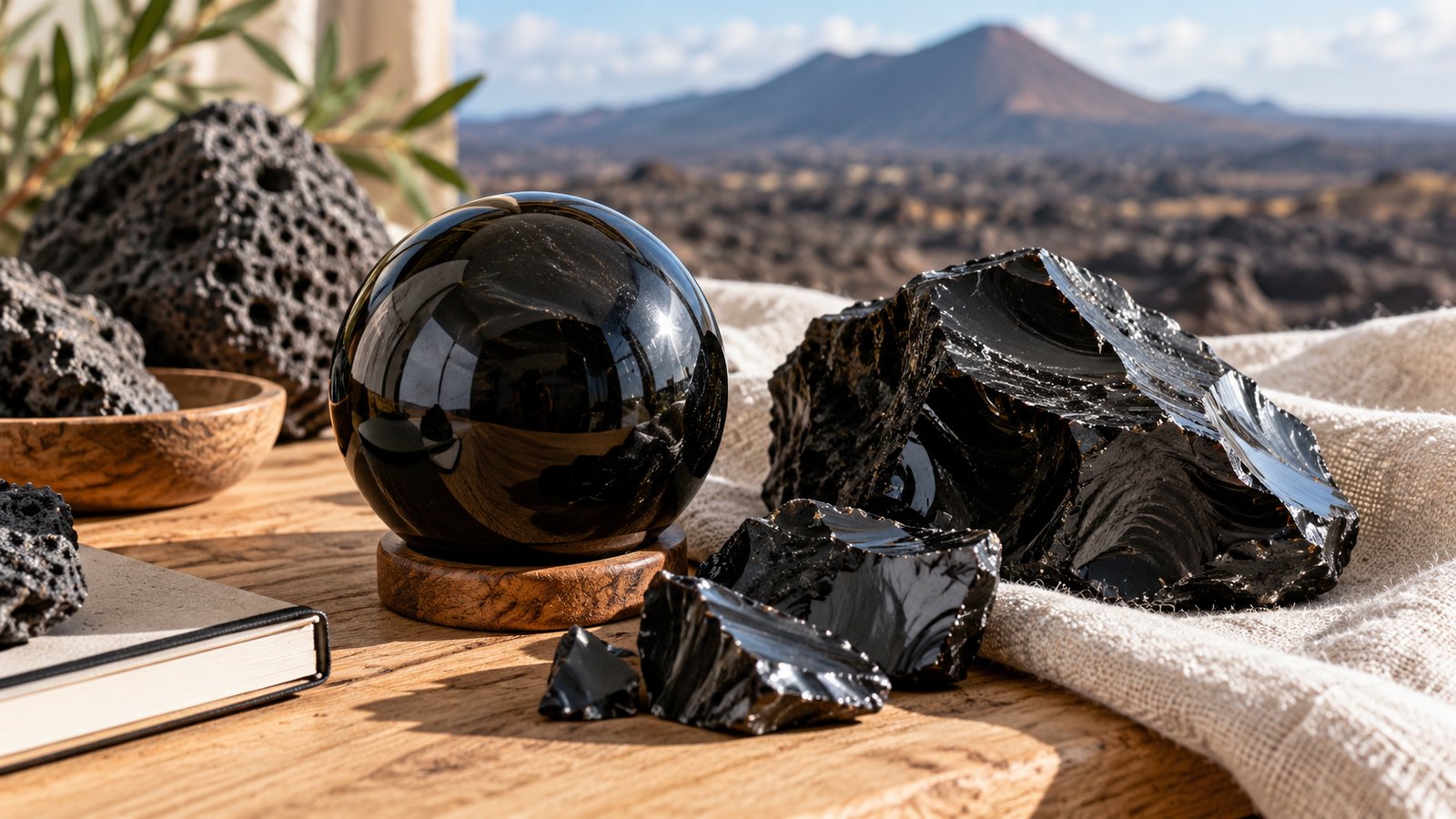
Sources are spread across the world because silica-rich volcanoes erupt in many places. Well-known locations include Yellowstone in Wyoming, Oregon and California in the United States, central Mexico, Iceland, Italy, Armenia, Turkey and Japan.
Smithsonian conservation scientists used chemical fingerprinting to study Mesoamerican obsidian mirror tablets and traced mahogany obsidian in some of them to the Los Azufres volcanic field in central Mexico. Chemical fingerprints are one reason archaeologists value obsidian: each source has a distinct chemical signature, so a flake found at a dig can sometimes be matched to its volcano.
For stone buyers, this means origin claims are checkable only with lab tools. Treat a seller’s label as a story unless supported by a documented source, and expect most polished obsidian on the market to come from a handful of large producers.
Obsidian in History
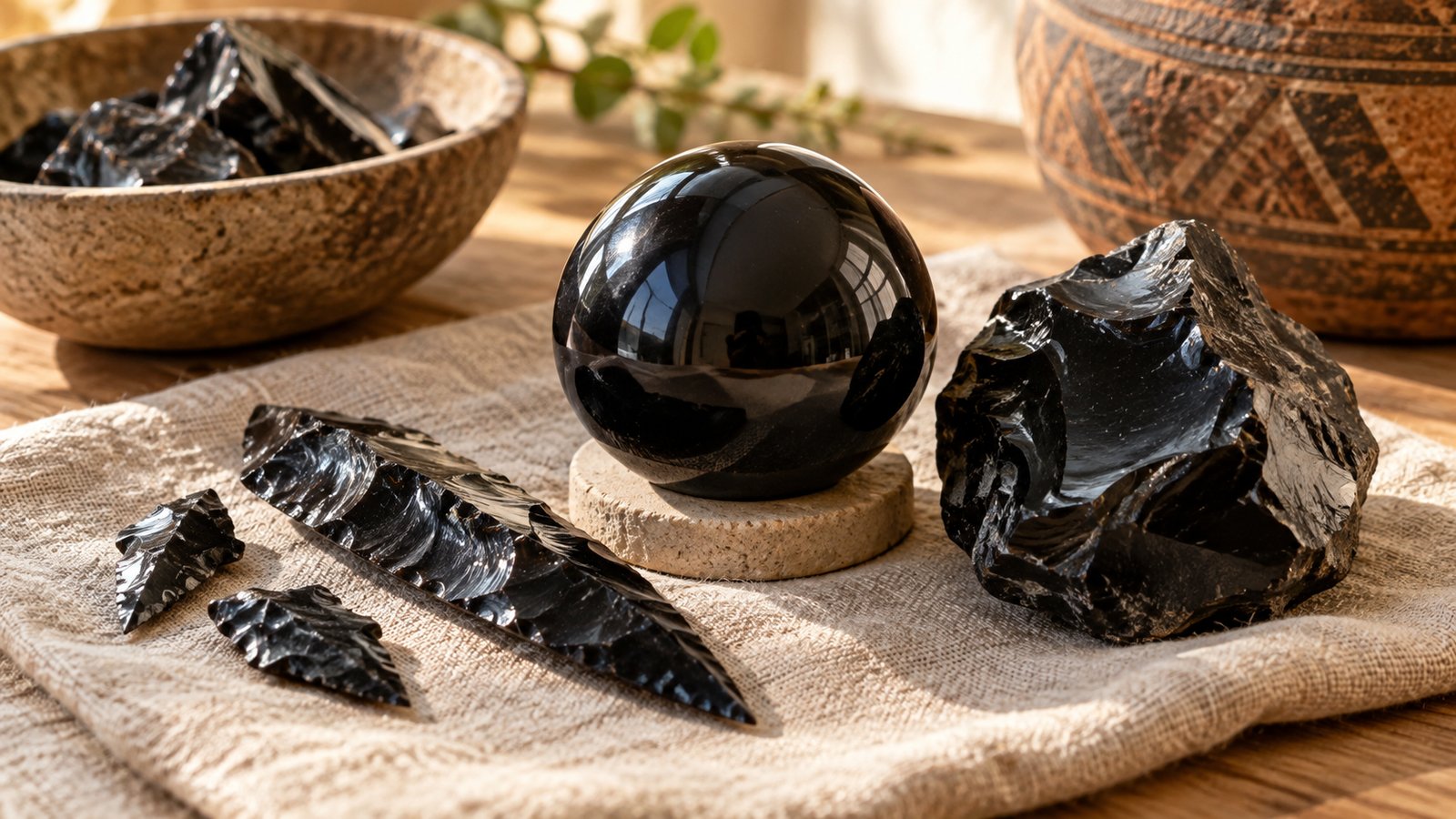
Because it fractures into blades sharper than steel, obsidian was one of the most important materials in prehistory. Britannica notes that the sharpest stone artifacts were made from obsidian and that Native Americans, Aztecs and Greeks all used it. Trade in obsidian over long distances is one of the best-documented patterns in early human economies, and archaeologists trace it with chemical analysis.
In Mesoamerica, craftspeople polished obsidian into mirrors. The Smithsonian’s Museum Conservation Institute has studied multi-kilogram obsidian mirror tablets in collaboration with the National Museum of the American Indian, and the scientists describe skilled artisans polishing them roughly 500 years ago. Aztec tradition linked obsidian mirrors with the god Tezcatlipoca, whose name is commonly translated as “smoking mirror.” That is a documented belief within a specific culture, and it is shared here as history, not as advice.
Modern uses continue. Blades of the stone are still used by some surgeons and researchers for experimental precision cuts, because the edge can be extremely fine, though most hospitals rely on steel. Knappers who make stone tools as a craft prize it for the way it breaks.
The word itself has a Roman source. Gemological sources report that the name comes from a stone found in Ethiopia by a man called Obsius. Treat this as an old etymology from antiquity rather than a settled fact.
What Obsidian Means in Crystal Traditions
The following are modern crystal ideas, not scientific claims, and they are not medical.
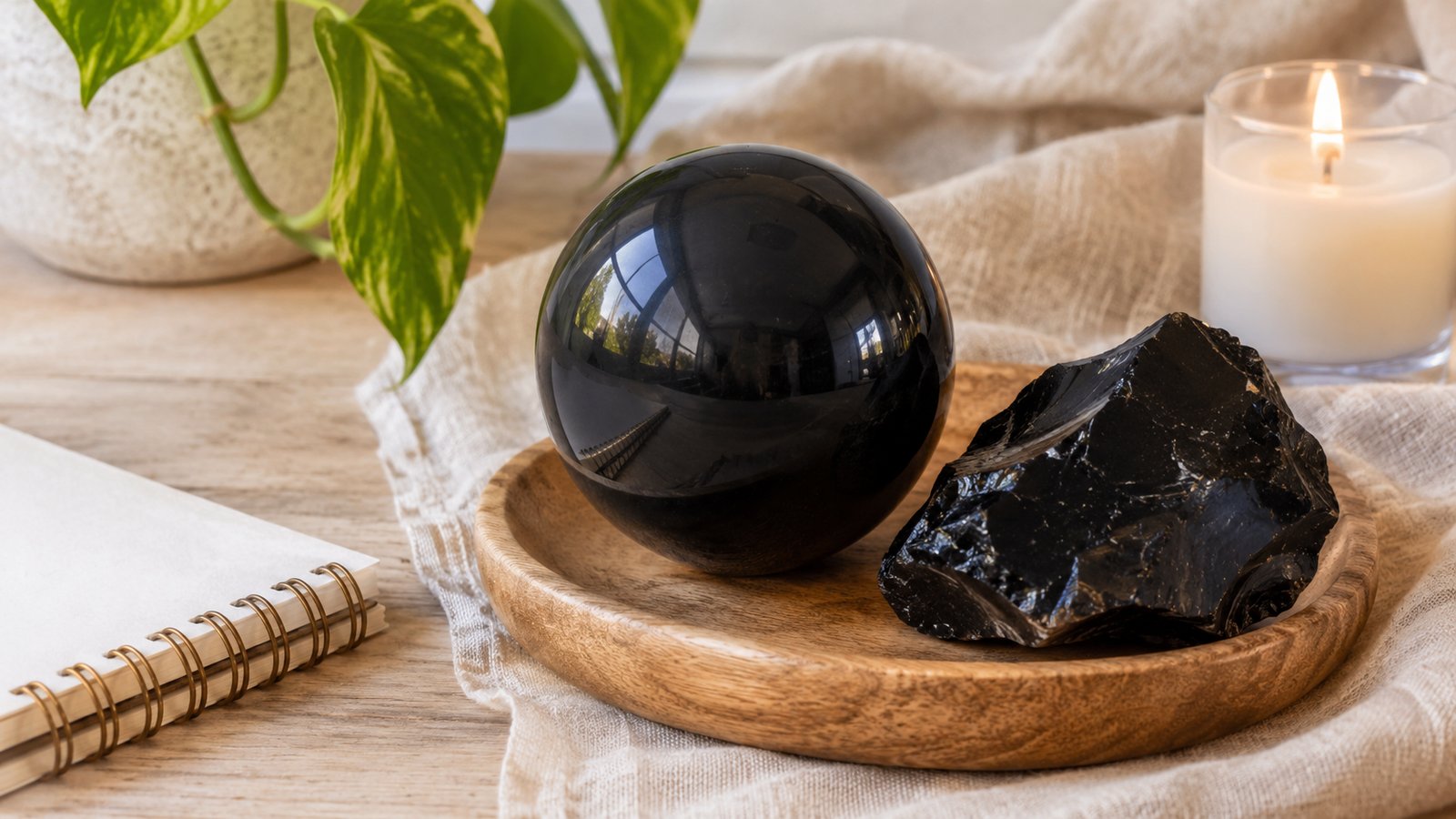
- Protection. People often call obsidian a shield stone, probably because of its dark color and the mirror history.
- Self-reflection. The reflective surface links it with honest looking inward, and some journalers keep a sphere or mirror piece nearby.
- Grounding. Heavy black stones are commonly linked with a steady, earthy feeling.
- Truth. The sharp fracture gives rise to ideas about cutting through confusion, a metaphor more than a property.
- Releasing what no longer serves. Some practitioners use obsidian in rituals of letting go.
Because the stone is associated with strong introspection, some traditions suggest using it in short sessions. If self-reflection brings up difficult feelings, take a break and speak with someone you trust or a mental health professional. A stone cannot treat anxiety or any other condition.
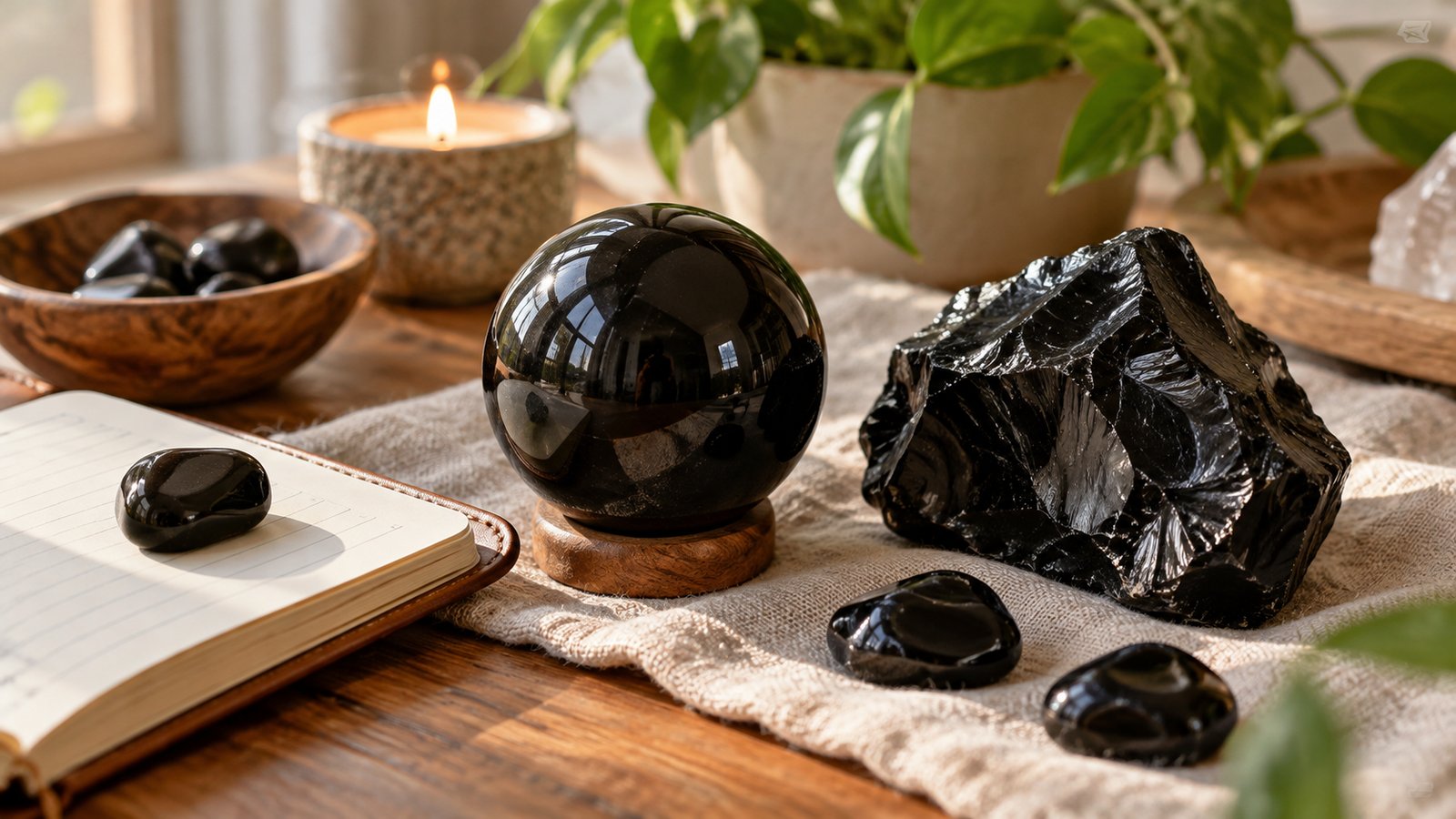
Simple Ways to Work With Obsidian
A reflective stone suits a simple journaling habit.
- Sit somewhere quiet with a notebook and a small obsidian piece or sphere.
- Hold the stone for a moment and look at the reflections on its surface without trying to see anything in particular.
- Write one answer to this question: what am I avoiding looking at right now?
- Write one small action that would address it.
- Close the notebook, set the stone down and move on with your day.
In a grid, the stone works well as a boundary stone around the edge, with a clear quartz point in the middle. The crystal grid guide shows simple layouts. For another dark protective stone with a very different mineral makeup, read about black tourmaline.
A second routine suits evenings. Place the stone near a lamp, spend two minutes watching the light move across its surface, and write down one thing that went well and one thing you want to do differently tomorrow. Short, regular check-ins like this work because of the habit itself, and the obsidian is only the object that reminds you to sit down.
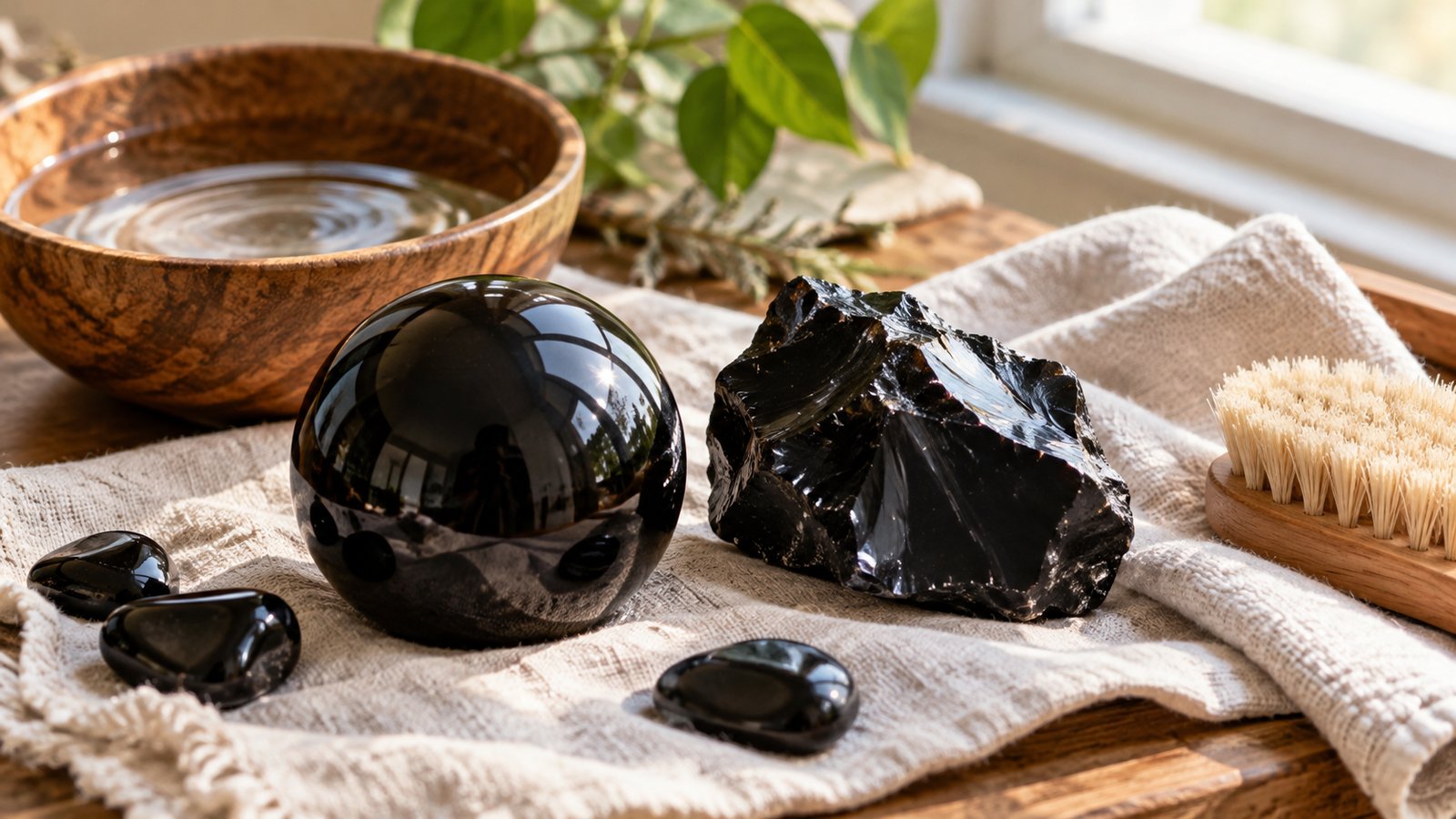
Caring for Obsidian
With a hardness of 5 to 5.5, obsidian scratches more easily than quartz, and a fall can chip or crack it. Treat it like fine glassware.
- Clean it with a soft cloth, lukewarm water and a drop of mild soap, then dry it.
- Skip ultrasonic cleaners and hot water, because sudden temperature changes can crack glass.
- Store pieces in separate soft pouches. Rough, sharp pieces can cut a pouch or other stones.
- Handle raw or broken pieces carefully. Edges can be sharp enough to cut skin, so keep them away from children and wear gloves if you handle large chips.
- Avoid acids and abrasive cleaners, which can dull the polish.
Water is not a problem for plain obsidian in brief contact, though there is no benefit to soaking it. The guide to which crystals cannot go in water explains which stones really need to stay dry.
For cleansing, people use smoke, sound, moonlight or a few hours on a selenite plate. These are customs. The glass itself only needs a wipe and a safe place to sit. See how to cleanse crystals for ten methods and the stones each one suits.
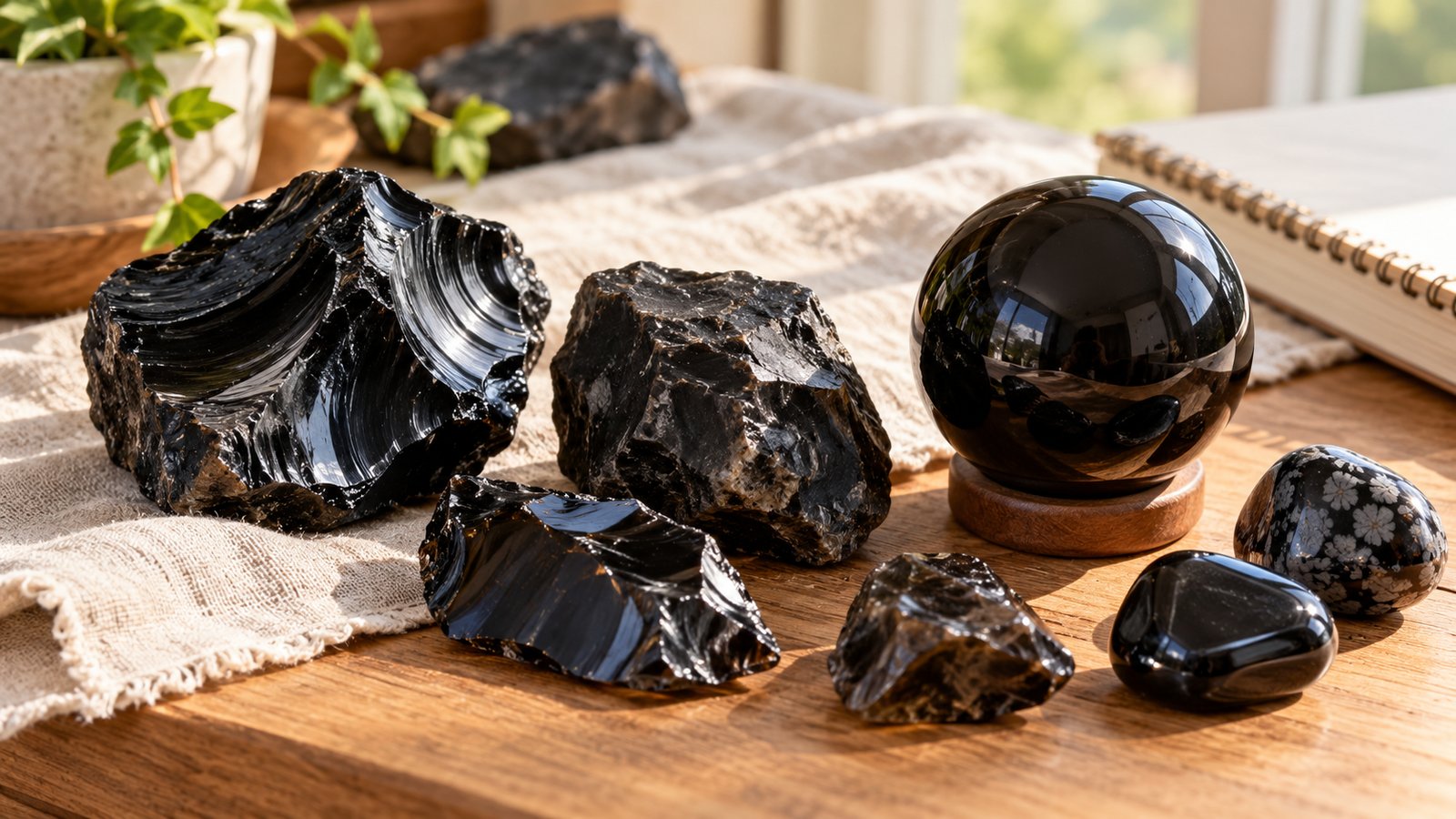
How to Spot Fake or Misrepresented Obsidian
Because the stone is inexpensive, fakes are mostly about material, not price.
- Man-made black glass. Slag glass and cheap molded glass are often sold as obsidian. Look for perfect uniformity, very regular bubbles, a seam line from a mold or an unnatural gloss. Natural obsidian shows flow lines, small imperfections and sometimes tiny bubbles or crystals.
- Dyed or colored glass. Gemological references warn that many colored glasses are sold as obsidian, often with claims of being natural. Bright blue, green or purple “obsidian” is almost always glass, since natural obsidian is mostly black, gray, brown or red.
- Rainbow or sheen claims. Natural sheen depends on aligned inclusions and changes with angle, while painted or coated surfaces look flat and may flake.
- Apache tears that are too perfect. Real ones are irregular, rounded and translucent smoky brown at the edges.
- Reconstituted stones. Crushed rock bonded with resin can pass as obsidian but feels lighter and may show a granular pattern.
Run a short test at home if you already own the stone. Look at the broken edge under a bright lamp: real obsidian shows smooth, shell-like curves, called conchoidal fracture, and often faint swirl lines that follow the way the lava flowed. Many molded fakes show a flat, perfectly uniform surface instead. Do not break a stone to check, though, because sharp fragments are a hazard.
Hold a thin edge up to a bright light. Natural obsidian is usually translucent smoky gray or brown at thin edges, while many fakes are opaque black. Also pay attention to weight. Gemological tables give obsidian a specific gravity around 2.35 to 2.6 according to gemological tables, so it should feel similar to glass, not like metal.
Buying Tips
Ask whether the stone is natural volcanic glass, where it was mined and whether it has been dyed or coated. Look at photos in daylight and avoid listings that promise special powers instead of describing the material. Prices are low, so a high price should come with a clear reason, such as a hand-carved piece or a rare variety like rainbow or sheen obsidian.
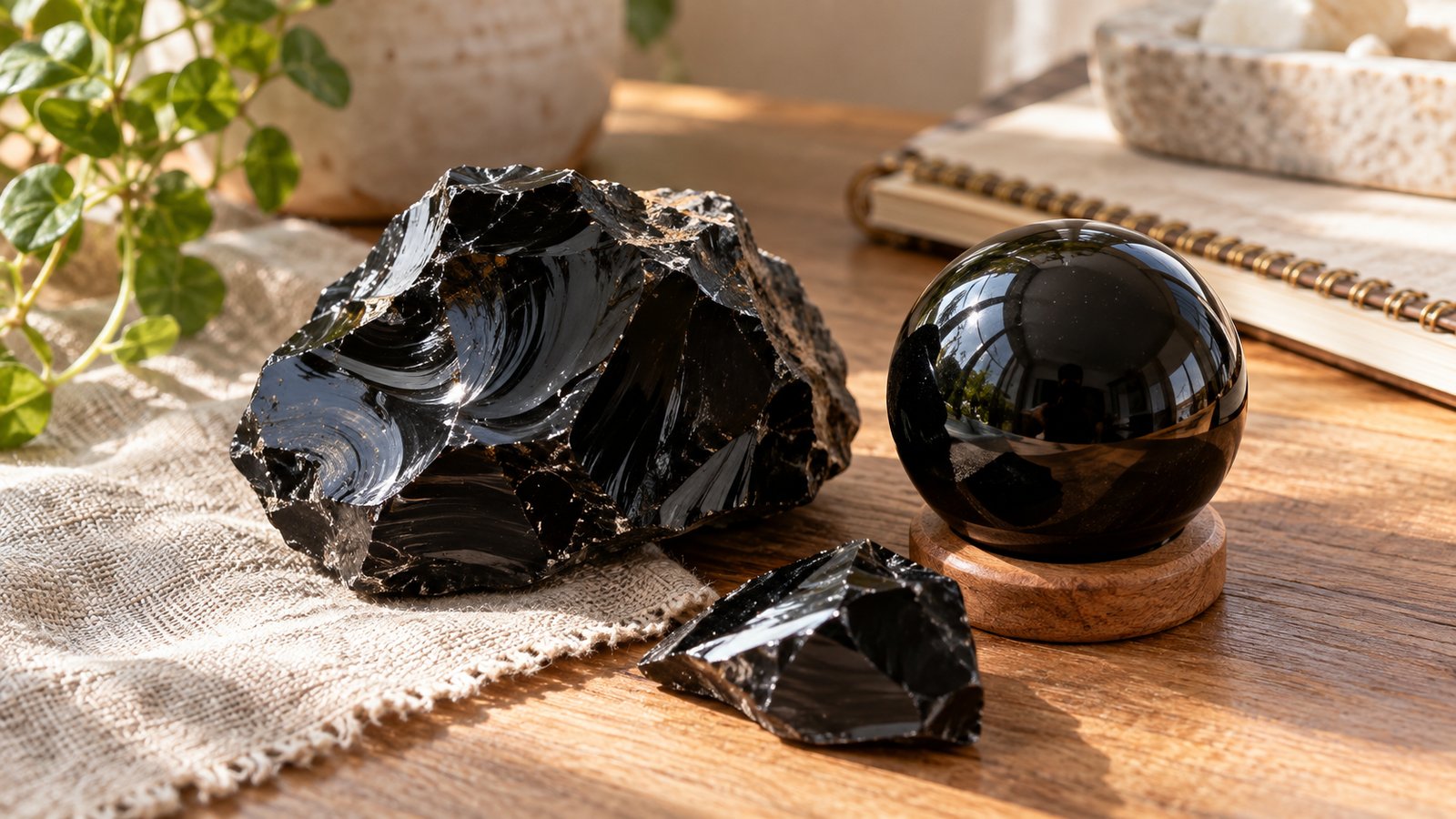
Frequently Asked Questions
Is obsidian a crystal?
No, it is not a crystal, because it has no ordered crystal structure. The stone is natural volcanic glass, though many crystal shops sell it alongside true crystals.
Is obsidian a mineral or a rock?
Most references call it a glassy igneous rock. Volcano World points out that, being non-crystalline, it does not meet the usual definition of a mineral either.
Can obsidian go in water?
Yes, briefly. Dry it afterward, and avoid hot water or sudden temperature changes that could crack it.
Why is obsidian so sharp?
Its glassy structure breaks along smooth curved surfaces, so the edges where those surfaces meet are extremely thin. That property made it valuable for tools.
What is snowflake obsidian?
Snowflake obsidian is volcanic glass that contains white patterns of the mineral cristobalite, formed as parts of the glass begin to crystallize.
Is obsidian good for beginners?
As a first stone it is popular because it is inexpensive and easy to find, though it chips more easily than quartz, so gentle handling matters.
Is obsidian dangerous to own?
Polished pieces are safe for normal display. Raw chips and broken edges can be razor sharp, so handle them with care, keep them away from small children and wear gloves for large rough pieces.
Is rainbow obsidian natural?
Yes, rainbow and sheen effects are natural, caused by layers of tiny gas bubbles or inclusions in the glass. Surfaces that look painted, flaking or unchanging as you tilt the stone are more likely coated.
Does obsidian lose its shine?
The polish can dull from scratches and hard water spots, and a soft cloth with a little mild soap usually restores it. Deep scratches need professional repolishing.
Can obsidian be used in jewelry?
Yes, mostly in pendants, beads and earrings that are not bumped often. Because it is softer than quartz and breaks easily, a protective setting suits it better than a ring.