
| ✨Hey there! This post may contain affiliate links, meaning we earn a commission if you make a purchase through our links, at no cost to you. Please read our disclosures for more info. |
Quick answer: pink amethyst is a trade name for pink crystalline quartz, best studied from geodes at the El Choique mine in Patagonia, Argentina. It is still silicon dioxide, the same mineral as ordinary quartz, with a Mohs hardness of 7. A 2020 Mineralogical Record study found that its color comes from iron-related color centers plus microscopic hematite, which is not the same coloring mechanism as massive rose quartz. The name is debated because amethyst has historically meant purple quartz. In crystal traditions, people link pink amethyst with calm, compassion and heart-centered comfort. Those meanings are cultural, not medical. Dyed druzy, glass and mislabeled rose quartz are the usual look-alikes, so ask for origin and treatment details before you buy.
Pink amethyst showed up in a big way on the mineral market in the late 2010s, and the soft rose-mauve geodes now sit in a lot of home collections. This profile belongs with the other stone guides in our crystal meanings guide. If you already know purple amethyst or rose quartz, this article is about how the pink material compares, how to care for it, and how to keep a sales label honest.
Sources: Mineralogical Record, Vol. 51, No. 2 (2020), study of pink amethyst geodes from the El Choique mine, Patagonia, Argentina; Gemological Institute of America guidance on quartz, amethyst and jewelry care; Federal Trade Commission jewelry guides on disclosure of treatments and laboratory-grown stones. Color-center and hematite findings are summarized from reports of that 2020 mineralogical study. Meanings described here are cultural and spiritual traditions, not scientific or medical claims. Crystals are not a substitute for medical or mental health care.
Contents
hide
What Pink Amethyst Is
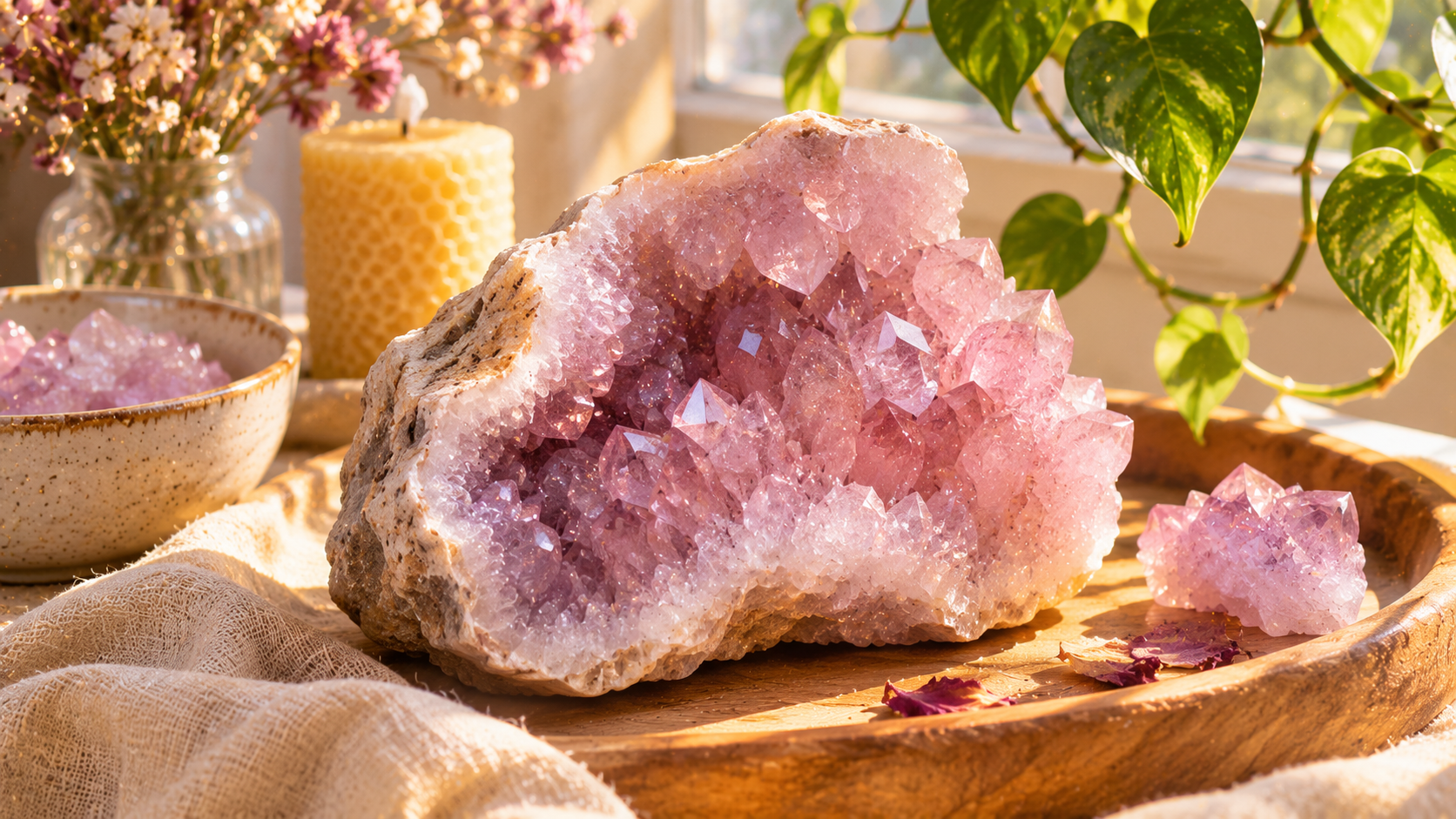
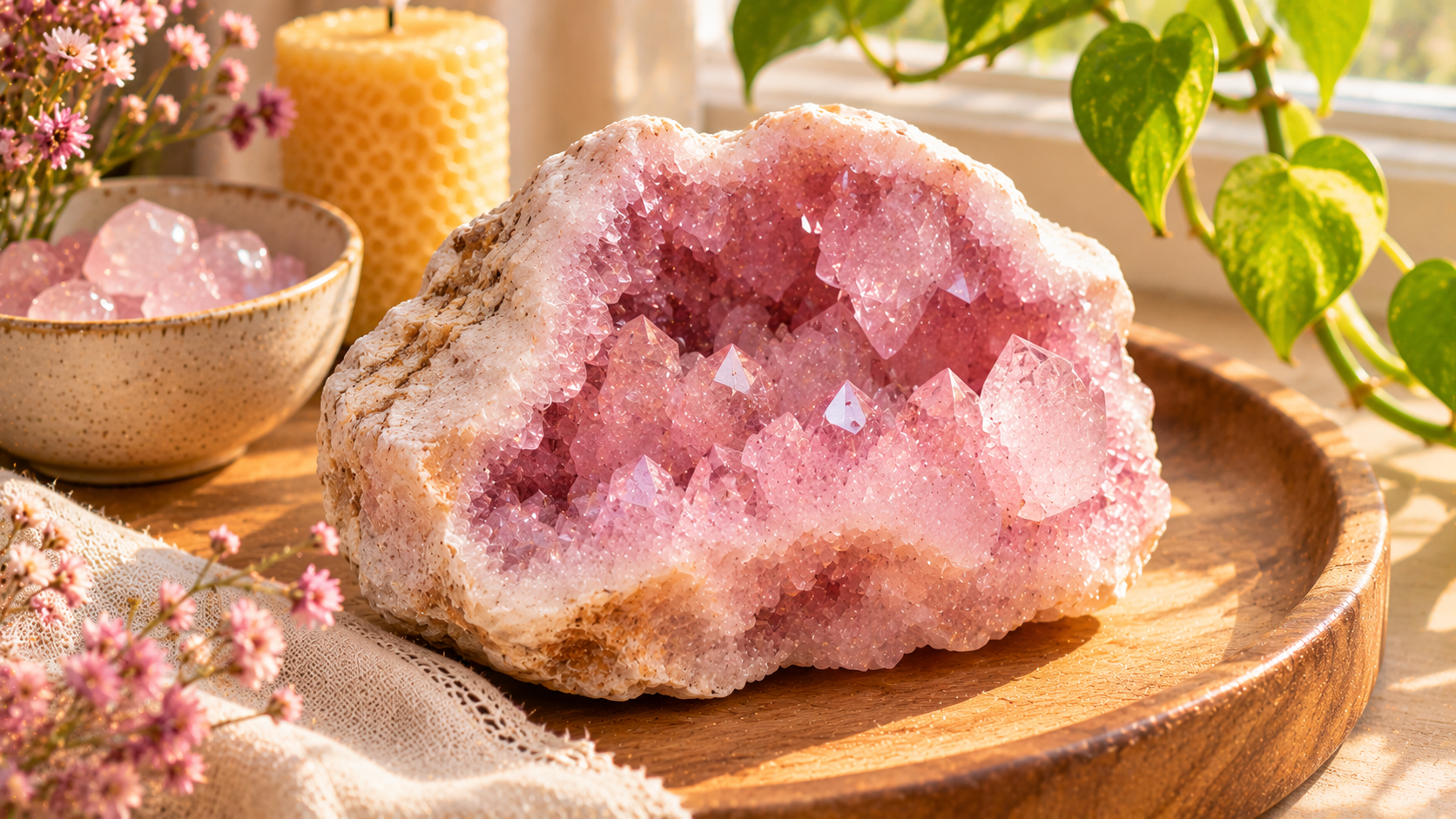
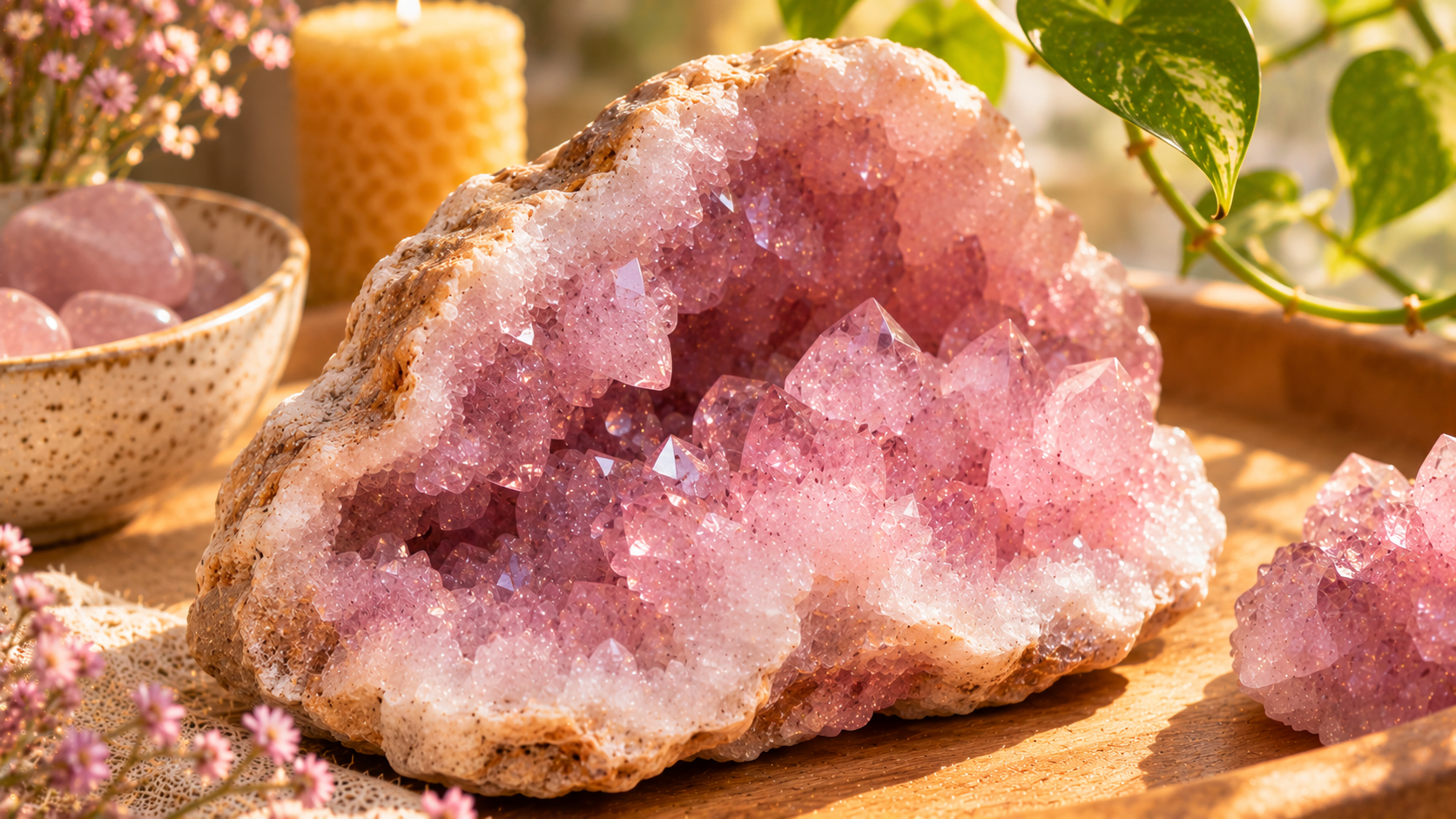
Pink amethyst is not a separate mineral species. Chemically it is quartz: silicon dioxide (SiO2). Like other macrocrystalline quartz, it forms visible crystal points, often lining the walls of geodes or cavities in a druzy crust. Typical specimens from the Argentine deposits show a pale pink, mauve, rose or salmon wash over a lighter base, and they can be translucent rather than glassy-clear.
Gemologists and mineral collectors do not all agree that “pink amethyst” is the best name. Amethyst, in the classic sense, is purple quartz. Some writers prefer “pink quartz” or “hematite-bearing quartz.” The trade name stuck because the best-studied Patagonian material has a genetic link to amethyst-style iron color centers, not because the crystals look like a lighter rose quartz boulder.
A useful comparison is the habit. Ordinary rose quartz is usually massive: you see a pink chunk more often than a cluster of sharp points. The Argentine pink material commonly forms recognizable quartz crystals in geodes, more like the familiar amethyst cathedrals from Brazil and Uruguay, only in a softer pink palette.
| Property | Pink amethyst (typical) |
|---|---|
| Mineral | Quartz (silicon dioxide) |
| Color contributors | Iron-related color centers plus microscopic hematite, per the 2020 El Choique study |
| Typical colors | Pale pink, rose, mauve, salmon |
| Mohs hardness | 7, like other quartz |
| Crystal system | Trigonal (quartz) |
| Specific gravity | About 2.65 |
| Luster | Vitreous |
| Common habit | Druzy or crystal-lined geodes and clusters |
| Best-studied locality | El Choique mine, Neuquén Province, Patagonia, Argentina |
Hardness 7 means a piece can scratch glass, but a geode wall or a delicate point can still chip if it is knocked against a harder surface. Treat cabinet specimens more gently than a thick tumbled stone.
How Pink Amethyst Gets Its Color
Purple amethyst and this pink material both involve iron, but not in the same way. Classic amethyst owes its violet color mainly to iron in the quartz structure and to natural irradiation that creates color centers. The 2020 Mineralogical Record work on El Choique geodes reported that pink amethyst also has an iron-related color center, with microscopic hematite adding a red-pink tint. The mix of a faint amethyst-like component and hematite is what reads as pink to the eye.
That is why mineralogists argue it is not simply rose quartz under a new label. Rose quartz, in the familiar massive form, is usually colored by microscopic fibrous inclusions related to dumortierite, a different story. A rarer crystallized “pink quartz” (sometimes discussed separately from both rose quartz and pink amethyst) can fade in strong light because its color centers are sensitive. Pink amethyst color stability can vary; prolonged strong sunlight is still a poor idea, because amethyst-family color centers are known to fade with enough light and heat.
Retail copy sometimes says the color is “just hematite inclusions” or “just iron impurities,” as if those phrases were interchangeable. Inclusions and structural color centers are not the same thing. Hematite particles can tint a stone. Color centers change how the crystal itself absorbs light. The El Choique research describes both contributing. When a seller cannot tell you even the country of origin, treat dramatic color stories with caution.
Heat can alter amethyst. Heating purple amethyst is a well-known path to some yellow or brownish “citrine” in the trade, and heat can also wash or shift color. A very even, hot-pink druzy that looks painted should make you think of dye, not a rare natural saturation.
Where Pink Amethyst Comes From
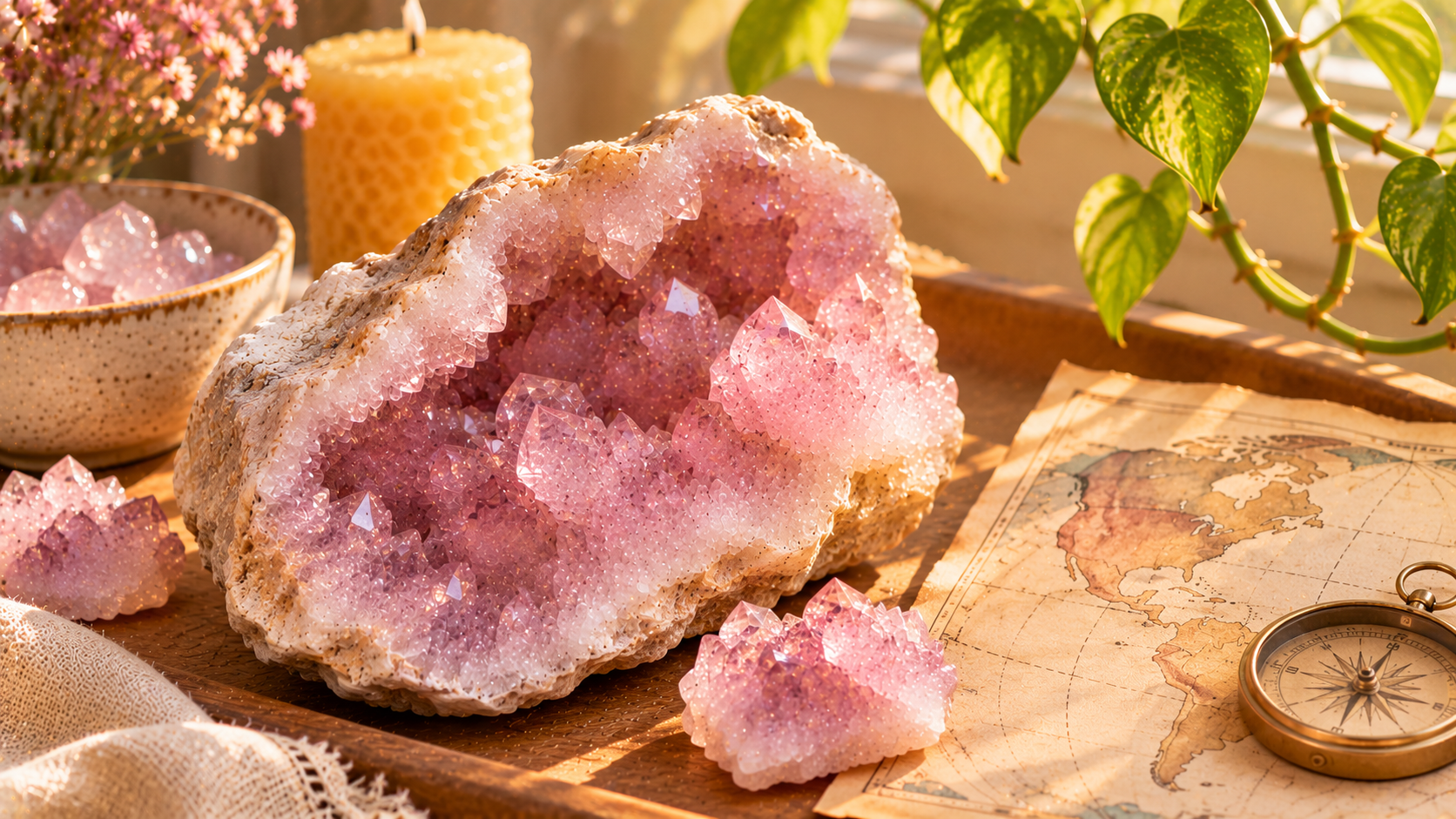
The locality that put the name on the map is the El Choique mine in Patagonia, Argentina, in Neuquén Province. Reports of the scientific study and later trade histories describe geodes that entered the international market around 2017 after earlier discovery at the site, with detailed mineralogical work published in 2020. Specimens often look like small amethyst cathedrals: a rustic outer rind and a crystal-lined interior in dusty rose rather than violet.
Brazil also supplies material sold as pink amethyst. Appearance and growth habit can differ from the Argentine geodes. “Patagonian pink amethyst” or “Argentine pink amethyst” is a more precise label than a bare “pink amethyst” tag when the seller actually knows the source. “Rose amethyst” is a looser phrase and sometimes refers to pale lavender Brazilian amethyst, which is not the same product.
Single-mine exclusivity claims are common in marketing and are easy to overstate. The honest version is narrower: the best-documented deposit for this particular pink geode material is El Choique, and other stones may be sold under the same trade name. Ask for the country, and if possible the district, in writing.
Mining and cutting do not change the mineral. They do change what you are buying. A complete geode half, a cut slab, a sphere and a silver pendant are different products with different fragility. Points on a thin druzy wall are more likely to bruise than a thick cabochon.
Pink Amethyst Meaning and Symbolism
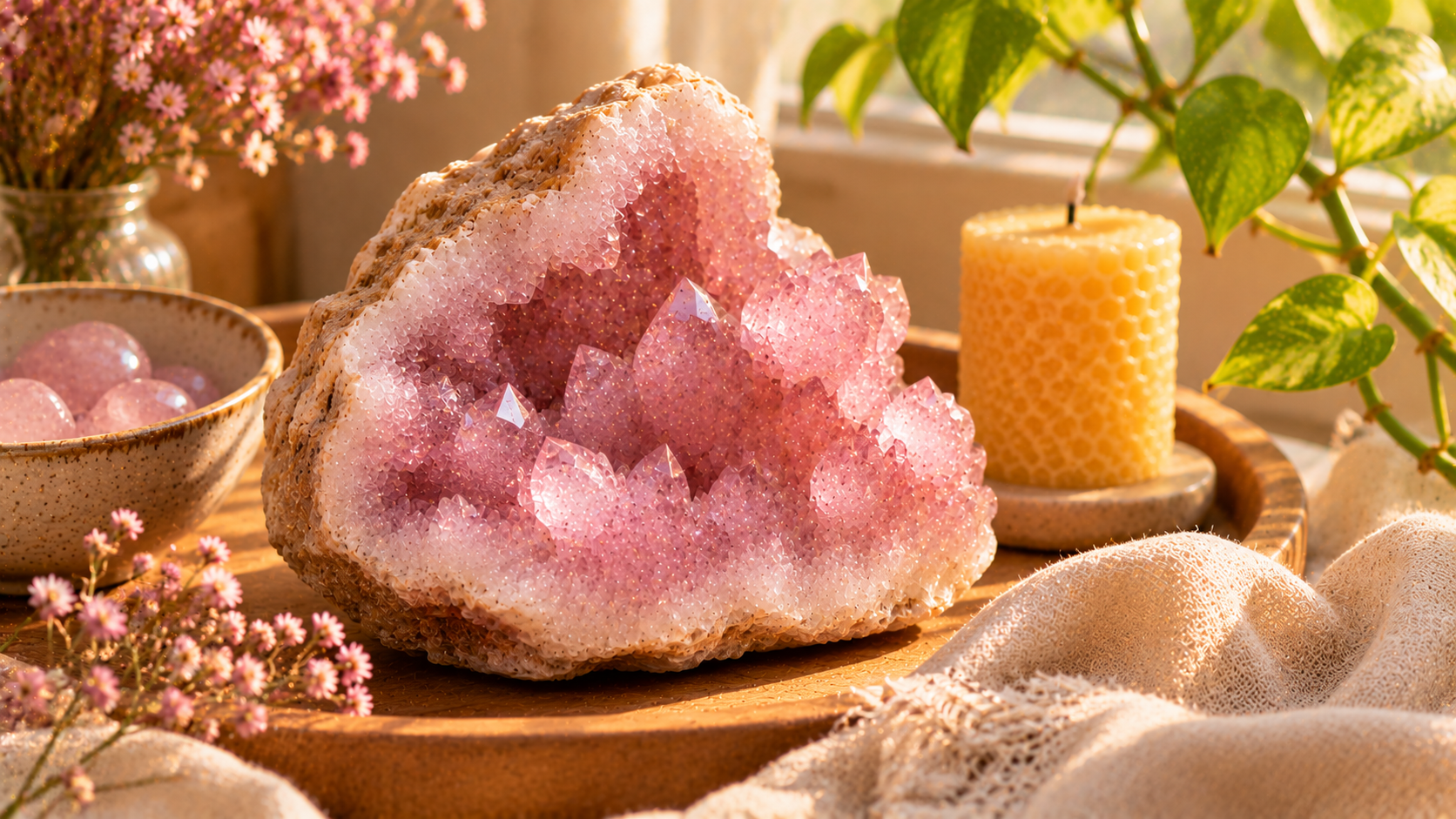
Pink amethyst does not have a long ancient jewelry lore under this modern trade name, because the material itself became widely available only recently. Most of the symbolism you will see is contemporary crystal tradition, often borrowing from both amethyst and rose quartz.
People who work with stone symbolism often link pink amethyst with:
- Emotional calm and a gentler form of the “quiet mind” theme associated with purple amethyst
- Compassion, self-kindness and heart-centered comfort, overlapping with rose quartz lore
- A sense of safety when feelings run high
- Gentle support during grief or self-doubt, framed as meaning, not treatment
Those ideas can be personally meaningful. They are not clinical findings. No crystal has been shown to diagnose, treat, cure or prevent disease, and no pendant replaces therapy, medication or other care you and your clinician have chosen. If a product page promises to heal panic, attract a partner or detox the body, that is marketing, not mineralogy.
Some writers assign pink amethyst to the heart chakra, sometimes with a secondary nod to the crown because of the amethyst connection. Chakra language is a spiritual framework, not a geological property. You can enjoy it without treating it as a medical map.
If you like collecting by color families, this stone also sits naturally beside the pink and purple stones in our pink crystals and purple crystals guides.
Pink Amethyst vs Rose Quartz vs Purple Amethyst
This is the comparison most buyers actually need.
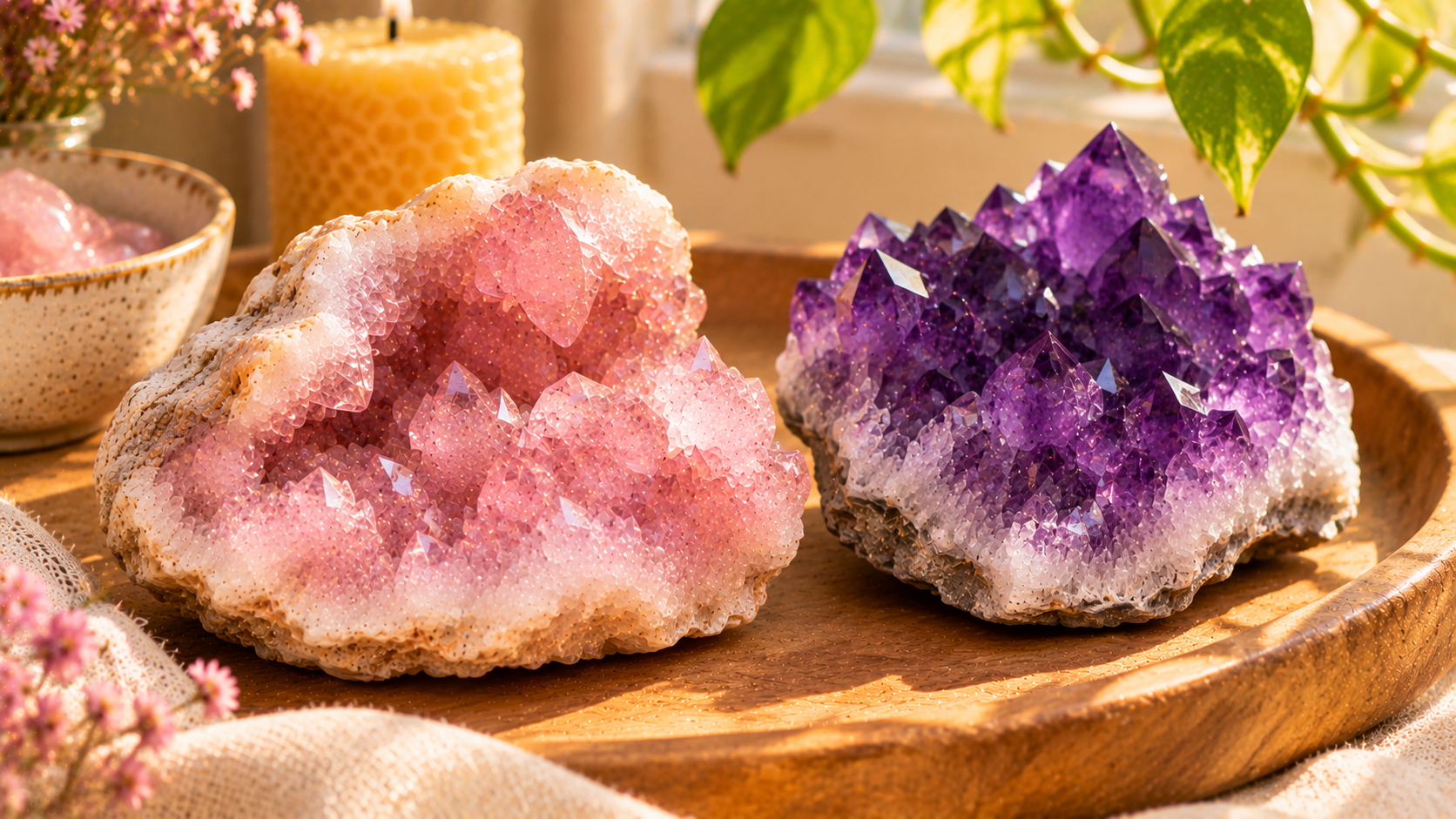
Purple amethyst is the classic violet to reddish-purple variety of quartz. Its color is tied to iron and irradiation-related color centers. It commonly forms in geodes, especially from Brazil and Uruguay, and it is a traditional February birthstone.
Rose quartz is the familiar cloudy-to-translucent pink quartz, usually sold as massive chunks, tumbled stones, spheres and carved figures. Distinct crystal points are uncommon in ordinary rose quartz. Its typical coloring is not the same hematite-plus-iron-center combination described for El Choique pink amethyst.
Pink amethyst, as sold today, usually means crystallized or druzy pink quartz, often in geode form, with a mauve or rose tone. It can look like a pastel amethyst cathedral or like a bed of tiny pink points. It should not automatically be called rose quartz, and rose quartz should not be relabeled pink amethyst to raise the price.
Other look-alikes include:
- Dyed quartz or dyed amethyst druzy, where pink pigment gathers in cracks
- Glass “geodes” or resin-heavy composites
- Pale amethyst with a pink photograph and a hopeful title
- Heat-shifted or treated quartz with an uneven, weakly pink cast
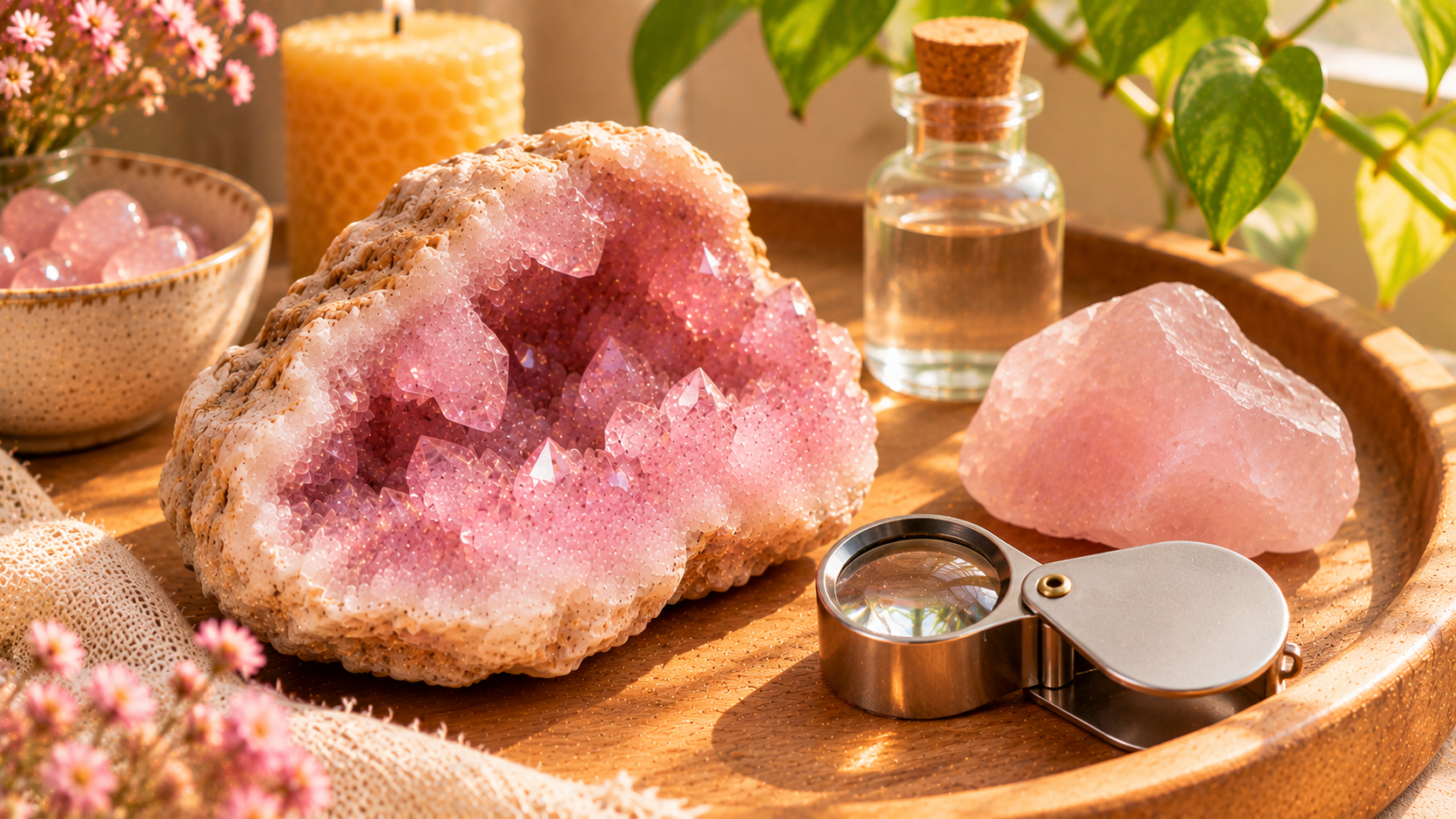
A jeweler’s loupe helps. Dye often pools in fractures. Glass may show bubbles. Natural quartz points have a characteristic hexagonal character, even when the crystals are small and crowded.
Treatments, Imitations and How to Spot a Fake
The Federal Trade Commission expects sellers of gem materials to disclose treatments and laboratory-grown or imitation stones that a buyer would not reasonably expect. “Pink amethyst” is a trade name, not a protected geographic indication, so the words on the card are only as good as the seller.
Practical checks:
- Origin. Argentine Patagonian geodes have a recognizable look, but look is not a certificate. A named mine or at least a country is better than “imported.”
- Color distribution. Natural color tends to sit in the crystals themselves, sometimes with white or colorless zones. Dye loves cracks, drill holes and the rind.
- Saturation. Extremely vivid hot pink, especially on cheap small clusters, is a reason to slow down.
- Habit. A perfectly spherical “geode” with identical points all around may be assembled or heavily cut. That is not automatically fake quartz, but it is a manufactured object and should be sold as such.
- Hardness and feel. Quartz is 7 and feels cold and relatively hefty for its size (specific gravity around 2.65). Plastic is warmer and lighter. Glass can be close in weight; bubbles and mold lines are better clues than a casual scratch test, which can damage a real specimen.
- Price realism. A huge, richly colored cathedral at a flea-market price deserves questions, not a romantic story.
Laboratory reports are uncommon for inexpensive collection pieces, and that is fine if you are buying decor. For a costly jewelry stone, a report from a respected gemological laboratory is the clean way to confirm quartz identity and any treatment the lab can see.
Avoid “scratch tests” on a finished piece you care about. Avoid bleach, acid or salt-water “authenticity tests.” Those can etch or stain a real specimen and still fail to identify glass.
Caring for Pink Amethyst
Quartz is relatively tough, but pink amethyst is often sold as geodes, thin druzy plates and clustered points. The weak spot is the crystal tips and the bond between the crystals and the matrix, not the Mohs number alone.
A careful routine:
- Dust with a soft, dry brush.
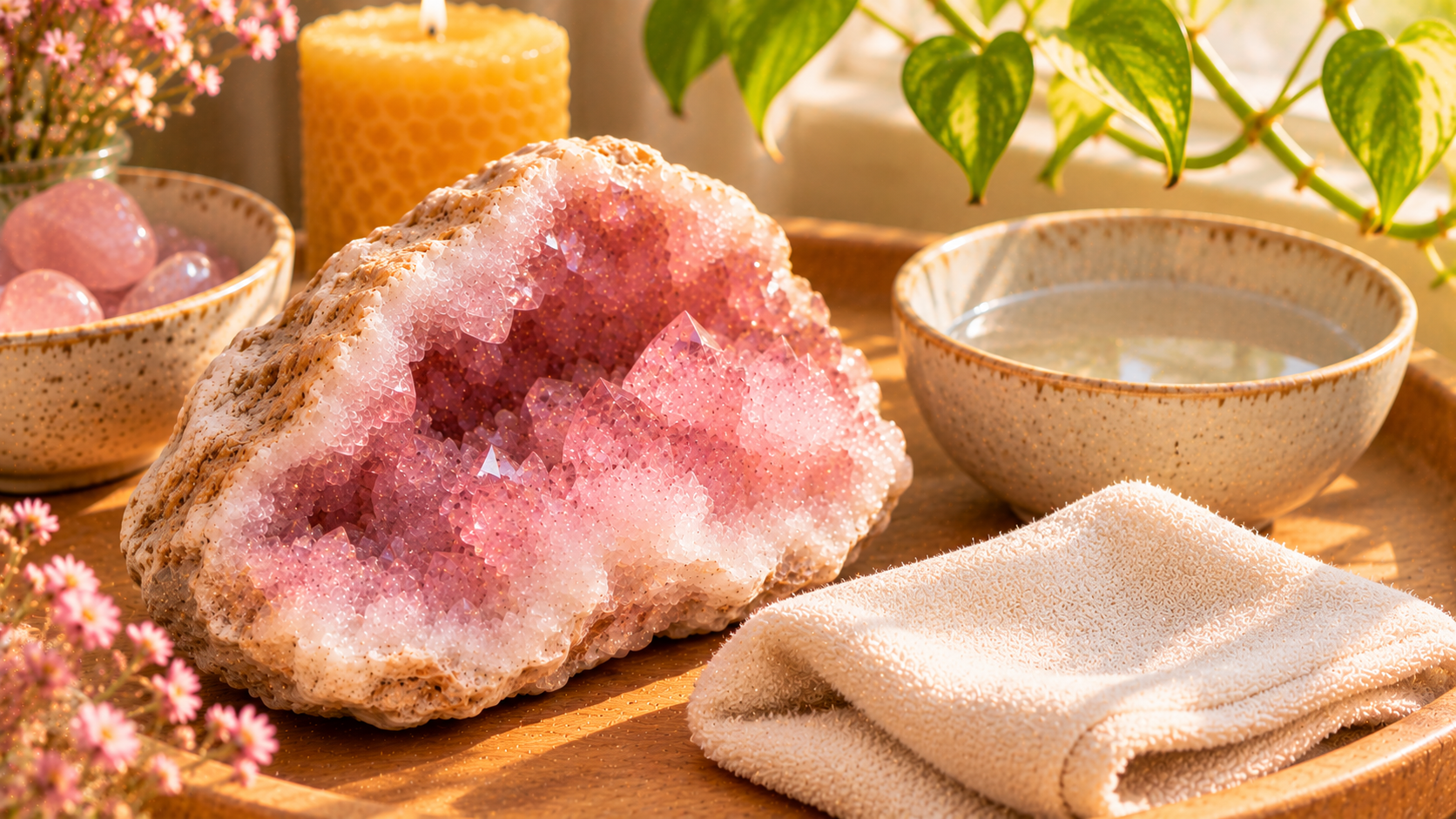
- If you need a wash, use lukewarm water, a drop of mild soap and a quick rinse. Dry promptly with a soft cloth.
- Keep pieces out of prolonged strong sunlight and away from heater vents. Color-center stones can fade; heat is unkind to both color and any hidden fractures.
- Skip ultrasonic and steam cleaners for druzy, fractured or unknown-treatment pieces.
- Skip salt water, raw salt beds and prolonged soaks, especially if the specimen has a rusty matrix, calcite neighbors or a glued stand. For water-sensitive collection mates, see which crystals cannot go in water.
- Store so points do not knock against harder stones such as topaz, sapphire or diamond. A lined box or a separate dish is enough.
- For jewelry, a protective setting helps. Remove rings for the gym, gardening and dishwashing.
Cleansing, in the spiritual sense, is a personal ritual. Smoke, sound, moonlight on a windowsill and a brief visualization do not change the chemistry. If you use water or salt in a cleansing practice, match the method to the specimen’s durability rather than to a social-media list. How to cleanse crystals covers gentler options that do not risk the stone.
Buying Pink Amethyst
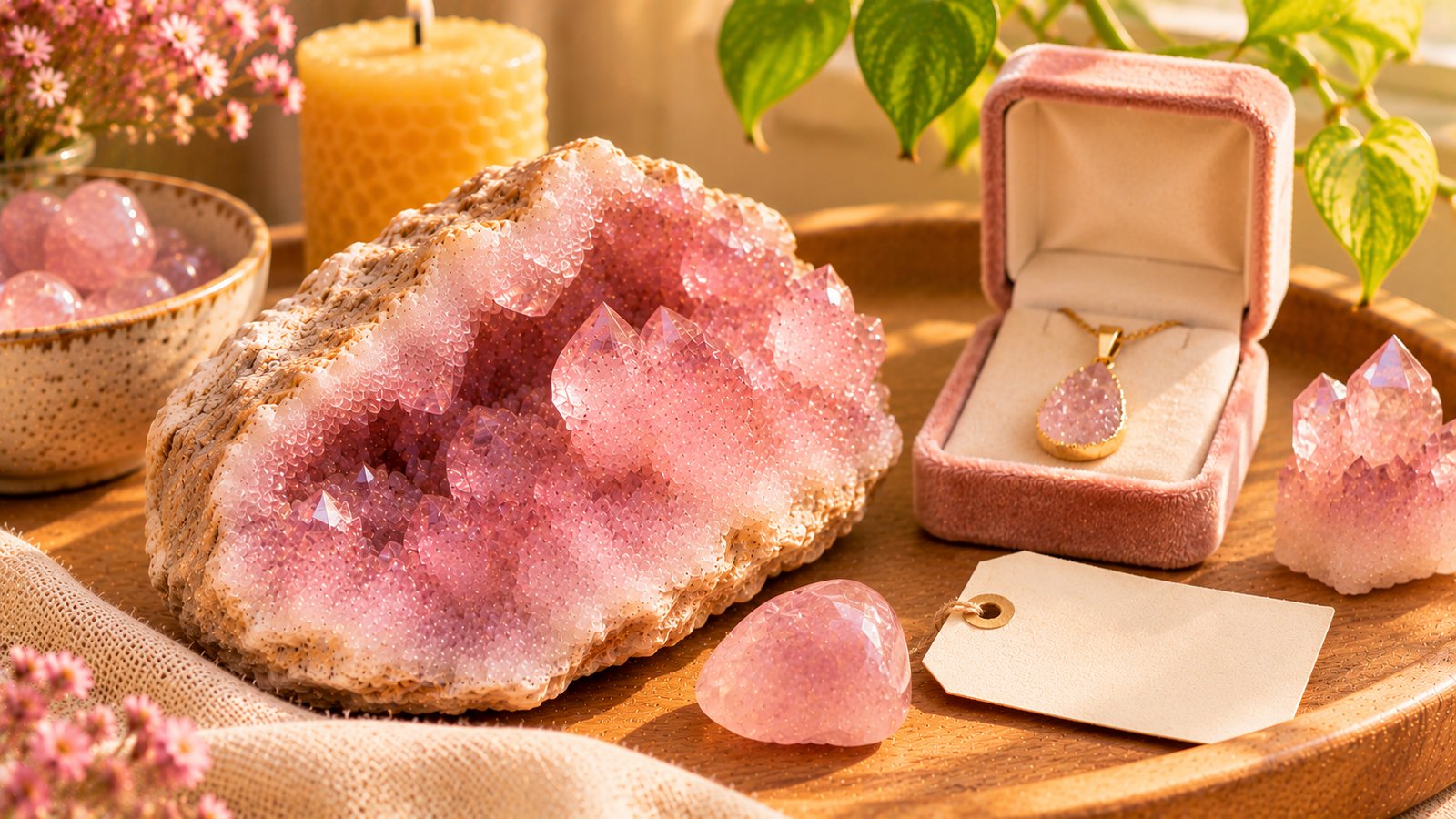
Decide first whether you want a display geode, a small cluster, a palm stone or jewelry. Display pieces should sit upright without stress on a thin wall. Jewelry should have intact points or a smooth cabochon, a secure setting and a clasp you trust.
Questions worth asking:
- What country did this come from?
- Has it been dyed, heated or stabilized?
- Is the stand or matrix natural, or has it been cut and glued?
- For jewelry, is the stone quartz, and has a lab checked a high-value piece?
A seller who answers calmly is a better sign than a dramatic rarity story. Pink amethyst is distinctive and attractive. It is also widely available now, which is good news for buyers and a reminder that “the last piece on Earth” is usually a script.
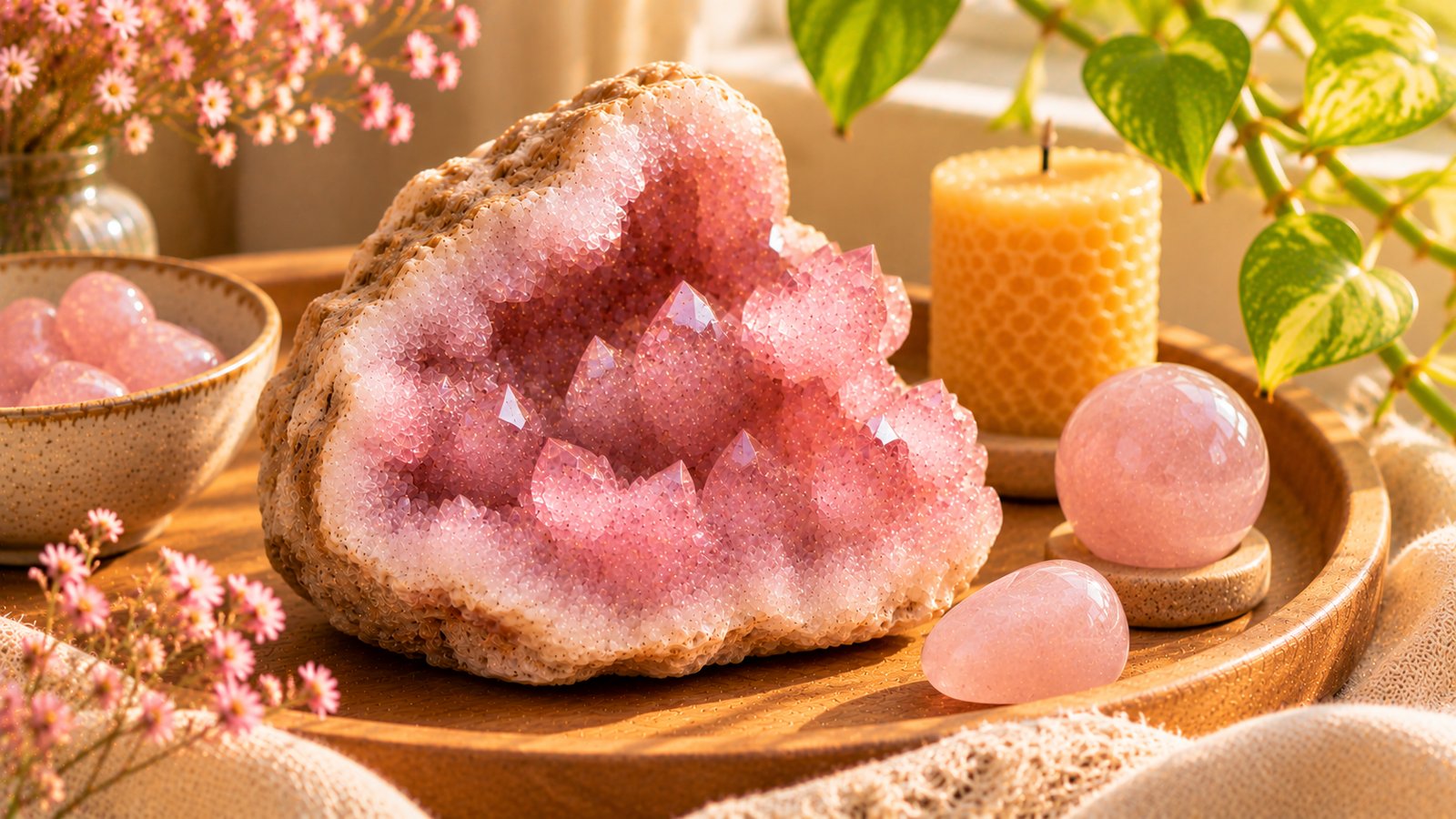
When you add it to a collection, it pairs visually with rose quartz, pale amethyst, clear quartz and other soft-pink stones. Keep the harder identifications honest, and let the meaning stay in the realm of tradition, where it belongs.
Frequently Asked Questions
Is pink amethyst the same as rose quartz?
No. Rose quartz is usually massive pink quartz with a different typical coloring. Pink amethyst, as used in today’s trade, usually refers to crystallized or druzy pink quartz, often from Argentine geodes, with iron-related color centers and microscopic hematite described in the El Choique study.
Is pink amethyst a real amethyst?
It is real quartz. Whether it should be classified as amethyst is debated, because amethyst has historically meant purple quartz. The 2020 mineralogical work found a related iron color-center chemistry plus hematite, which is why the trade name exists.
Where does pink amethyst come from?
The best-studied source is the El Choique mine in Patagonia, Argentina. Material from Brazil and other places is also sold under the same name, so ask for origin.
Can pink amethyst fade?
Color stability can vary. Amethyst-family color centers are known to fade with enough light and heat, so keep specimens out of harsh, prolonged sun and away from high heat.
Is pink amethyst water safe?
Quartz itself generally tolerates a brief rinse. Delicate druzy, iron-stained matrix, glued stands and fracture-filled jewelry are poorer candidates for soaking. Dry the piece after washing.
What does pink amethyst mean?
Modern crystal traditions often connect it with calm, compassion and heart-centered comfort. Those are cultural meanings, not proven health effects.
How can I tell if my pink amethyst is dyed?
Use a loupe and look for pigment concentrated in cracks, unusually hot even color on a cheap cluster, and color that wipes or bleeds on a damp white cloth. When in doubt, buy from a seller who discloses treatments.
